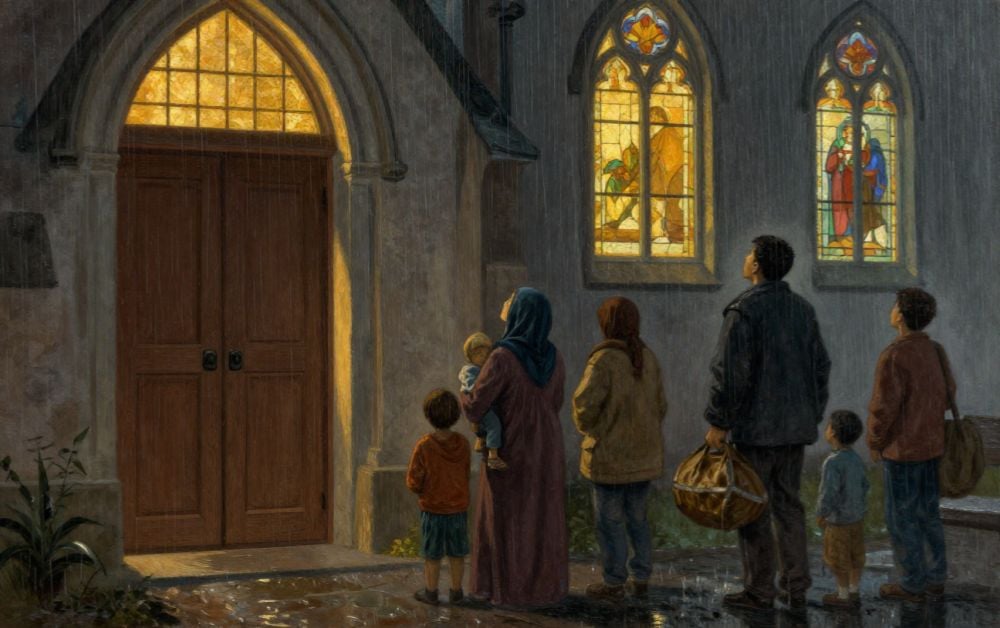
How can we call ourselves Christian, and not understand the most fundamental truth of what that means? It means our shared belief in the resurrection of Christ unites us as the family of God. We must see Christ in ourselves, as we see Christ in others. Our dignity is not earned, lost, or shaped by political ideologies. It simply is because we are the family of God.
A few months ago, it became clear to me that relatives who adamantly taught me about the love of God growing up were not applying their own teachings as it related to the dignity of migrants in our country. As we witness the stammering outward expression of Christian nationalism come to life in the United States, this didn’t come as a surprise, but yet was still a punch in the face, because of the realization that people who I care about deeply, are hypocrites who do not love or live the same ideals they taught me about. The saddest part is there is the little to no willingness to engage with the perspective I have to offer. Assumptions were made that I was “deviating” from “the truth” (obedience to supporting anti-migrant policies and ideology), and a defensive attack was made on my understanding and character without a conversation. I offered a counter perspective rooted in real experience (my daily proximity to migrant families, and time spent at the Tijuana-San Diego border) and was ignored.
American Christians who grew up in rural, predominately conservative and Christian landscapes, are likely to have a similar story if they’ve found their escape through education, deep engagement with theology, travel, and proximity to migrants. If I didn’t have any of the previous four opportunities, I think I would be the exact person I’m writing about. What I find is that poorly catechized Christians who grew up embracing their geopolitical upbringings without escaping them for some time, are unlikely to have the capacity to identify how their political environments distort their religious understandings. You can make the argument that Jesus said, “render unto Caesar what is Caesar’s”, but it means nothing if you don’t understand how deeply rooted political ideologies distort one’s self-proclaimed theology. Politics shape the world we live in, and we cannot escape them. Those who are well versed in Christianity and have wrestled with the moral teachings of Jesus should be able to clearly identify the shortcomings of any political affiliation as it relates to their faith. Christianity does not fit neatly into left or right, blue or red, nor liberal or conservative political ideology. It is its own beast.
I want to zoom in on this issue of immigration; despite the many hot topics we could analyze. As it relates to immigration, I remember being spoon-fed the idea that immigration was not necessarily good for America, and that the presence of migrants put our “American values” and “safety” at risk. Therefore, without question, for most of my life I had a more negative perspective of migrants. My social circles and influences subconsciously, and sometimes consciously, reinforced that. Being a Christian meant subscribing to the conservative checklist. It was not until I had the opportunity to study at university and engage with literature, assignments, research, and people, who challenged those ideas, that my perspective shifted. More importantly, however, it was also not until I started deeply diving into what I claimed to believe as a Christian, and better understand the moral teachings of Jesus, that my heart and mind began to really change. I was able to make connections between the things I was learning in university and the things I began to better understand about my faith, as well as identify the disconnect between my rural Wisconsin attitudes towards migrants and my proclaimed beliefs as a Christian.
I spent a year collectively in the Caribbean (Haiti and Jamaica) and a few weeks in Mexico, during college which also deeply broadened my perspective on the complexity of immigration and the lives of those who choose to migrate. The most profound experiences that have shaped my present understanding have been leading a service trip to a migrant camp in Tijuana and engaging in 1 on 1 conversations with migrants and lawyers at the border, as well as living and working closely with migrant families in South Florida for the past two years. What I have learned is that I only believed what I believed about immigration growing up because I swallowed the ideological pills that my environment force-fed to me growing up. I affiliated those ideas with “being Christian”—therefore, the correct “Christian perspective on immigration” became the ideas I was raised with about them. With many years of subtle growth, experiences, research, and education, I evolved as a person, and immigration became much more of a relevant and personal reality of my life. Today, I can synthesize my personal experiences and relationships with migrants across many countries, and with Gospel principles which I more deeply understand as it relates to the dignity and rights of God’s people. I can do so with great clarity, and without hesitation, renounce the injustices and xenophobic ideologies that are imposed on the migrant communities of America today. Thankfully, as a Catholic Christian, our co-governing Faith document, the Catholic Catechism, the U.S. Bishops, and the current Pope Leo XIV, as well as his predecessor Pope Francis, have been strikingly clear about the need for Christians and nations to uphold the rights and dignity of migrants, even in the midst of logistical and ideological complexities.
These relatives and friends who I clash with on this matter today, are often the same people that have not had the opportunity to experience the things I’ve mentioned above. They are often in these rural conservative Christian geographical contexts. In addition, proximity to migrants is often not a reality of their lives, so the extent to which they have the opportunity to evolve, or even care to, is limited. I try to keep this in mind in my boundaried engagements with them, yet it is challenging because something that is so clear to me, and so deeply intertwined with my Christian values, is not so clear to many who claim to subscribe to the same “Way of Christ” which I strive to. We are in the same boat, but listening to different captains, fighting about which way we should go.
My hope is that these individuals I am speaking about, I may also be speaking to if they happen to read this. I hope that they can understand that the immensity of God’s love for them, and for others, goes way beyond the walls of their understanding. I pray that we may all be open to the Holy Spirit as we navigate these intense days of political turmoil and divide in this country. A country that claims to be Christian by its nature yet is allowing itself to be navigated by worldly structures, rather than the spirit of Christ. May we be patient with one another, as we continue to be open to civil conversation, and pursuing growth in knowledge, understanding, and wisdom. May we keep everything we do and think oriented to the unfathomable, unboundaried, love of God, which extends equally to all peoples of this earth.