The sole cause of man’s unhappiness is that he does not know how to stay quietly in his [bed]room. —Pascal, Pensées, trans. A. J. Krailsheimer
I’ve got a friend named Leroy. Leroy can fall asleep in five minutes, no matter the situation. We have traveled the world together, from fun family vacations in Italy and Spain to intense conferences and heated debates focused on race and racism in America. It doesn’t matter what the occasion or the stressor he experiences throughout the day; Leroy sleeps as if he were hardwired for it.
The data shows that Leroy is increasingly the exception. In the United States, over seventy million people suffer from chronic sleep disorders, with roughly one in three adults regularly getting less than seven hours of sleep per night, and nearly one in five reporting trouble either falling or staying asleep most days. I am one of those people.
I think my initial sleep challenges began when I was ten. My first issue was going to bed every night terrified that there were snakes under my bed (which, obviously, there were not). I would run the length of the hallway and dive under the covers to avoid getting anywhere near the dark threat underneath. My second issue arose from a film produced in the Cold War era that ended with a dramatic nuclear explosion that swept away the characters in a sudden, world ending blast. Each night, thereafter, I found myself lying in bed looking out my window, worried that a red flash followed by a massive mushroom cloud would suddenly appear and I’d be instantaneously vaporized. This, of course, was accompanied by existential thoughts in my already overactive mind about life, death, and the capricious nature of human existence.
My chronic sleep problems, however, began a couple years later when I worked as a paperboy for The Washington Post. My father, a Dutch immigrant with a work ethic that would make John Calvin jealous, insisted I have a job from age eight onward. When I was twelve, I picked up a daily paper route in the northern Virginia suburb of Washington, DC, where we lived. It included well over 140 homes, with an even larger distribution on Sundays. My mornings began at four o’clock. After folding the papers and getting them stuffed into a burlap bag with large pouches, I rode my bike through the cul-de-sacs of our neighborhood, throwing papers into the darkness and onto the front steps of homes.
It would often be after six o’clock when I returned home, climbed the stairs to my bedroom, and fell—exhausted—back into bed. When it was time for school, my mom would come to wake me. After three or four tries, she would finally pull the covers off my bed and force me to get up. I hated mornings and getting out of bed then and still do to this day.
I didn’t realize it then, but the brain creates associations and makes patterns that linger throughout our lives. Like many, I remain hyperalert and can’t sleep if I have an early-morning flight and know that I have to get up at four o’clock.
Whether it was caused by poor sleep habits, fear, or frequently interrupted sleep, I have struggled to get rest most of my life. Sleep has been a constant battle for as long as I can remember.
An Expert on Sleeplessness
It’s odd to become an expert (sort of) by failing at something. Yet that is what I’ve become. I’m quite knowledgeable about all the ways one can lose sleep and the wide-ranging effects it can have on one’s life.
In addition to my overactive mind, a hopelessly philosophical bent, and the poor sleep routines that I developed as a child, life has thrown plenty of curveballs my way that have negatively affected my sleep over the years. Here are a few examples, some of which you might relate to:
- We have four kids (need I say more?), and none of them were good sleepers as infants (as the memoirist Leo Burke humorously wrote, “People who say they sleep like a baby usually don’t have one”).
- My spouse and bed partner has chronic back pain, which causes her to toss and turn. She sometimes travels in her sleep, migrating to my side of the bed and causing me to wake up from being overheated.
- I’m a hot sleeper in general and easily overheat at night if I don’t get the ratio of blanket weight to room temperature just right.
- I suffer from seasonal affective disorder, which is amplified by gray Portland winters and disrupts daily routines and circadian rhythms.
- I spent a decade traveling internationally and managing chronic jet lag.
- I have sleep apnea.
I recognize that this list is pretty typical. The less typical contributors to my struggle with sleep have been a decade of chronic illness and a subsequent dependence on sleep medication, which started with a specific work trip in 2010.
I was directing a creative team for World Relief when the 2010 Haiti earthquake hit. I traveled there just weeks after the disaster as part of a response and strategy team. We documented stories, gathered imagery, and connected with local staff. The devastation was overwhelming—over two hundred thousand lives lost, homes flattened, and entire communities living without sanitation or shelter. In the middle of it, I got sick. Parasites, they said at first. But what began as a short-term illness became something else entirely.
The infection triggered Crohn’s disease, a chronic condition that went undiagnosed for the next decade, leaving me without answers as to why my body hurt so much. I kept working, pushing, trying to live out the justice-driven calling I’d preached for years: Give your life away. But something was fraying at the edges. I wasn’t bouncing back anymore. My mind was still running at full speed, but my body couldn’t keep up.
I had to learn—slowly, painfully—that giving your life away doesn’t mean ignoring the life you’re living. Service disconnected from rest will eventually reduce to performance, not passion. What I needed, underneath all of it, wasn’t just energy. I needed rest that restored me. Not simply sleep that passed the hours but sleep that healed the wounds I didn’t yet have words for.
In those years of uncertainty, I did what many of us do: I tried to keep going. I kept writing, teaching, traveling, and pushing through. When the nights grew unbearable, I turned to sleep aids—first the gentle kind, then nightly doses of Ambien—just to make it through.
That season taught me just how fragile and essential sleep really is. It also showed me how complex the relationship between our bodies, minds, and rest can be. This book is, in part, a response to that journey, a deeper dive into sleep as something that shapes (and is shaped by) our culture, health, and humanity.
I once told someone that Ambien saved my life. I don’t know whether I would have made it through what seemed like an impossibly difficult season of anxiety and depression without it, but eventually the remedy became the thing that needed a remedy. My Ambien usage led to a strong dependence and ultimately an addiction following a traumatic season of life. It started as a sleep aid but then became an unsustainable physical and psychological necessity. As is often said about addiction: It worked until it didn’t. I eventually had to seek professional treatment for my Ambien addiction, help for which I am forever grateful. All of my sleep problems, culminating in multiple years of disastrous insomnia and panic around sleeplessness, led me to begin thinking more deeply about sleep, its purpose, and how it is connected to the things that hold deeper meaning in our lives: health, family, a life of service, and happiness.
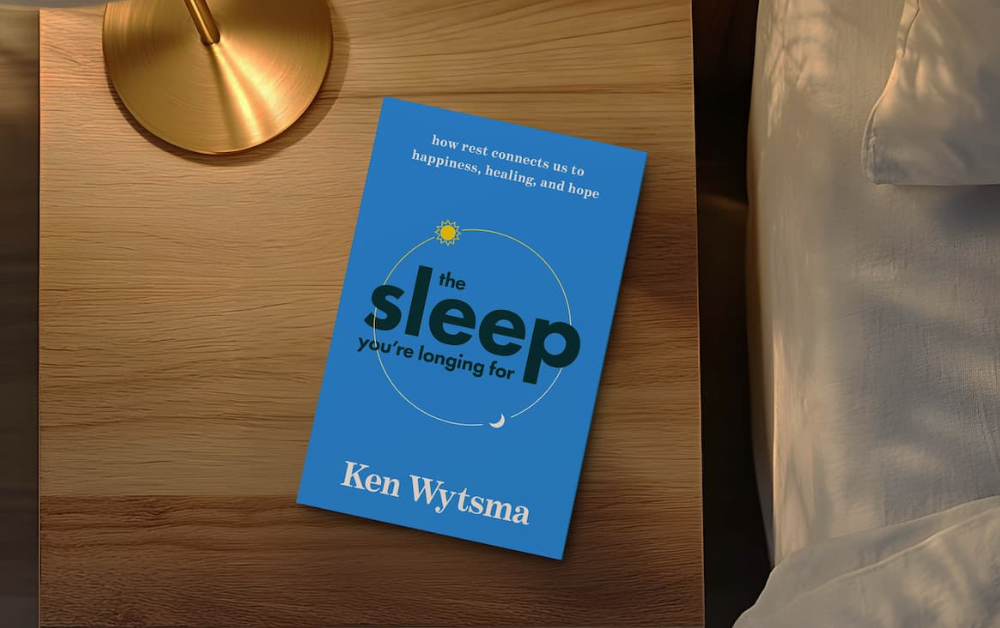
Content taken from The Sleep You’re Longing For by Ken Wytsma, ©2026. Used by permission of Brazos Press.