
Here are common phrases we hear people say, both outside and inside the church:
I’ve got to get my life right, then I can . . . I need to love myself to love others.
I am in my head.
I have worked hard to get where I am. You are bringing me down.
You are robbing me of my joy. I can do it myself, thank you. I need “me time.”
We can only have quality relationships to the extent that we are each emotionally healthy.
Being a Christian is first about my relationship with Christ, so that has to be my primary focus.
I need to live my truth.
Everyone needs to find and live into their own truth. You worry about yourself; I’ll worry about me.
At least I am not like that person. I am okay. Sure, I’ve got faults, but those people have more. I got to get mine.
I am me: take it or leave it. I am what I am.
You can be anything you want to be. I’m worth it.
I did it my way.
I want to find my person, the one who makes me whole. I love you; you make me feel so good, so complete.
God helps those who help themselves.
In our call to renew our minds, it is thinking in these ways that de-forms us. Christian or not, we may all struggle with such thinking. In fact, you may be struggling right now to see what is the problem with at least some of these ways of thinking. Isn’t being a Christian about my relationship with Christ? And if so, shouldn’t that be my primary focus? Am I wrong to want to find love with someone? Doesn’t almost everyone want that, Christian or not?
We will unpack these, but if you are struggling at all with any of these ways of thinking needing to be altered, we are succeeding in making our point. It is easy to say we need to renew our minds to be consistent with Christ’s. But what that means in actual practice is an ongoing struggle.
This leads us to critique the number-one focus of many of the above ways of thinking. They assume I, me, and myself do the deciding, do the work of renewing, and make the determinations. The false teaching here is that we are individual Christian islands, shaping and determining the outcomes of our lives. We are each the center of our own story. Such a set of lies dooms us to anxiety, depression, sadness, feeling like a failure, and endlessly struggling to be enough. This is not the Christian path whatsoever.
When we are called to be Christians, we join a continent of the faithful. Through our intimate relationships and our larger Christian community, we together engage in the process of renewing our minds. We do so primarily by engaging in discipleship, a process that, by definition, involves more than one person. So, the first step in the renewing of our minds is to accept that we must be with others whether we are being discipled or doing the discipling.
A second incessant lie told to us as Americans is it is truly about me. We desperately want “it” to be about ourselves, and we are told repeatedly it is. In fact, we are oftentimes told it is harmful not to make it about us, as not “taking charge of our life” can lead us to be co-dependent or susceptible to authoritarian leaders. We want to be important, we want to be loved, we want attention, we want to matter. But in the renewing of our minds, a major key teaching of Christianity is that all of this is guaranteed and already settled. God so loved the world (every single one of us and our systems, organizations, etc.) that he gave his only begotten Son. By definition, without exception and not open for debate, we are loved, we matter, and we are of eternal importance. We don’t achieve it, and we don’t search for it; we don’t take charge of it for ourselves. It is a given fact. One of our personal favorite sayings is that there is nothing we can do to make God love us more, and there is nothing we can do to make God love us less. To quote the title of singer Rachel Lampa’s song, we are “perfectly loved.” Our second step in renewing our minds is to let this truth flood over us, to accept it, and to proceed to live as if it is true, which, in fact, it is. We will need the support of our Christian friends and family and of our larger Christian community when we are tempted to waver from this truth.
Thus follows the third vital step in the renewing of our minds: accepting that we do not stand alone. We stand in community. We must seek out Christian friends, family, mentors, and eventually mentees. We are to support and encourage one another in the renewing of our minds. Iron sharpens iron, as the famous saying goes, and it is most certainly true in the Christian life.
As we are pursuing kingdom racial change, we see in the world’s teachings the ongoing seeds of the problem. The world’s teachings require both comparison and relativity. How do I know if I am okay? How do I know if I am good-looking, smart, or special? By comparing myself to others and deciding it is so. Sometimes I will determine I am indeed smart, based on my comparison. But other times, I will encounter people who I determine are smarter than me. When that happens, I will either feel bad about myself, questioning my worth, or I will come to dislike or discount those other persons so that I will not have to conclude they are actually smarter than me.
Such ways of worldly thinking invite, accept, and may even demand inequality, injustice, and endless, exhausting competition. Comparison is about ranking, hierarchy, and assessing value and worth relative to others. The fourth step as we seek to be renewed in Christ’s likeness is to flood our minds with the Christian truth that comparison, ranking, hierarchy, and assigning differential value to people is all to be left behind, swept into a dustbin of falsehoods. Instead, we train ourselves, with the support of other Christians, to think completely differently. Each of us has different skills, gifts, experiences, social networks, and more, but we all are valued equally in the kingdom. God has assigned us different roles, using our different gifts in different places and times to do God’s work on earth collectively. We dare not rank God’s assignments. We have no basis by which to make such a determination (compared to what?), and there is no gain to doing so. Recall Jesus’s teaching that to whom much is given, much is expected (see Luke 12:48). I may say I have done twice as much as you in building God’s kingdom, but if God expected me to do three times more because of the gifts given, in a ranking system, I would come up the “loser.”
But it doesn’t work this way in Christendom. Each of us stands together equally in need of Christ, equally reaching upward to touch the garment of Christ, equally empowered by the Holy Spirit to do the work we have been assigned. Our calling is to support one another in our collective work using our unique giftings and placement in the world.
In chapter 2, we arrived at a building block for kingdom racial change: Every single one of us occupies a social location—a specific place in the social world within a specific society within a specific historical moment (Building Block 2). We thus assess the world and suggest how it should be improved from our social location, what we know to be true. This fact is both positive and negative. The positive is that we have an important and unique view of the world. We can see and know in ways others cannot by virtue of where we stand. The negative is two-fold: First, we too often conclude our view is either the only view or the best view. Second, our understandings are, on our own, parochial and limited to but a portion of the truth.
As we renew our minds, this building block becomes nothing but positive. We realize God has blessed us with a vital view of the world. And we humbly realize, completely, that we need others precisely because our unique view of the world necessarily limits us. The beauty is that in this realization we find the blessing and joy of the diverse Christian community as God calls believers from all social locations. Part of our calling and our joy is harnessing our diversity for God’s huge work in the world. It is messy, to be sure, but it is at the same time wondrous and powerful, as it is something God does as we allow our minds to be renewed.
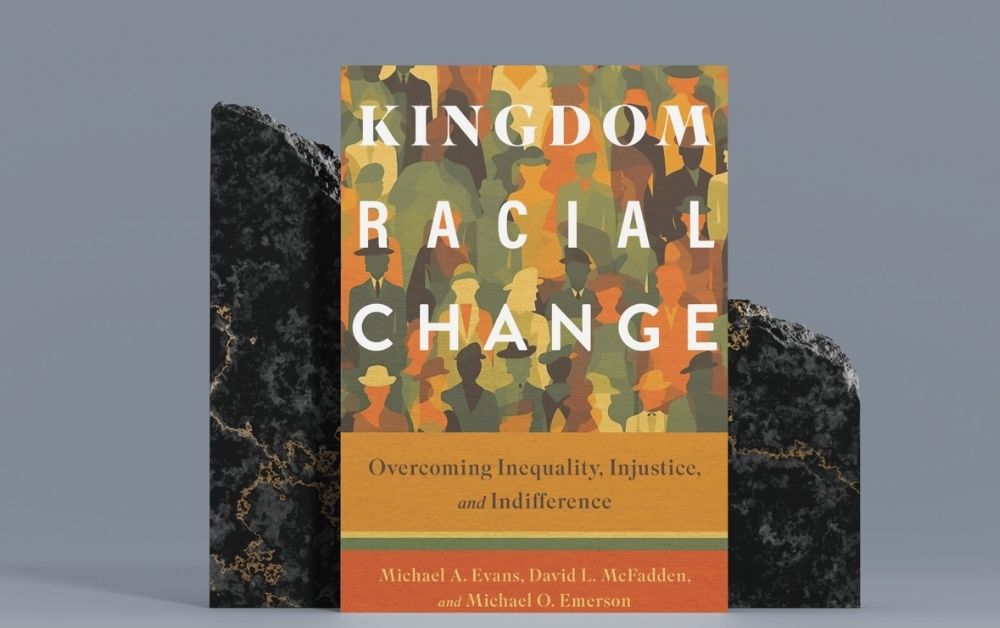
Excerpted from Kingdom Racial Change: Overcoming Inequality, Injustice, and Indifference by Michael A. Evans, David L. McFadden, and Michael O. Emerson ©2025 (Wm. B. Eerdmans Publishing Co.). Reprinted by permission from the publisher.