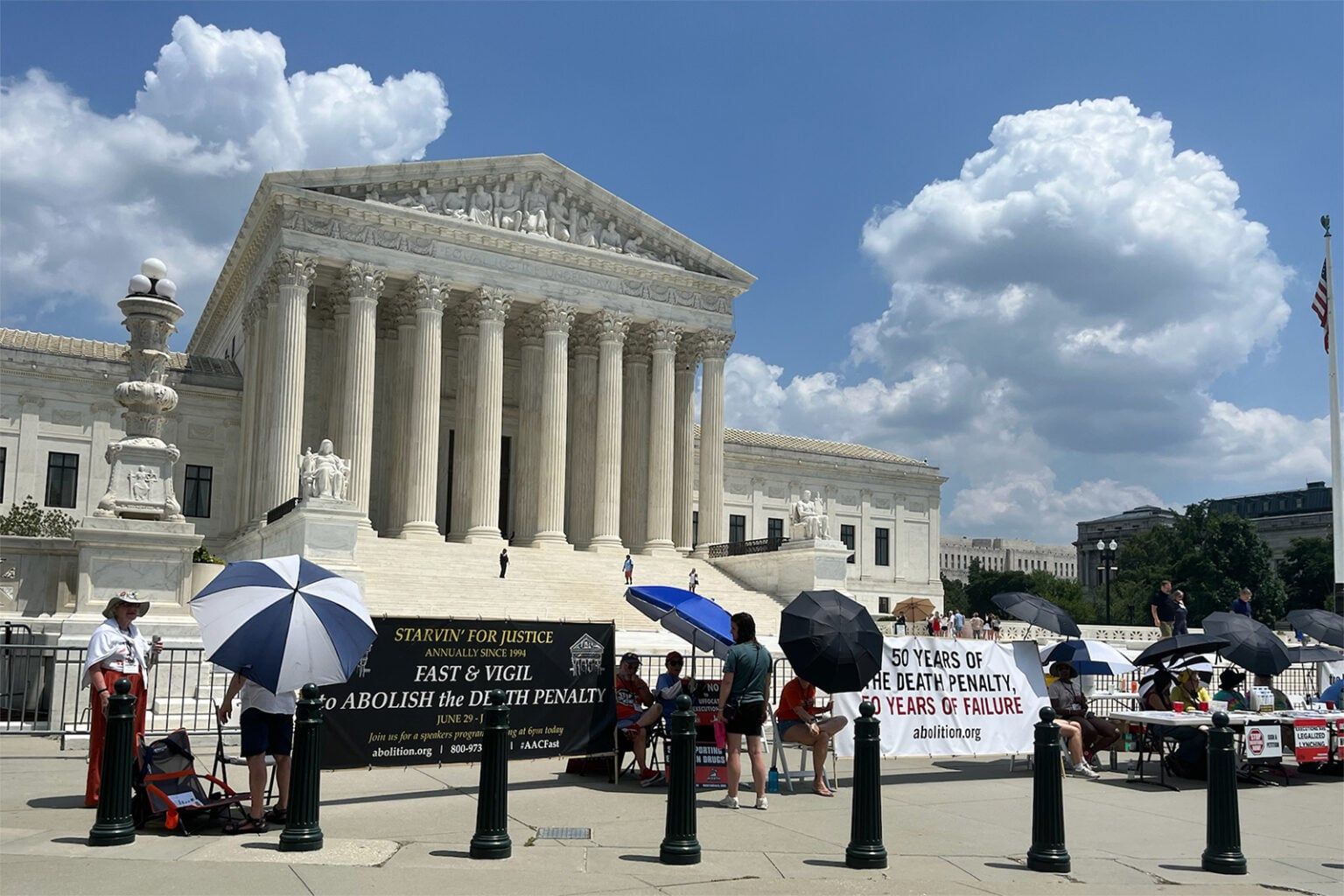
WASHINGTON (RNS) — On the anniversary of a Supreme Court ruling reinstating the US death penalty, faith leaders, those affected by murder and activists organize to call for an end to the death penalty. But religion has also been present in support for capital punishment.
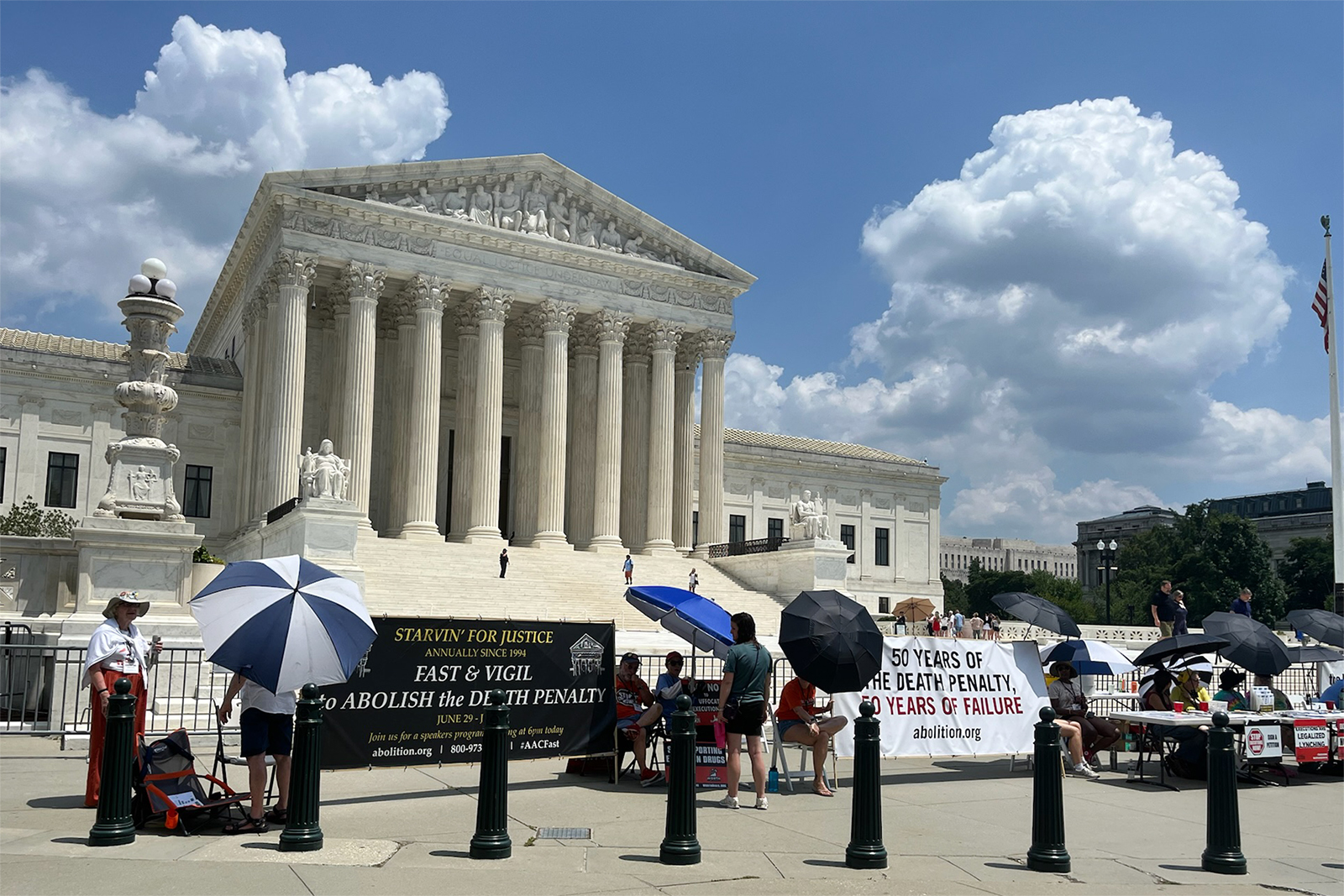
WASHINGTON (RNS) — In her first years attending a fast marking the anniversary of the Supreme Court decision that resumed the modern-day death penalty in the United States, SueZann Bosler was still on medication to treat the effects of being stabbed in the head by the same man who murdered her father, the Rev. Bill Bosler, in 1986.
To honor the wishes of her father — a Church of the Brethren minister in Florida who was against the death penalty — Bosler worked for a decade to commute the death sentence of the man who killed her father and injured her, despite initially struggling to forgive him. “ It saved my life, forgiveness,” she said.
On Thursday (July 2), the 50th anniversary of the 1976 Gregg v. Georgia decision that reignited the modern era of the death penalty in the country, Bosler is on her fourth day of fasting. She has been taking shifts as part of the “Starvin’ for Justice” anti-capital punishment protest outside the U.S. Supreme Court to try to convince passersby to join her in opposition as temperatures climb above 100 degrees.
But the solidarity of about 85 protesters involved makes the time joyful, Bosler told RNS, because she’s often the sole person protesting outside the Florida Supreme Court.
In the 50 years since the Gregg decision, faith-based opposition to the death penalty has been a cornerstone of successful abolition and commutation campaigns — even as religious Americans as a whole tend to support the death penalty, data suggests.
“Faith leaders have been instrumental” in death penalty abolition in New Jersey, New Mexico, Connecticut, Virginia and several other states, according to Abraham Bonowitz, the executive director of Death Penalty Action and co-founder of L’chaim! Jews Against the Death Penalty.
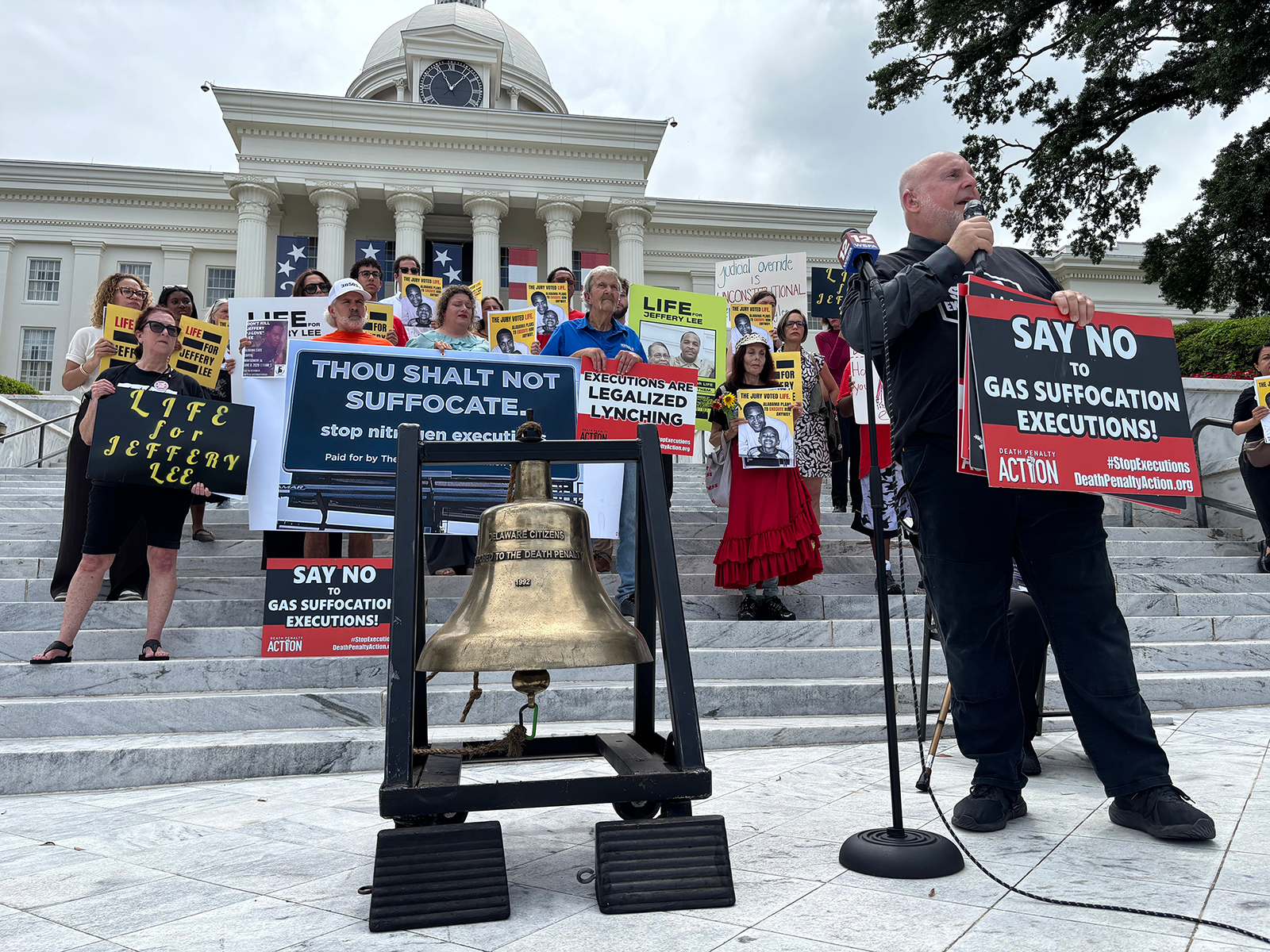
Bonowitz also credited faith leaders like the Rev. Sharon Risher, whose family members were murdered at Mother Emanuel AME Church in Charleston, South Carolina, in 2015, with successfully pressuring President Joe Biden to commute the sentences of 37 people on death row in the last days of his presidency. Emanuel’s shooter was not among those commutations.
“God commands us not to kill,” said Art Laffin, an organizer of the Starvin’ for Justice protest and member of the Dorothy Day Catholic Worker community. “It’s not an option, it’s a command.”
Laffin, who has publicly prayed for the man who murdered his brother, Paul, said that on the cross Jesus was “given the death penalty of his day” but put “into practice the command to love your enemies” by asking God to forgive his killers. “The best way to honor my brother is to work for the prevention of violence,” he said.
Executions in the U.S. surged last year, largely driven by an increase in Florida, and religious death penalty abolitionists are feeling renewed energy and searching for any openings they can find to prevent executions.
The death sentence remains a legal punishment in 27 states. Of those, four states — California, Pennsylvania, Oregon and Ohio — have instated execution moratoriums in the last few years. In the 23 states where the death penalty remains, it continues to emerge as a topic of vociferous debate, especially amid criticism over botched executions.

Currently, the federal death penalty applies to all 50 states but is rarely used. Since 1988, there have been 16 federal executions, 13 of which occurred in a six-month period between July 2020 and January 2021.
In Sacramento on Tuesday, faith leaders and activists delivered petitions from more than 25,000 people urging California Gov. Gavin Newsom to commute the sentences of all those on death row in the state, alongside 565 LED candles representing their lives.
Faith-based activists are also ramping up pressure on Ohio Gov. Mike DeWine to commute sentences as his term ends this year. Bonowitz said DeWine sometimes attends Mass at the same Columbus parish as his wife, Bonowitz said. The church, St. Catherine, prays for the abolition of the death penalty at every Mass. A spokesperson for the Diocese of Columbus did not confirm or deny those prayers when reached by email.
Last month, DeWine, who had earlier in his career sponsored a bill to reinstate the death penalty in Ohio, called for state lawmakers to abolish the death penalty. Despite pressure, he has commuted only one of the state’s more than 100 death penalty sentences to life in prison without parole.
In Florida, Catholic bishops have written repeatedly to Gov. Ron DeSantis, who is Catholic, asking him to stay the executions of 22 people in the last year. They recently urged DeSantis to prevent the execution of Dusty Ray Spencer, 74, who last week became the oldest person executed in Florida’s modern history. Faith-based activists have also elevated the voice of Ron McAndrew, a former Florida prison warden who says he is haunted by men he executed.
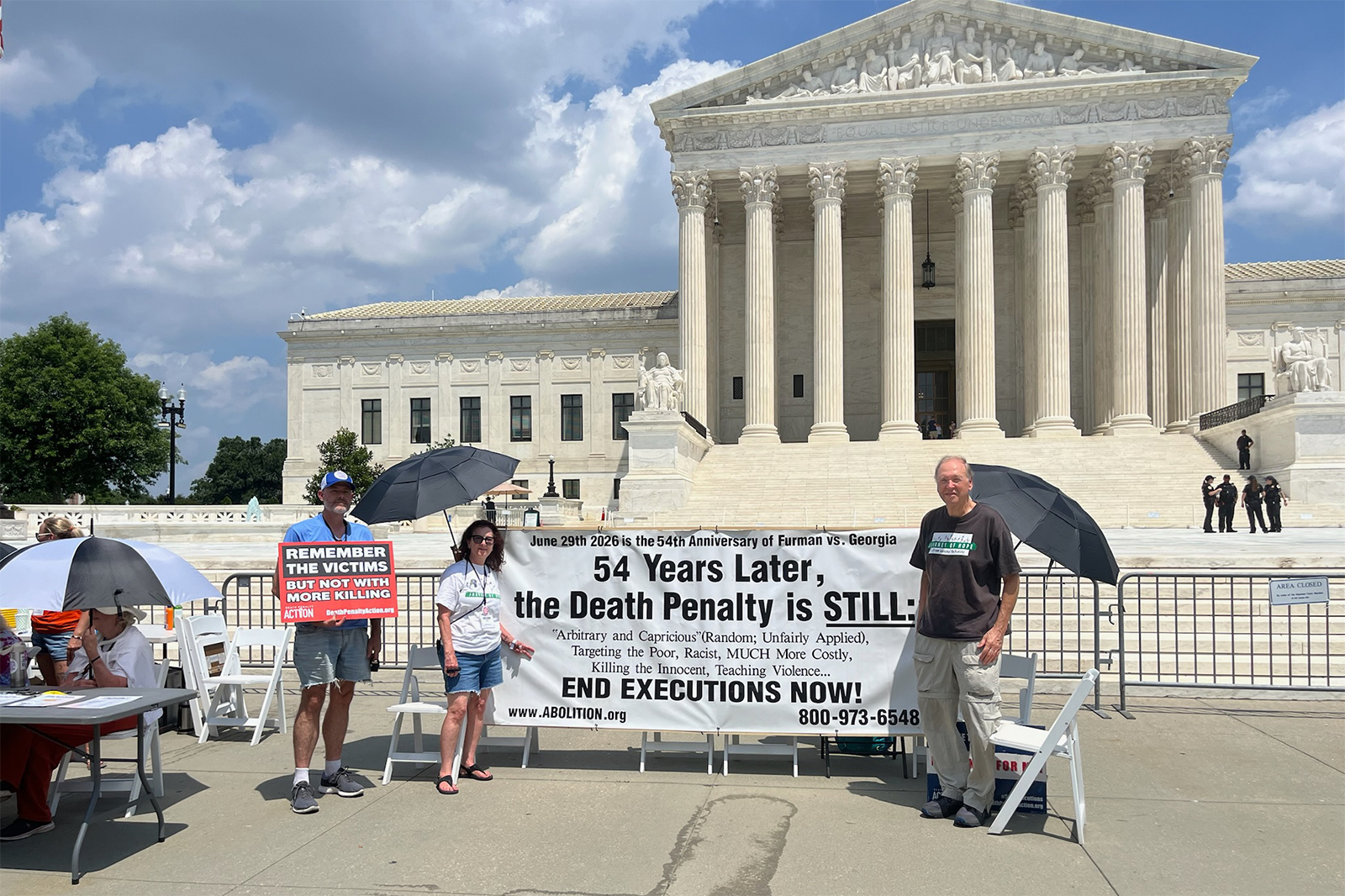
In the nation’s capital, the activists hope to mark the 50th anniversary of the Supreme Court decision by appealing to passersby and the consciences of the justices inside, many of whom are Catholics and have issued decisions advancing the death penalty.
The Rev. Jack Sullivan, Jr., a Disciples of Christ pastor and the brother of a murder victim, Jennifer, told RNS the anniversary “confronts people of goodwill across the country, and particularly people of faith, who believe in the powers of hope and life and love and redemption.”
Like Bosler and Laffin, Sullivan is part of Journey of Hope, a national anti-death penalty organization led by family members of murder victims.
Among the advocates fasting are also those who minister to those on death row. Maureen Bibby, a Catholic from Tennessee, said she’s “become best friends” with the man she visits on death row.
“It’s the only place in the world where you are known only by the worst thing you’ve ever done,” Bibby said. “These are human beings.”
On July 2, 1976, in a 7-to-2 decision, the Supreme Court ruled capital punishment did not violate the Eighth and Fourteenth Amendments. The decision was a dramatic reversal of the court’s 1972 ruling in Furman v. Georgia, which had halted executions nationwide.
Since Gregg v. Georgia, “1670 people made in God’s image and likeness have been executed,” Krisanne Vaillancourt Murphy, executive director of Catholic Mobilizing Network, an anti-death penalty organization, said in a statement to RNS.
Vaillancourt Murphy added that more than 200 people on death row have been exonerated since 1973 — “a sobering reminder that our criminal legal system is fallible, and that the death penalty is irreversible.” Perjury, false accusations and official misconduct are the leading causes of wrongful convictions, the advocacy group Equal Justice Initiative has found.
In the history of capital punishment, Black Americans have been disproportionately sentenced to death, especially when the crime involves white victims. The majority of state executions since 1976 have occurred in the U.S. South. As a result, several scholars and activists have deemed capital punishment “a direct descendant of lynching” and racial oppression.
“The country has had and continues to have racism flowing in the groundwaters of our land,” Sullivan said, “and it certainly affects the criminal justice system and the handing down of sentences, including and especially death sentences.”
Religion has also been present in support for capital punishment. A 2021 Pew Research Center report found that a majority of religiously affiliated U.S. adults, especially Protestants, favor the death penalty for people convicted of murder — as do a majority of all Americans, per the survey.
In advocating for death sentences, some prosecutors have delivered closing remarks including scriptural quotes such as Leviticus 24:17, Genesis 9:6 and Exodus 21:12 that call for the death penalty as punishment for murder.
Yet Bonowitz, who is Jewish, said those who base their support for the death penalty on Hebrew Scripture must look at rabbinic interpretations, which argue “the death penalty exists” but humans “cannot be trusted with this power to execute.”
Shane Claiborne, the author of “Executing Grace: How the Death Penalty Killed Jesus and Why It’s Killing Us,” told RNS, “The death penalty wouldn’t stand a chance in America without the support of Christians.”
Claiborne, co-founder of Christian social justice group Red Letter Christians and a key figure in the religious left, said he saw opportunities to work with conservatives on the issue. “There’s something deeper that should connect us, which is this profound sense that no one’s beyond redemption and that our government is not infallible, so we shouldn’t entrust it with this power,” he said.
Sister Helen Prejean, part of the congregation of St. Joseph and an anti-death penalty advocate, said in a recent video reflecting on the 50th anniversary of the Gregg decision, “I think it is the most terrible decision the Supreme Court has made after Dred Scott,” which ruled enslaved people were not U.S. citizens.
Prejean is known globally for her decades-long crusade against capital punishment. Her campaign has included making personal appeals to both Pope John Paul II and Pope Francis.
Francis ordered a change to the catechism of the Catholic Church in 2018, which positioned capital punishment as “inadmissible” and “an attack on the inviolability and dignity” of people.
Sullivan, the Disciples of Christ pastor, also acknowledged that central biblical figures such as Moses, David and Saul “committed murder” but “were transformed by the power of God” and became pillars of the Chrisitan faith. “How do we know that on death row, there isn’t another Moses or Esther or David, or Mary or Saul?” he asked.
The 50th anniversary of Gregg falls just days before America celebrates its 250th birthday. For Sullivan, the close proximity of the two milestones gives the nation the opportunity to reflect.