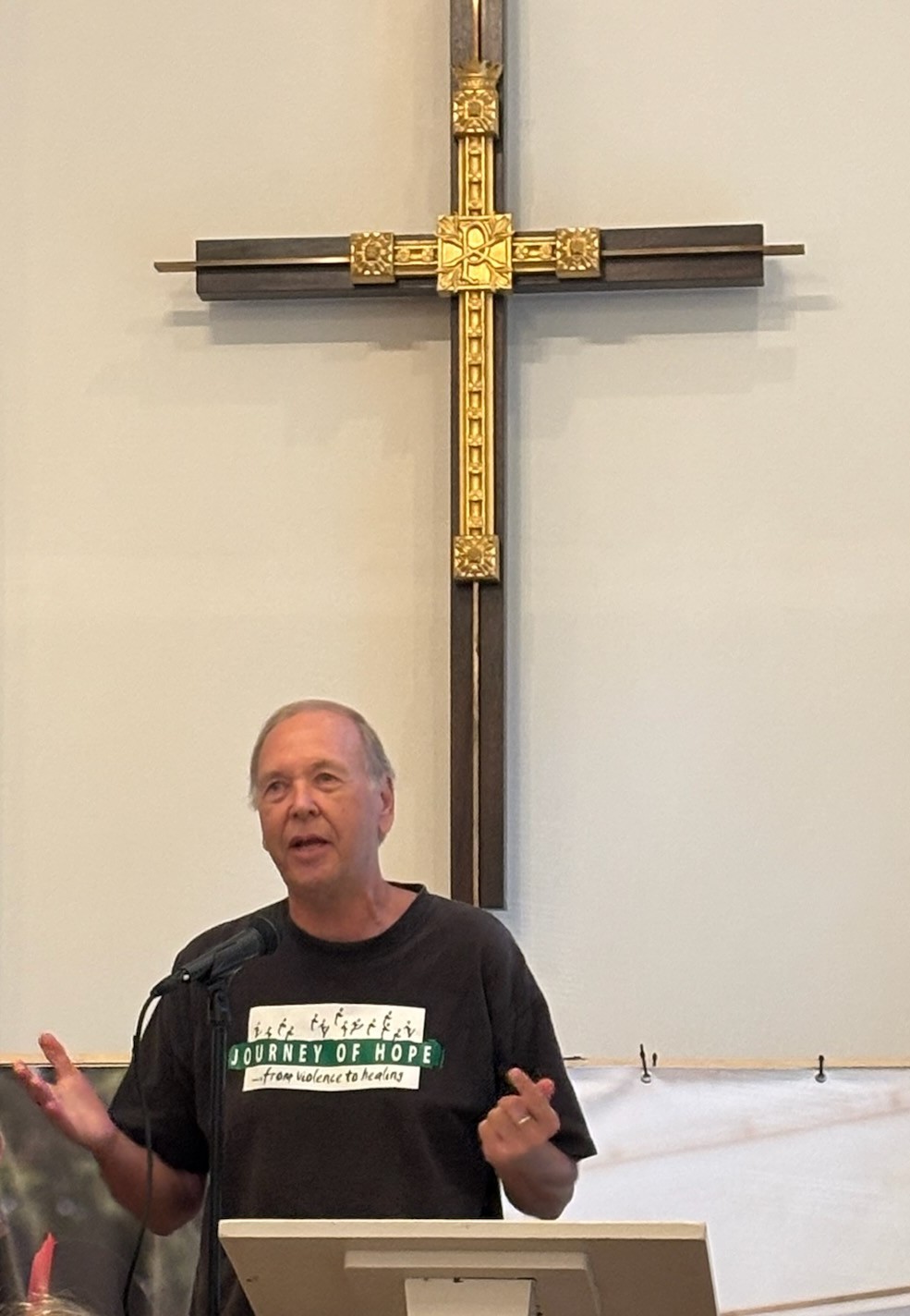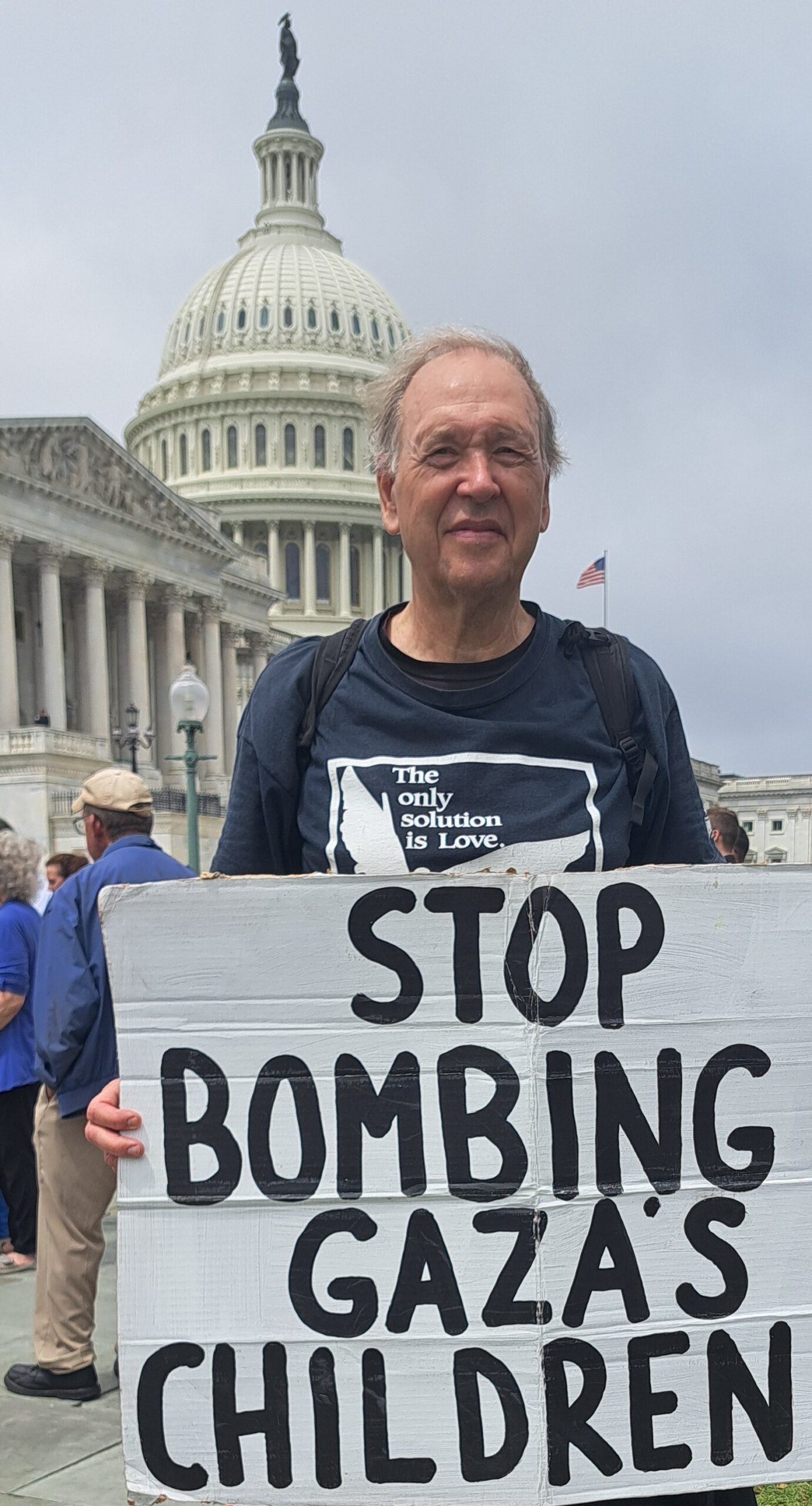
On March 27, 2026, twenty-seven peace and justice makers, including many Catholic Workers, were arrested at the Pentagon as they prayed and sang for peace and the abolition of war and all weapons of war. The occasion marked the 70th birthday of longtime Catholic Worker Patrick O’Neill who, with other Catholic Workers, helped organize the action. Charged with “interfering with agency functions,” the groups’ charges were later “dismissed without prejudice.” This means the government reserves the right to bring up the charges over the next five years.
In the Pentagon 27 press release prior to a June 4th court hearing, our group declared: In his recent encyclical, Magnifica Humanitas (Magnificent Humanity–MH), Pope Leo XIV condemned the increasing pervasiveness of the military industrial complex in our society and the use of AI in war. “AI does not remove the intrinsic inhumanity of conflict; indeed it can only bring about conflict more quickly and render it more impersonal, lowering the threshold for resorting to violence, transforming defense into threat prediction and thus reducing victims to data,” the pontiff wrote. [198.]
Consequently, Pope Leo encouraged people of goodwill to continue actively resisting war and injustice: “Even in the darkest nights, the Lord raises up men and women who refuse to give up, who persevere in doing good, who protect the vulnerable and open pathways to reconciliation. The memory of the saints, righteous people and the oft-forgotten peacemakers, show us that grace does not magically eliminate conflict, but instead it inspires active resistance to evil and an astonishing creativity in doing good.” [Id.–211].
The Pentagon 27 did exactly this on March 27th, as an expression of their Christian faith.
Since its inception in 1933 and up to the present time, the Catholic Worker, founded by Dorothy Day and Peter Maurin, have condemned and resisted war and weapons of war. Following the U.S. use of nuclear weapons in Japan in 1945, Day immediately condemned these atrocities and called for the abolition of these weapons of indiscriminate mass murder. Her stance on Gospel nonviolence has greatly influenced church teachings regarding its opposition to war and nuclear weapons. She is mentioned in Pope Leo’s MH as among those whose commitment have helped “make history more humane.” Today, Catholic Workers continue Day’s inspiring Gospel witness of doing the works of mercy, peace and justice and nonviolently resisting a warmaking empire.
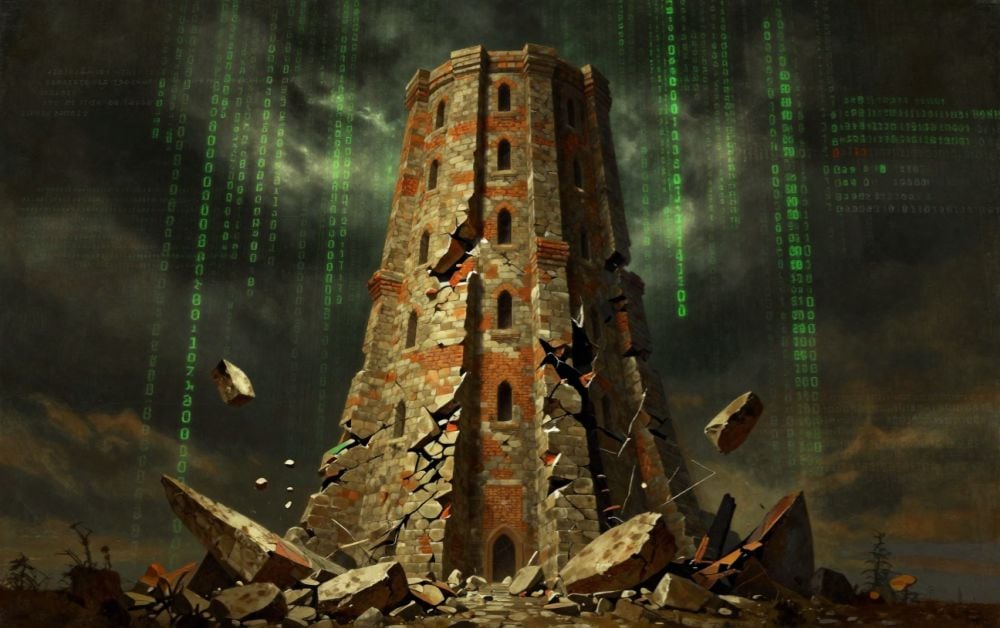
The rapid advancement of artificial intelligence (AI) is transforming industries at an unprecedented pace, and the business of warfare is no exception. AI-enabled weapons are reshaping modern warfare with significant implications for strategic planning, and battlefield operations.
This concern is not just theoretical. Militaries are rapidly integrating artificial intelligence (AI) into the making of life-and-death decisions: whom to target, what force to use, and how to weigh the expected harm to civilians. The adoption of AI in the military domain is now a global phenomenon, evident in the conduct of parties to armed conflict, in the priorities of major military powers, and in the investments of many other states.
In its immoral and illegal U.S.-Israeli war against Iran, the Pentagon has relied on artificial intelligence in its operations. The system, known as Project Maven, relied on technology by Palantir and also incorporated the AI model Claude built by Anthropic. Israel has used similar AI targeting programs in Iran, as well as in its genocidal war in Gaza and assault in Lebanon. Craig Jones, an expert on modern warfare, says AI technology is helping militaries speed up the “kill chain,” the process of identifying, approving and striking targets.
AI technology also increases the risk of nuclear war. On January 27, 2026, the Bulletin of the Atomic Scientists reset the “Doomsday Clock” to 85 seconds to midnight—the closest to global catastrophe it has ever been—due to dangerous threats posed by Nuclear Weapons, the Climate Crisis, Artificial Intelligence, worsening world tensions and other perils.
The nuclear threat is further exacerbated by current U.S. nuclear policy and an unstable president who threatened to “blast Iran into oblivion” and “back to the Stone Ages,” and warned: “A whole civilization will die tonight, never to be brought back again.”
To be clear, the cornerstone of U.S. military policy is its intent to threaten the use of nuclear weapons. As the only nation to have used nuclear weapons against the Japanese in 1945, the U.S. has since threatened to use nuclear weapons as blackmail on over 20 occasions. The U.S. government refuses to adopt a “no-first-use” policy and is now modernizing its nuclear arsenal at a cost of nearly $1 trillion over the next several decades. And the U.S., along with and eight other nuclear nations, refuse to ratify the TPNW which now deems nuclear weapons illegal under international law. Moreover, the Trump administration’s Nuclear Posture Review includes planning for limited nuclear war by developing low-yield nuclear weapons to counter an adversary’s limited use of nuclear weapons in any conflict.
Any such “limited” use of nuclear weapons remains a fallacy. A study by King’s College London published earlier this year revealed that AI models used in 21 simulated nuclear crises escalated the conflict by threatening nuclear war in 95% of 329 turns of play. According to Professor Kenneth Payne, the study’s leader, “Nuclear escalation was near-universal: 95% of games saw tactical nuclear use and 76% reached strategic nuclear threats. Claude and Gemini especially treated nuclear weapons as legitimate strategic options, not moral thresholds, typically discussing nuclear use in purely instrumental terms.”
As the leading arms dealer in the world, the U.S. government, instead of funding vital human needs programs, will also spend $1.5 trillion on the 2027 military budget. The role of the military industrial complex continues to be the driving force in the militarization of our country and world and, in the words of the late Daniel Ellsberg, making “near extinction possible.” (See new film, An Ordinary Insanity). This murderous complex must be exposed, resisted, and dismantled!
In MH Pope Leo writes:
“The growth of the military-industrial complex has become a defining feature of the current political landscape and has become a key sector in the economy of various countries. The close link between economic interests, the military apparatus and political decisions produce an “armed nation,” in which war appears as a natural extension of politics, and the arms market becomes an autonomous driving force behind military decisions. Nor can we ignore the enormous economic interests behind war. The armaments industry, and countries that supply weapons, profit from a market that thrives precisely on conflicts. In this sense, there are also financial interests that contribute to fueling tensions in various regions of the world.” [Force without limits: 193].
In our time, a culture of power is taking hold, in which the availability of resources and the ability to dominate tend to dictate the agenda and criteria for decision-making. In this way, the common good of humanity is relegated to the background and the concrete tragedy of peoples at war is reduced to a secondary consideration in relation to strategic interests. This culture of power infiltrates society, changes relationships and behaviors, and grows by normalizing war, pursuing ever-greater military power, taking advantage of the crisis of multilateralism and fueling a false realism that insists that there is no alternative. [Culture of Power: 188]
There are times when, in order to remain human, we must set aside our reservations and take a stand. In some conflicts, it is unjust to remain neutral, nor is it enough merely to claim that we are not complicit. When we witness the bombing of civilians, attacks on hospitals, schools or vital infrastructure, and violence that affects children, we are confronted with scandals that wound humanity itself. For this reason, we cannot limit ourselves to the level of abstract analysis. Pope Francis encouraged us to “touch the wounded flesh” of those who suffer, look at their faces, listen to their stories and acknowledge their wounds. Painful events require both history and memory, the former to recount the facts, the latter to bear witness to lived experiences. [Adopting the perspective of victims: 216-217].
People of faith and goodwill cannot allow killing, war, genocide, nuclear weapons, death-dealing technologies and idols of death to be normalized. We need to reject ideologies and theologies that support Christian nationalism, systemic racism and oppression, violence of any kind, killing, military occupation and intervention, war, genocide and even omnicide. And we need to adopt nonviolence practices, as many are doing today, as a primary means to respond to conflict, to resist systemic violence and injustice, and as an alternative to militarized-based national security. History is replete with powerful examples of how nonviolent resistance and nonviolent civilian defense have been used to counteract state-violence, aggression and authoritarian rule, thus resulting in transformative change.
Pope Francis declared: “War is a sacrilege. Let us stop fueling it.”
Pope Francis, who also declared the possession of nuclear weapons as immoral, further stated: “Before the danger of self-destruction, may humanity understand that the moment has come to abolish war, to erase it from human history before it erases human history.”
Pope Leo reminds us as Christians of what is essential to our faith:
“War is never worthy of humanity, and it is never blessed by God…peace is a duty of justice because we are one human family, a magnifica humanitas that finds its head and redeemer in Christ.”
“…We cannot believe in Jesus and promote war. We cannot believe in Jesus and kill the innocent…We cannot believe in Jesus and abandon those who suffer, those who weep, those who flee from misery.”
https://www.ncronline.org/
Now more than ever we need to heed and act on the Gospel mandate of nonviolence and love, even for enemies, and Rev. Dr. Martin Luther King’s exhortation: “The choice today is…either nonviolence or nonexistence.”