Introduction
Western Christianity has wreaked havoc on people across the globe. I have tried for so many years to speak truth to power—through my many books and other writings, through my talks, and through my lifestyle.
Western Christianity has charted an unfortunate path. (When I write about Western Christianity, I define it as the movement affected by Jesus’s death, influenced in the second century and later adopted by Western Europe in the fourth century, spreading throughout Western Europe, the Americas, and much of the world under Western empire’s influence. I do not automatically include Eastern or Far Eastern Christianity.) As political scientist Samuel P. Huntington said, “The West won the world not by the superiority of its ideas or values or religion but rather by its superiority in applying organized violence. Westerners often forget this fact; non-Westerners never do.” The violence that has been used in the world by Christianity and witnessed by its victims and the perpetrators alike, has been incalculable. We might say that the credibility of the product is a major problem, and management is unwilling to risk change.
The values adopted by Western Christianity are, foundationally, the opposite of the teachings of Jesus. Jesus talked of loving our neighbors, especially the ones we dislike. Today, Western Christians spread hate and indifference, and they even sanction hunting down immigrants. The Samaritans shared a common border with Israel during Jesus’s day; but instead of cheering the deportation of his Samaritan neighbors, Jesus both welcomed them and learned from them.
After many years of thinking long and hard about the question of whether one can actually follow Jesus as a Western Christian, I have determined my own opinion on the matter. I believe you can be a Western Christian and follow Jesus but that it’s extremely difficult. It is difficult to preach a gospel of love when the adherents of your religion have hated and killed so many throughout the years. And these acts have not ended. The hatred and violence in the name of Jesus continues today.
In this book we will look at multiple doctrines that Western Christianity invented and trace the harmful effects of those doctrines. We will look at the way that fealty to the empire corrupted Western Christians. And we will examine all the things that Western Christianity wrecked, the harms and injustices it left in its wake. We will also catch a glimpse of Jesus through the lens of Indigenous and Hebrew understandings rather than imperial American and Roman frameworks.
By writing this book, I am taking a bold step. I will say things that a lot of people do not think should be said. How do I know this? As they say, this ain’t my first rodeo. I have no doubt that my words will be met with disdain from some quarters. My character will likely be demeaned and my scholarship repudiated, all by well-meaning Christians who consider themselves keepers of the truth. This will be nothing new, of course. Whenever religion has been challenged it has been met with fear and force, hubris, and arrogance.
Conservatives and progressives alike will find concerns with this book. Some will argue that I’m a liberal because I have reduced Jesus to the simple bearer of an ethic (although this is not so. I do talk a lot about following Jesus’s example, but I also speak about a daily relationship with the Spirit-Man Jesus). Others may have concerns that I am not spending enough time unpacking theological and historical claims that I make. I will simply state what my years of academic rigor and my years of experiencing the Great Mystery—God—have shown me.
Well-meaning people will feel they must protect the purity of the gospel and will insist I have wandered from the faith. In truth, the situation is the exact opposite. In my now fifty-plus years of devotion to our Creator, to Jesus, I have found the “pearl of great price.” I have found joy unspeakable and love without limits, all flowing from a wonderfully loving God who cares for us all.
Who I Am
As you read this book, also keep in mind I could be wrong. (Wait! What? Yes, I said that. Please regroup). I am a simple human being and therefore limited in my understanding. Every book (especially every theology book), every chapter, and every article should begin with this same declaration. We are all mere human beings searching for answers. Hopefully, my life has been a testament of integrity. I have given Creator my all since I was nineteen years old. If nothing else, perhaps my critique and questions will lead you to greater truth. My best hope as a former professor is that by the end of this book, you have different and better questions than you do now.
I will share my experience, opinions, and even facts here or there, but I am doing just that: sharing the truth I know. I have learned on the long road of life that most of what we deem to be facts are simply deliberative opinions. I’m pretty sure that every fact has an opinion that formed it. I’m not apologizing, just trying to be honest.
I’m also writing in a style that hopefully allows you to get to know me as we take this journey together. Since I can’t be in the room with you, I hope I can write in a style that at least makes you feel like we are going through this together. This might seem unprofessional to you at times, especially if you are used to reading academic books. But I’m not trying to be the expert here, just a responsible human being who has thoughts, opinions, feelings, and hopefully, some experience worth your time.
I wrote Living in Color: Embracing God’s Passion for Diversity (2001) at a time when most White people assumed racism was over. Apparently not. Evangelical White pastors and others were my intended audience. (Anyone have any concerns about the racism of White evangelicals between 2001 and now?)
My next book, Shalom and the Community of Creation: An Indigenous Vision (2010), helped people discover more of the core of how we are all supposed to live in shalom or whatever the similar construct is in each society, but particularly leaning on Native American understandings. Shalom is what Jesus was and is all about, and my understanding of it completely reoriented my theology and consumed my life.
I then cowrote, with Bo Sanders, Decolonizing Evangelicalism (2020) to address the colonized views within evangelicalism. It was a short but powerful book written in a conversational style and jam packed with what could be called dis-orienting, creative ideas and some academic history of decolonization. Bo and I went into detail concerning critical race theory before it became a social hot potato.
In 2022 I published three books, all for different purposes. (1) Becoming Rooted: One Hundred Days of Reconnecting with Sacred Earth. We all need to reconnect with Grandmother Earth, and this book had appeal to readers who aren’t theologians or professors. I continue to be grateful when even today readers share how this book has helped them. (2) Mission and the Cultural Other: A Closer Look was directed particularly to people who want to understand the roots of American-style missionary endeavors, which I trace to White supremacy. (3) Indigenous Theology and the Western Worldview goes deeper into understanding where White supremacy comes from, tracing the Western worldview’s roots to ancient Greece. To my surprise, the Academy of Parish Clergy voted it one of the top ten books of the year.
In and out of those years I published three children’s books called The Harmony Tree Trilogy, each with a different ecological theme and each dealing with concerns between host and settler peoples. My children’s books all have a timely ecological message as well as deep theological implications (they may be my favorites).
Edith and I published Journey to Eloheh: How Indigenous Values Lead Us to Harmony and Well-Being (2024) as a living model of how the values of Indigenous peoples can create positive change in society. We demonstrated how those values are embedded in our lives through our own stories.
So although I keep saying, “This is the last book I am writing to the church,” the books somehow keep coming. So, I must ask myself an honest question. Maybe you have asked this same question of yourself: “Why do I still care about the church?” My answer: It is groups like churches, which are already formed as affinity units around the world, that can make a positive change. I think Jesus saw this as well!
Although Jesus never intended to begin a religion, I think he did have the vision of a mass movement that could usher in a new way of living in the world; a way of living in harmony with each other. A way of resolving conflict through truth and love. Since I met the Spirit-man Jesus, I have not been able to shake loose from his vision. This vision, I feel, should be the same vision of the Christian church. If only the church could major in what Jesus said to do and minor in the rest, the world would be a much better place. But this is the last book I’ll write to Western Christianity . . . really!
The Purpose of the Book
Even though my insider journey in Western Christianity took me on a deep path of love and learning, I always questioned why. All I read about the early church—their sharing, their love for one another, and the values taught by Jesus—were only faintly reflected in the churches I attended. My overall church experience was positive, but I always felt that something essential was missing. And I am certainly not alone. Maybe you have felt something similar? Along the way I searched for authentic Christian community, visiting many communities and belonging to a few. I submerged myself deep into scholarship and theology, often asking questions that were not always welcomed.
When I first began teaching at a seminary, most of my students were planning on going into church ministry or another form of Christian ministry. Their questions were primarily theological and sociological like “Why is there evil?” and “How do I welcome people of color to my church?”
Fifteen years later, I would estimate three-quarters of my students were there for existential reasons, not vocational ones. They were questioning God’s existence, the validity of church, and the authenticity of the faith in which they were raised. Most of them have held on to some form of spirituality but have rejected the church and formal religion.
In this book I will barely mention the negatives of Western Christianity that most critics name. Yes, Christian nationalism is at an all-time high in this country. Yes, many of those same people are attempting to do away with most of the safety nets for the poor and marginalized. Yes, we no longer welcome the stranger as was taught by Jesus. The purpose of this book is not the obvious criticism, however, but rather it is to go deeper, down to the root of the hows and whys Western Christianity has become what it is today: a religion unrecognizable to the God it claims to serve. We need a deeper understanding of the problem if there is going to be change. In understanding these things, we can remove the religious stumbling blocks in our paths.
The story of Western Christianity going off the rails early and adherents continuing to make horrendous decisions is not just an academic walk-through of history. Those wrong concerns affected millions of followers and tarnished the potential spirituality of those who have been looking in. The acts of the unfaithful have changed the way people have understood God. What could be more important than representing a God of love with love?
Most scholars agree that Job is the oldest book in the Bible, and it ends with a conversation between God and Eliphaz, one of Job’s ne’er-do-well friends. As the story goes, God is telling Job’s friend that God is angry at him. Why? Apparently, the author wanted to get the point across by emphasizing it at the end of the book, explaining the rest of the whole story of Job. What was the great sin perpetrated against Job and apparently against God? “After the Lord had finished speaking to Job, he said to Eliphaz the Temanite: ‘I am angry with you and your two friends, for you have not spoken accurately about me, as my servant Job has’” (Job 42:7).
Eliphaz and his friends misrepresented God to Job. They told Job lies about God’s character. This is exactly the great evil of Western Christianity. Over the years, it has told (and shown with its actions) lies about who God is and why Jesus came. Western Christianity has misrepresented God to people; and unfortunately, it did not happen by accident in most cases. Western Christians have often portrayed God as a distant judge primarily concerned with rules rather than relationship. They have created a God of fear, violence, and control: a God designed in their empire-driven cultural image rather than a God embracing and loving the fullness of life on earth. Churches systematically controlled believers through rigid doctrine instead of encouraging them to follow Jesus’s radical example of love and justice in action. This emphasis on correct belief over right living allowed people to claim Christian identity without embodying the compassion and community-centered transformation that Jesus demonstrated.
Questioning our faith does not weaken our faith, nor does it weaken God. Our deepest and most sincere questions about how we understand God, our faith, and our own spirituality can make us stronger.
In the following chapters, I will question areas of doctrine and church politics. I will question some of Western Christianity’s deepest theologies and beliefs that, for hundreds and even thousands of years, have been considered sacrosanct. To understand where Western Christianity needs to go, we must first discuss where it has been.
Even though I was a professor of religion for over fifteen years, this is not an academic book per se. It is based on a whole lifetime of study and scholarship. For that reason, I’ve intentionally limited the number of notes except where they are needed to show that certain statements are not simply my opinion and to be sure some of the deep thinkers get credit for their ideas and words.
I have always disliked the academic style of writing, and I have experimented along the way in my writing journey all these years to write more personally; more in sync with the average reader. My apologies ahead of time for instances in which I fall back into that academic trap. Please have patience with me, as I am still peeling off the layers of “academese” that I have garnered through my years as a professor and scholar.
The truth I know is based on my own life and is limited to my own experiences and observations, trials and tribulations, disappointments and betrayals. We must all find our own path to the truth. My greatest hope in writing this book is to take away some of the stumbling blocks that have been laid on all our paths so we can continue an honest journey. Know that I have prayed for you, and I bless your passageway as you travel to find your path of truth.
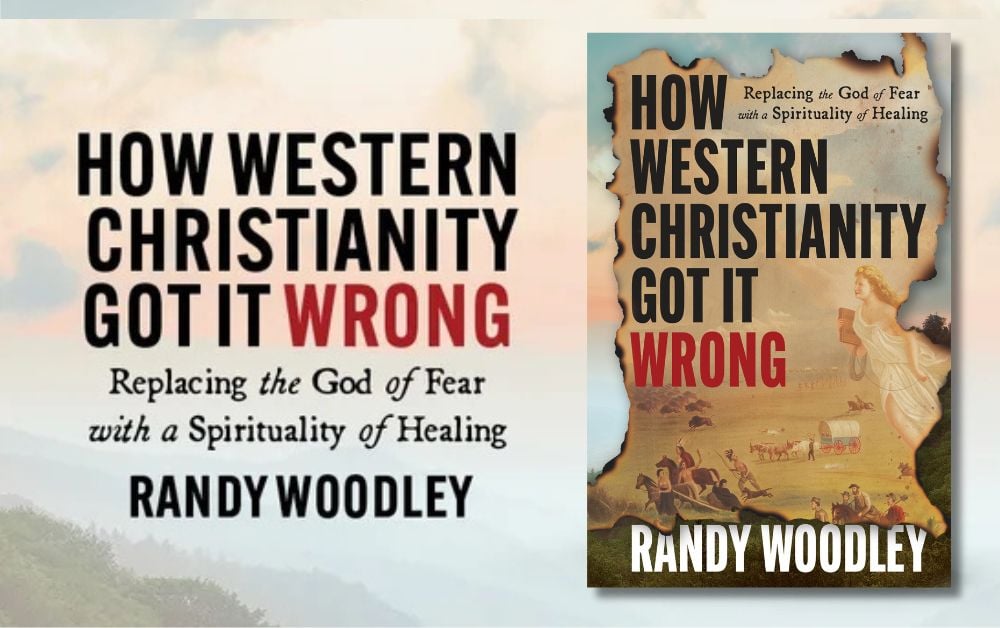
Reprinted with permission from How Western Christianity Got It Wrong: Replacing the God of Fear with a Spirituality of Healing (July 14) by Randy Woodley copyright © 2026 Broadleaf Books.