Introduction
When former Vice President Kamala Harris stepped on stage to accept the prestigious Chairman’s Award at the NAACP Image Awards program only a month into the second presidential term of Donald Trump, she reassured the audience that our nation was not only up to the challenge of resistance but had also survived worse:
This organization came into being at a moment when our country struggled with greed, bitterness and hatred. And those who forged the NAACP, those who carried its legacy forward, had no illusions about the forces they were up against—no illusions about how stony the road would be. But some look at this moment and rightly feel the weight of history. Some see the flames on our horizons, the rising waters in our cities, the shadows gathering over our democracy, and ask, “What do we do now?” But we know exactly what to do, because we have done it before, and we will do it again. We use our power. We organize, mobilize. We educate. We advocate. Our power has never come from having an easy path. . . . Our strength flows from our faith—faith in God, faith in each other, and our refusal to surrender to cynicism and destruction. Not because it is easy, but because it is necessary. Not because victory is guaranteed, but because the fight is worth it. (1)
She also quoted one of the NAACP’s founding members, the scholar and activist W. E. B. Du Bois: “It is today that our best work can be done, and not some future day or future year.” (2)
It was her first major public appearance since leaving office, but Harris did not directly mention her election loss to Donald Trump or directly mention his actions since taking office.
Instead, Harris, the first woman, Black American, and South Asian American ever to be vice president, said:
While we have no illusions about what we are up against in this chapter in our American story, this chapter will be written not simply by whoever occupies the Oval Office nor by the wealthiest among us. The American story will be written by you. Written by us. By we the people. Thank you, God bless you, and God bless the United States.
Those were words a divided nation needed to hear in a time of rapid and unrelenting disruption and chaos only a few weeks into President Donald Trump’s second term.
DRAFTING THE DECLARATION
On July 4, 2026, our nation celebrates the 250th anniversary of its Declaration of Independence from British rule.
The United States Semiquincentennial, also called the Bisesquincentennial, the Sestercentennial, or the Quarter Millennial, will feature festivities marking various events leading up to the anniversary, on Independence Day, and afterward. The United States Semiquincentennial Commission, established in July 2016, is coordinating the observance.
The American Revolutionary War was already underway after the battles in Lexington and Concord in April 1776 when the Second Continental Congress convened in Philadelphia on May 10.
The delegates met at the Pennsylvania State House, later named Independence Hall in honor of the historic event that would take place there.
The Congress named the Committee of Five—John Adams of Massachusetts, Benjamin Franklin of Pennsylvania, Thomas Jefferson of Virginia, Robert R. Livingston of New York, and Roger Sherman of Connecticut—to draft a declaration on behalf of the delegates. The committee members prevailed upon Jefferson to write the first draft. He sequestered himself in a rented house for more than two weeks before presenting a draft to fellow committee members by the end of June 1776. It was further edited by the Congress and ratified on July 4. The Declaration affirmed the colonies’ intent to free themselves of British domination and listed twenty-seven grievances against King George III justifying the decision.
The 250th anniversary of this historic event presents an opportunity to reflect on our nation’s evolution, its flaws and its strengths, and its challenges and its progress as it continues to grapple with diverse opinions, conflicting values, and competing demands under the banner of democracy. In this book, we reflect on the promise our nation still holds, the impediments it has met, and the challenges that lie ahead.
A NATION OF MAVERICKS, REBELS, OUTLIERS
This book looks at our history through the lens of various movements that have helped define our nation and shape it, nudging it toward greater freedoms at times and pulling it back at others. We profile individuals who led those movements or played parts that are not as well-known: the mavericks, rebels, outliers, and ordinary citizens who had extraordinary impact. We have sought especially to be inclusive of women and people of color whom history has overlooked.
On August 20, 1619, “20 and odd” Angolans arrived at Port Comfort, Virginia. They were originally captured by the Portuguese and put on board ships, then stolen by English privateers along with forty others and reloaded onto their ships. The twenty or so who came to Virginia were sold as indentured servants who, like White indentured servants already there, would be contracted to work with no pay for a set amount of time and then be freed.
The servants of African origin were often forced to continue working after the end of their contract, and in 1640, a Virginia court sentenced a Black man, John Punch, to a lifetime of slavery for attempting to run away. Two White indentured servants who fled with him were only given extended indentured servitude. (3)
Punch is considered the first enslaved person in the colonies, and some historians consider his case to be one of the first times a legal distinction was made between Europeans and Africans in the colony, laying the groundwork for the invention of chattel slavery.
As fewer White indentured servants arrived from England, a racial caste system developed, and more African servants were held for life. In 1662, Virginia and other colonies passed a doctrine that mandated that children would inherit the legal status of their mothers. Children of enslaved women would be born into chattel slavery. The act decreed, “Whereas some doubts have arisen whether children got by any Englishman upon a Negro woman should be slave or free, be it therefore enacted and declared by this present Grand Assembly, that all children born in this country shall be held bond or free only according to the condition of the mother.” (4) If she was enslaved, so was the child. If she was free, her child was free. It was passed by the General Assembly in December 1662. Under common law, it had been presumed that the status of the child was determined by the father’s status.
FREEDOM FOR WHITE MALE GENTRY
At the time of independence, slavery had already been practiced in the colonies for about a hundred and fifty years, and about a half million descendants from West Africa were enslaved. British women were brought to Jamestown about the same time the first twenty to thirty Africans arrived in Virginia. The White women had few rights and, despite Abigail Adams’s plea to her husband, John, to “remember the ladies” while drafting a plan for the new nation, they did not gain any under the Declaration of Independence, the Articles of Confederation, or the subsequent Constitution.
It was quite the contradiction, declaring freedom, especially eco nomic and religious freedom, mainly for the White, male, landed gentry while maintaining a system of oppression for others and enslavement for those of African descent. It has taken nearly all these two hundred and fifty years to break through some of the chains of oppression for women and people of color, and at this juncture, the nation seems poised to retrench.
A NATION OF IMMIGRANTS
Yet, we can still be what former President Ronald Reagan called the “Shining City on the Hill.” Testament to that is the reality of the centuries-long immigration of people to this land, coming from across the planet, seeking a better life.
If the country is failing, as some conservatives contend, it hasn’t stopped attracting newcomers in all of these generations. From 1892 to 1954, some twelve million American families came from eastern and southern Europe. Most spent a few hours at the now famed Ellis Island and then were welcomed into the country. Only about 2 percent were denied entry. (5) Many experienced discrimination but ultimately were accepted into the dominant culture.
Times have changed, and millions of immigrants are now rejected annually, even separated from their children. In his second administration, President Donald Trump threatened “mass deportations” and began rounding up immigrants and sending them out of the country.
The foreign-born population in the United States has grown exponentially over the past fifty-plus years in numbers and share of the population, according to US census data. In 1970, foreign-born people numbered 9.6 million (4.7 percent) of the population. By 2022, foreign-born people numbered 46.2 million (13.9 percent) of the population. People from other countries continue to be drawn to the United States even after some 250 years of revolution, rebellion, and radical movements. (6)
THE WAY FORWARD
In this book, we aggressively explore the complex history of the United States, including the colonists’ quest for religious freedom, the displacement of Indigenous people, and enslavement and the responses to it, including rebellion, self-emancipation, the Underground Railroad, and the Abolition Movement. We trace the history of some of the most fundamental social movements that have shaped the nation: the struggles for rights—women’s, labor, and civil—as well as the movements for peace and environmental stewardship, including climate change.
By looking back, we can find inspiration to move forward from On April 1, 2025, Senator Cory Booker, Democrat of New Jersey, broke the record for the longest speech on the Senate floor, twenty-five hours and five minutes, starting March 31, 2025, and running into the next day, to express resistance to the policies of President Donald Trump. The speech broke the record set by Senator Strom where we find ourselves now. We can remind ourselves how individuals who were brave enough and unswerving in their ideals often stepped out on their own to challenge the norms of their times. A few others may have followed them. Maybe their ideas became popular. Maybe not. Some were not successful. Either way, we can learn from how they conducted themselves, how they reached out to others to join them, how they organized for the fight, and what they learned from failures. In these challenging times, we need to borrow from their courage and replicate their tactics.
On April 1, 2025, Senator Cory Booker, Democrat of New Jersey, broke the record for the longest speech on the Senate floor, twenty-five hours and five minutes, starting March 31, 2025, and running into the next day, to express resistance to the policies of President Donald Trump. The speech broke the record set by Senator Strom Thurmond of South Carolina for a speech during his filibuster of the 1957 Civil Rights Act (twenty-four hours and eighteen minutes). Thurmond was a Democrat who switched to the Republican Party in 1964.
As Booker began his speech, according to the Congressional Record of March 31, 2025, he said:
I don’t think that our Founders would have ever imagined a body like this with Black people on both sides of the aisle, with women serving here, with folks from many different backgrounds. We are in many ways doing what the Founders had envisioned, which was this idea of every generation making this a more perfect Union. But there have been times in this journey where our Union was in crisis and was in peril. There were times in this great American journey, over our 250 years, where so many heroes had to emerge, people that I have come to revere….
I know there are veterans in this body—I admire them so much—who have answered that call to serve our country and put their lives in sacrifice. There are people I admire that are heroes of mine that were suffragettes. There were people who fought as abolitionists. There are people more recently that I have come to lionize and admire because they did so much for this country—not with titles, not with high ranks or positions, but folks who, when this country was facing crossroads, was facing crises, they stood up. They spoke up.
One of my greatest heroes of life was a man I got to serve with named John Lewis. I served with him while in this body. Every opportunity I had, I would ask him about the times when he was just a twenty-something. He was the youngest person who was a featured speaker on the March on Washington. He was called the bravest man in the civil rights movement because he kept putting himself in harm’s way to dramatize, to let folks know, to bring attention to the injustices in this world and to say very strongly that this—what was going on in our country—is not normal, that what is going on in our country is wrong. (7)
He recalled that Lewis often urged people to “get in good trouble, necessary trouble, and help redeem the soul of America.”
Booker said, “John Lewis’s call to everyone has, I think, become more urgent and more pressing. If I think it is a call for our country, I have to ask myself, how I am living these words? So tonight, I rise with the intention of getting in some good trouble. I rise with the intention of disrupting the normal business of the US Senate for as long as I am physically able. I rise tonight because I believe sincerely that our country is in crisis.” (8)
As we commemorate this important anniversary of the nation, we hope this book forces readers not only to look at our nation’s gains and accomplishments but also to reflect on how hard our ancestors had to fight for each right, privilege, social advance, and economic success we have secured. They can be lost in an instant or preserved for generations to come. It is up to us.
On September 17, 1787, the final day of the Constitutional Convention—before the public had seen the result—a prominent Philadelphia woman, Elizabeth Willing Powel, asked Benjamin Franklin, the publisher who was a delegate, “Well, doctor, what have we got, a republic or a monarchy?”
He replied, “A republic . . . if you can keep it.”
It is considered one of the more famous questions in our nation’s history, and it has resonance for us now. It is our challenge today. Can we keep it?
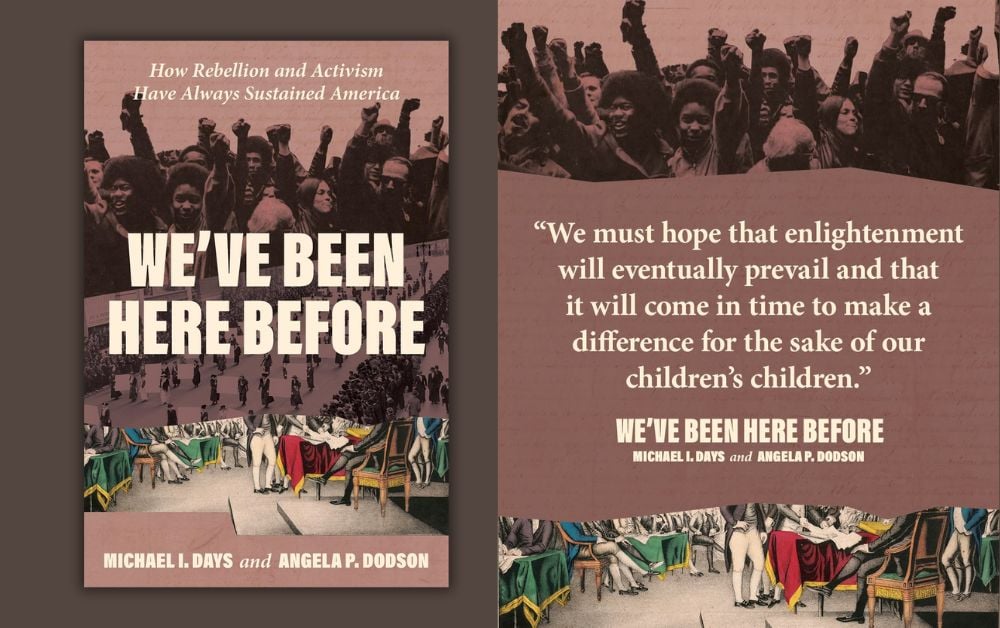
Reprinted with permission from We’ve Been Here Before: How Rebellion and Activism Have Always Sustained America (June 9) by Angela Dobson and Michael Days copyright © 2026 Broadleaf Books.
INTRODUCTION NOTES
(1) Jonathan Lundrum, “Kamala Harris Receives Prestigious Chairman’s Prize at NAACP Image Awards,” APNews.com, February 23, 2025, accessed March 18, 2025, https://apnews.com/article/naacp-image-awards-2025-kamalaharris-
wayans-505a7fc692abd4eceb1f47791ecd3991.
(2) W. E. B. Du Bois, Prayers for Dark People (University of Massachusetts Press, 1980).
(3) Encyclopedia Virginia, “General Court Responds to Runaway Servants and Slaves (1640),” accessed March 18, 2025, https://encyclopediavirginia.org/primary-documents/general-court-responds-to-runaway-servantsand-
slaves-1640/.
(4) General Assembly, “Negro Womens Children to Serve According to the Condition of the Mother” (1662), accessed March 18, 2025, https://encyclopediavirginia.org/primary-documents/negro-womens-children-toserve-according-to-the-condition-of-the-mother-1662/.
(5) Lesley Kennedy, “At Peak, Most Immigrants Arriving at Ellis Island Were Processed in a Few Hours,” June 21, 2018, accessed March 18, 2025, https://www.history.com/news/immigrants-ellis-island-short-processing-time.
(6) Shabnam Shenasi Azari, Virginia Jenkins, and Joyce Hahn, The Foreign-Born Population in the United States (2022): American Community Survey Briefs, April 2024, accessed March 18, 2025, https://www2.census.gov/library/publications/
2024/demo/acsbr-019.pdf.
(7) Cory Booker, Congressional Record, Congress.gov, March 31, 2025, accessed May 26, 2025, https://www.congress.gov/119/crec/2025/03/31/171/57/CREC-2025-03-31-senate.pdf, S1931–32.
(8) Booker, Congressional Record, S1932.