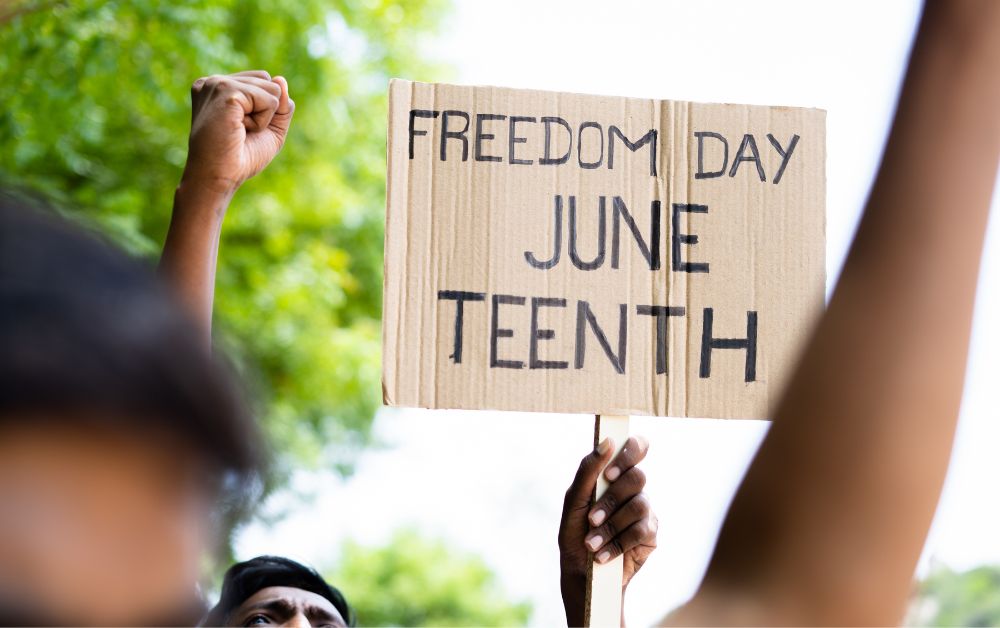
I think it would be fair to assume we are all keenly aware of the vast tidal wave of racism, division, and so-called “Christian” nationalism which has recently arisen in our communities and across the world. A movement that seeks not only to erase all honest remembrance and heartfelt repentance for the brutalities of our past but is now fiercely at work to deter us from moving forward as a people grounded and growing in equality, justice, and love.
Fr. Richard Rohr is often quoted as saying, “The best criticism of the bad is the practice of the better.” This Juneteenth, I would like to encourage us—especially those of us of European descent—to ask ourselves: when it comes to healing the deep generational wounds of racism in our country, how can we practice what’s better?
Is it possible, in this time when racial equality and historical truth are under such brutal attack, for us to move together in the opposite direction? An honest force of love, declaring ourselves present to the generational wounds of our country? Not only through our willingness to own, grieve, repent, and amend for them but also by celebrating those whose hard-won freedom shaped the foundation of this Juneteenth holiday (holy-day)?
Instead of fretting over social-media culture wars or the petty historical denials parroted by politicians, can we admit that the sovereign choice to truly honor Black ancestorship in America lies within each of us?
Instead of sidelining the story of enslavement as a “best forgotten” regretful tale of cruelty, can we recognize that those who were enslaved—yet won their freedom—birthed one of the most essential legacies of human endurance and spiritual resistance in our world today?
Can we confess that the artistic and cultural influence of these once brutalized people—and that of their descendants—has now spread to almost every corner of humanity?
Can we commemorate and celebrate them? Placing them at the center of our American story and honoring them for who they truly are—the ancestors and architects of modern spiritual resistance?
Surely, by doing this, we can in some way reverse this gnawing noise of racial hatred—and instead send honor, dignity, and love to our Black friends and family members.
We could begin this action through grateful moments of silence in our congregations (whatever color or religion the congregants might be)…through the prayers said at our family meals…through the stories we tell our children. We could gratefully acknowledge this “great crowd of witnesses,” who forged the path of nonviolent action and who now surely cheer us on as we protest the cruel separation and detention of families by ICE.
Much like the founders of Pride—which we also celebrate this month—we can’t hold out for state-sanctioned consent before celebrating the stunning beauty of those who were previously outcast. We can’t afford to wait for the authorities to come to their senses about historical accuracy in the classroom. We don’t need them to approve who or what we commemorate and celebrate. We can honor the founders of Juneteenth now, today, in our very own hearts. Like all liberation this change begins within!
Lastly, please allow me to confess my own selfishness in these matters—and the reason I direct my words toward white folks like myself. I would like for us to do these things not because they might seem righteous or in some way virtuous…but because we need them! My people, the white people, we need them! In Europe, the continent of my birth, I would be known as Scottish. But here in America, my adopted home these last 29 years, I am “white.”
I have witnessed—many times—my American loved ones, especially those raised in the South, not only pale with unspeakable shame at the atrocities of the past but also experience terror at the possibility of such violence in their own family history. (I wonder if these humiliating emotions aren’t somehow at the root of current right-wing bigotry, with those experiencing such bewildering shame having no tools to cope, so consequently pointing their blame outward through hate.)
Enslavement, Jim Crow, midnight kidnappings, and mass lynchings—yes, these brutal realities are too heavy for the shoulders of our children—but I have no desire to remove them by denial nor avoid them by dissociation. Neither of those flimsy tactics could possibly make us a whole, free people.
I want to equip my kids with the very tools which our tragically mistaken politicians would deny them: truth and the God-given rites of grief, acceptance, repentance, community commemoration…and eventually, hopefully…gratitude, celebration, and love.
To learn more about centering Black history in our American story, please check out The 1619 Project.