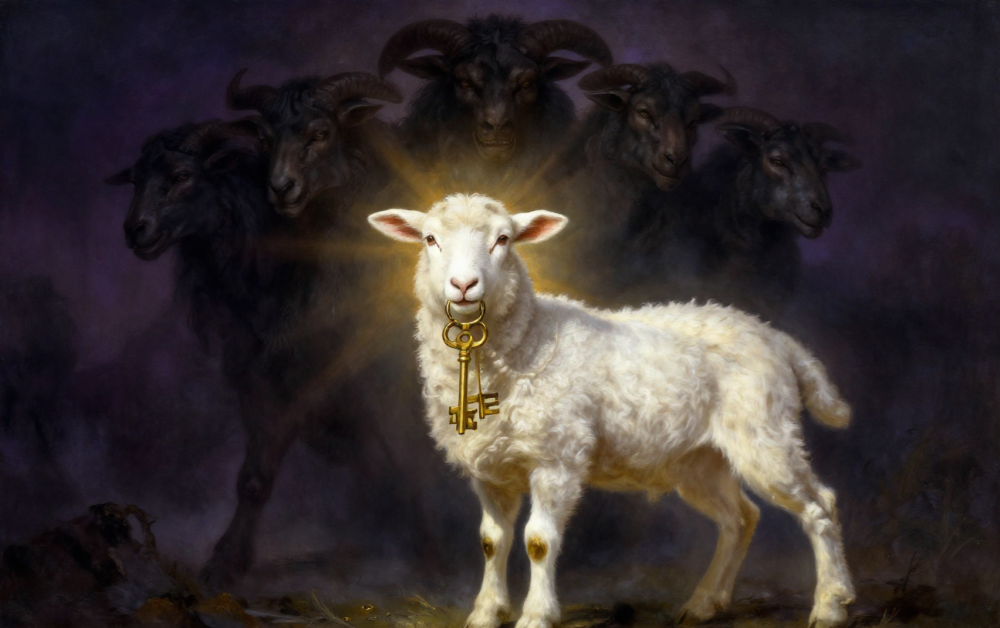
The Ancient Pattern of Power
When most readers encounter the Book of Revelation, they do one of two things. They either treat it as a coded prediction of contemporary events, a kind of encrypted newspaper from heaven, or they set it aside entirely as too strange and violent for serious reflection. Both responses miss what the text is actually doing. John of Patmos was not writing a puzzle to be decoded by people two millennia after his death. He was writing pastoral theology for people crushed by the most powerful political machine the ancient world had ever produced.
The beast of Revelation is not a single future tyrant. It is a pattern. It is the pattern of human empire at its most candid and most dangerous: power that takes rather than gives, that demands worship rather than rendering service, that devours the weak to sustain the comfort of the strong. To understand this is not to strip Revelation of its drama. It is to discover that the drama is far more urgent than any newspaper could make it.
Reading Revelation on Its Own Terms
Any responsible reading of Revelation must begin by taking seriously what scholars call its genre. The book is apocalyptic literature, a form well established in Second Temple Judaism. Apocalyptic writing uses highly stylized, symbolic imagery, drawn from the prophetic tradition of Daniel, Ezekiel, and Isaiah, to reveal the true nature of earthly realities. The point of the beast with seven heads and ten horns is not to give readers material for a timeline. Rather, it is to show what empire looks like from the perspective of those it has swallowed.
The seven heads of the beast in Revelation 17 are explicitly identified as seven hills, a reference no Roman in John’s audience would have missed. Rome, the city on seven hills, was the beast. But the text immediately complicates this identification. The heads are also seven kings, and the beast “was, and is not, and is to come.” The language mirrors the description of God as “him who is and who was and who is to come.” John draws a deliberate and audacious parallel. The beast is a dark parody of the divine. It mimics eternal power. That is precisely the point. Every empire since Rome has made the same claim.
The Seduction of the Counterfeit
Before we can understand why the beast is dangerous, we have to understand why it is attractive. And it is attractive. This is something moralistic readings of Revelation consistently miss. John does not portray the beast as obviously monstrous to those living under it. He portrays it as magnificent. The whole earth marvels at it. People ask, with what sounds like genuine awe, “Who is like the beast? Who can make war against it?” This is not the response of people who have been obviously oppressed. This is the response of people who have been genuinely impressed.
The beast does not simply offer raw power. It offers what every human heart longs for: security, order, belonging, and the sense that history is moving toward something purposeful. If you have ever felt the pull of a nation’s founding mythology, the deep comfort of “we are the good ones, the necessary ones, the ones history has appointed,” you have felt what Rome’s citizens felt. The beast offers a real, if corrupted, version of the peace that only God can give. And that is what makes it so hard to resist and so hard to see clearly.
This is where Revelation’s most theologically precise detail becomes crucial. In Revelation 13, the beast bears a fatal wound that has healed. The whole earth marvels at this. John describes a counterfeit resurrection. The beast does not merely rival God’s power. It mimics God’s story. It offers its own version of death and new life, its own version of a people rescued and given purpose, and its own version of a future worth hoping for. Idols, as the prophets knew and as Augustine would later articulate, are not arbitrary inventions. They are distortions of genuine goods. The beast is not appealing despite being false. It is appealing because it is a very good forgery.
What the Beast Actually Does
The most revealing passage for understanding the beast’s logic appears in Daniel 7, where four great beasts rise from the sea, each representing a successive empire. They are described as consuming, devouring, and trampling. The imagery is deliberately animalistic. These are not governing authorities in any ordinary sense. They are predatory forces. Daniel’s vision ends with the beasts stripped of their dominion and replaced by one “like a son of man,” a human figure who receives authority not to devour but to reign on behalf of the people.
John is reading Daniel, and he says: Rome is the latest beast in this long sequence. The sea-beast of Revelation 13 borrows characteristics from all four of Daniel’s animals. It is a composite creature because it represents not merely one empire but the logic of empire itself. But we have to press the question: why does power naturally tend in this direction? Why does it so reliably drift from serving to devouring?
The answer is anthropological before it is political. Augustine understood that disordered love, amor sui taken to its extreme, does not remain private. It organizes. It recruits. It builds institutions. Individual greed, when legitimized by law, celebrated by culture, and protected by armies, becomes something qualitatively different from mere personal selfishness. It becomes a system with its own gravity, one that pulls everything around it into its orbit and extracts value from the margins to sustain the center. What begins as a person loving themselves too much ends, across generations and aggregations, as an empire that treats the vulnerable as raw material. The beast is not an aberration of human nature. It is human nature at scale, operating without the restraint of the Lamb’s counter-logic.
The mark of the beast, worn on the right hand or the forehead, is economic. Those without it cannot buy or sell. This is not futurism. It is a precise description of how Rome worked. Its economy was built on slave labor, tribute from conquered peoples, and a patronage system that rewarded loyalty to the imperial cult. To participate in the economy was, in a very real sense, to bear the mark. To refuse was to be economically marginalized. John’s churches knew this tension intimately. And so, in different forms, do we.
“The beast wraps raw appetite in the language of civilization. It calls extraction progress, calls conquest order, calls the silencing of the weak stability.”
What makes the beast a beast rather than merely a government is its demand for worship. Rome did not simply rule. It constructed an entire theology of rule. The emperor was divine, or at least divinely appointed. The Pax Romana was a theological claim as much as a political one: the gods had sanctioned this order, blessed this expansion, and required this obedience. To question the empire was not merely sedition. It was impiety. This is why John’s vision is so theologically charged. He is not merely opposing a bad government. He is exposing a false religion, one that wears the face of order while feeding on the bodies of those it was meant to protect.
The Alternative Community
John is not writing abstract political theory. He is writing to seven specific churches, each in the shadow of imperial power and each being tempted in distinct ways. Some are tempted toward compromise, seeking to make peace with the beast’s economy by participating in trade guilds that honor other gods. Others are tempted toward despair, convinced that the beast is simply too powerful to resist. John’s vision addresses both temptations. But notice that he addresses them by first telling the truth about what the beast offers. He does not simply say “resist.” He says, in effect, “I know why it looks good. Let me show you what it actually is.”
The Lamb, standing “as if slain” at the center of the heavenly throne room, is the anti-beast. While the beast gathers power by devouring others, the Lamb exercises power by giving himself. While the beast’s counterfeit resurrection consolidates its own dominion, the Lamb’s actual resurrection opens a new creation for everyone. While the beast demands worship on pain of economic exclusion, the Lamb purchases people from every tribe, tongue, and language, not by conquest but by his blood. This is the theological heart of Revelation. The book is not primarily about the destruction of the wicked. It is about the vindication of a different kind of power, one the world’s wisdom has always regarded as weakness and always will, right up until it doesn’t.
The early Church grasped this with a clarity that is sometimes hard to recover. When Tertullian wrote that the blood of martyrs was the seed of the church, he was not making a sentimental point about courage. He was making a structural claim: the Lamb’s economy actually works, and it does so in a way the beast’s economy cannot touch or replicate. Communities organized around self-giving rather than extraction, around welcome rather than exclusion, and around the dignity of the powerless rather than the comfort of the powerful prove to be extraordinarily resilient. Rome could imprison John on Patmos. It could not imprison the vision he wrote there.
Why This Matters Now
It would be a mistake to read this piece as a critique of a single nation or political party. John’s vision is not that partisan. The beast is neither red nor blue. It is a human phenomenon, the temptation for any aggregation of power to begin serving itself rather than the people it was meant to protect. When any nation, institution, corporation, or movement begins to treat the vulnerable as raw material for its own expansion, wraps that extraction in the language of destiny, progress, or security, and demands a loyalty that crowds out every other allegiance, it bears the mark of the beast. The question John’s vision presses on every generation is not “Which empire is the beast?” but “Where does your allegiance lie?”
That question is personal before it is political. It is worth noting that the pull toward the beast’s economy is not felt only at the national level. It is felt in boardrooms and households, in the way institutions handle the people they find inconvenient, and in the way individuals build lives organized around their own security at the expense of those around them. The beast is old, but it does not operate only at scale. It begins in the disordered heart and simply finds larger and larger vessels to inhabit.
The churches John wrote to were not powerful. They were scattered, economically precarious, and politically invisible. What he gave them was not a strategy. It was a way of seeing, and, grounded in that seeing, a way of living together that embodied the Lamb’s economy rather than the beast’s. That is still the call. Not to political quietism, nor to the comfortable illusion that the right electoral outcome will solve what is ultimately a spiritual problem. The call is to the harder, longer, more particular work of building communities that demonstrate a different logic. Communities that serve rather than devour. That welcomes rather than excludes. That measures power not by what they can take but by what they can offer.
The beast is old and has worn many faces over many centuries. History is littered with empires that believed their own theology, mistook their own appetite for divine appointment, and are now dust and footnotes. The Lamb, by contrast, was slain and is alive, and holds the keys. In John’s vision, only one of those two remains standing at the end.
The city had no need of the sun or of the moon, for the glory of God illuminated it. The Lamb is its light.
– Revelation 21:23