What does it look like to create your own spiritual lexicon? Honestly, there really isn’t a straightforward answer to that. Maybe you come up with new words you feel are lacking for your experience by combining words (portmanteau words: e.g., “brunch,” “hangry,” “frenemy”) or by calling on Greek or Latin roots. Maybe you assign another word that is a near approximation, acknowledging that your personal usage of it may be more nuanced than the standard definition. Maybe you give certain emotions or ideas a descriptive title of your own making. To this last point, I tend to describe the intense lump of dread I feel in my chest when I am deeply worried about something as my “stress potato.” (3) By paying attention to this pattern of how I tend to embody that emotion, I am able to recognize much more quickly that I’ve internalized my anxiety and can take steps to alleviate or address it.
The point is to give your experiences language—something that helps make them more concrete and relatable for you. In doing so, you provide a means of containing and carrying them more neatly. Too often, our personal feelings and longings have been dismissed as unimportant or unchristian because they don’t follow the preapproved model of exactly what someone else decided was a “normal” or “acceptable” way to experience faith. Creating a personal spiritual lexicon legitimizes and validates your feelings and experiences, even if it is “just” for you.
Spiritual formation is a deeply personal process, and the way you encapsulate your experiences with God doesn’t have to resonate with anyone else; it might not even make sense to you at first. After all, do you think a burning bush and bare feet in the middle of the Moabite wilderness seemed logical to Moses at the time? Probably not. But it certainly forced him to pay attention.
Spiritual formation is the means by which we tether ourselves to God and to a broader community of faith and humanity as we make sense of life. As transcendent and mystical as these bonds may be, we need a means of defining and understanding them in order to cultivate a personal spirituality.
It’s becoming more and more popular for people to claim, “I’m spiritual but not religious”—in other words, they believe in Some-thing More but don’t necessarily agree with the more concrete rules most religions place on beliefs and behaviors. I hope that last sentence didn’t come off as judgmental because it was not intended that way. The fact is that being part of a belief system requires some boundaries around what one views as sacred as well as one’s convictions and actions—and not everyone wants to commit to that. That’s okay. Their spiritual journey is their own.
My guess is that you are looking for a spirituality that situates you somewhere between yourself a decade ago and your aunt who is part of a nudist nature coven. I mean, I’m not going to say you absolutely can’t engage in naked moon dancing, but maybe that’s not the first place we land.
But what about those who do want to be part of a church, or (perhaps more accurately) part of The Church universal? How do you rebuild a faith from the rubble of deconstruction—a faith that honors the hard, heartbreaking labor you have done without slipping back into the old scripts or traditions from which you just worked so hard to extract yourself? In short, how do you develop a faith you have chosen rather than one you have inherited?
Reconstruction is not an accidental process.
Whether we have pulled out old bricks, torn things down to the studs, or are rebuilding from the ashes, we know that nature abhors a vacuum.
Something is going to fill those gaps; are you going to choose it thoughtfully and deliberately or leave it to chance? This is an opportunity to carefully examine every bit of doctrine you allow to be a part of your reconstructed faith. This isn’t “cherry-picking”; it is holding each belief and tradition up next to the heart of God to see how it aligns and then deciding what you will do with it.
Actually, let me amend that previous sentence. It is cherry-picking in the same way that everyone cherry-picks. Every single religious group except for maybe ultra-Orthodox Jews cherry-picks. Unless you forbid the wearing of fabrics of mixed fibers (Leviticus 19:19; Deuteronomy 22:11), eating shrimp (Leviticus 11:9–12; Deuteronomy 14:9), or allowing women to wear gold, pearls, or braided hair (1 Timothy 2:9), you are cherry-picking. Even determining whether you honor the Sabbath on Saturday (like Judaism) or Sunday (like most—though not all—sects of Christianity), you are making choices about what scriptures to follow. It’s unavoidable. The real question is not whether you will cherry-pick, but which framework you will use for evaluating what elements of religious practice you will incorporate into a faith that makes you a better person in the way you love God and love your neighbor.
Language creates categories of thought that allow us to classify and order our experiences to make meaning out of them. For people emerging from deconstruction or detoxification of their faith, many of the old ideas, words, metaphors, and images of God and spirituality no longer fit. Many of the familiar, go-to concepts don’t work anymore either because they were twisted and misrepresented or because they are tied to painful feelings that stir up ugly memories of a faith that doesn’t seem consistent with the spirit of Christ. These reconstructing individuals are now faced with the daunting task of learning how to translate their engagement with and expression of faith into terms that resonate with their soul and the unique aspects of the imago Dei present in every human being. This is an opportunity to reclaim your faith by reclaiming the language of your faith—because (as we have already discussed) language can shape thought and understanding.
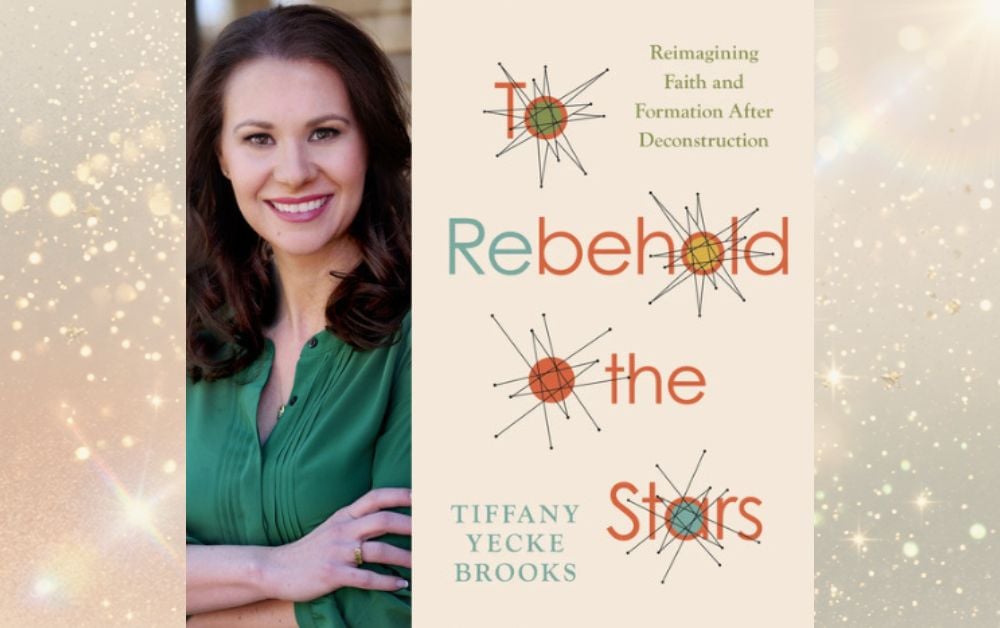
Excerpted from To Rebehold the Stars: Reimagining Faith and Formation After Deconstruction by Tiffany Yecke Brooks ©2026 (Wm. B. Eerdmans Publishing Co.). Reprinted with permission from the publisher.