I grew up in overlapping communities—a Baptist church and an evangelical Christian school—within which I was often cautioned or even commanded to stay away from “worldly” preoccupations. But I was bedazzled by the stories and poetry brought to life in motion pictures. This temptation troubled me, for I’d heard preachers say that the doors of movie houses were gateways through which the devil would lure people away from the safety of Christian community. Yet, when I slipped through those doors, I felt not lost, but found. And my faith did not falter there. It grew. I found that much of what I was being taught in church—in lessons about the brokenness of the world, the wages of sin, and redeeming grace—did in fact prove true throughout the world. And the Love that my church family sang of every Sunday, I could study it within this frame. As films flared to life above my head, I often received testimonies in vocabularies both strange and familiar, as if this were a kind of Pentecost. Compelled by a desire to live vicariously in other worlds, I’d dive through windows alive with light and shadow and gather experiential treasure I could not find anywhere else. I needed only to attend with conscience and discernment, testing all things and holding fast to what was good. (3)
I wanted to change those skeptical minds in my church sanctuary by convincing them to spend more time in the cineplex. I wanted them to come and see that we did not need this binary existence: secular/ sacred. The Way, the Truth, and the Life that they spoke of—it seemed alive and well and at play in the whole wide world. And why should this surprise them? Was it not John 3:16 that they made me memorize first? “For God so loved the world. . .” Did Jesus not have a fondness for surprising people in unexpected contexts, often unrecognized at first? At an early age, I learned to stand up in church and testify that the world was wretched and dangerous. In my naivete, I had been lost. I had been bound by a spirit of condemnation born of fears that should have no hold on the faithful. But here, in this cathedral of image and sound and surprise, of poem and story and suspenseful silences, of exuberant creativity, I came to believe ever so much more. I could sing with greater conviction,
Oh Lord, my God
When I in awesome wonder
Consider all the worlds Thy hands have made
I see the stars
I hear the rolling thunder
Thy power throughout the universe displayed,
Then sings my soul.
I was learning that no one need be lost wherever the light is at play.
“Ever since the creation of the world,” the Scriptures tell us, “God’s eternal power and divine nature, invisible though they are, have been seen and understood through the things God has made.” (4) We find eternal truths by attending to temporal specifics. But these invisible things, when apprehended, are too profound to be reduced to paraphrase. If we are to tell the Truth that we discover, we must, as Emily Dickinson taught us, “tell it slant.” (5) Narrative, poetry, visual art, music, and the suggestive language of cinema—these spoke so much more powerfully to me than dogma. They kindled in me a faith that could stay alive beyond the borders of my religious subculture. Moreover, they moved me to start loving the world, an experience that felt strangely dangerous and exciting because, quite contrary to Jesus’s teaching and example, I had been heavily indoctrinated by fellow believers against it.
But now I was learning the lesson that anyone who has tried to explain the art they love has learned: It is difficult to describe the ways in which art speaks.
3. “Test everything; hold fast to what is good.” I may have, for a period of years, included elements of 1 Thessalonians 5:21 in my passwords.
4. This is from Romans 1:20.
5. “Tell all the truth but tell it slant—(1129)” is included in Final Harvest: Emily Dickinson, edited by Thomas Johnson (Back Bay Books, 1964, pages 248–249). It’s quoted several times, like a sacred text, in this book.
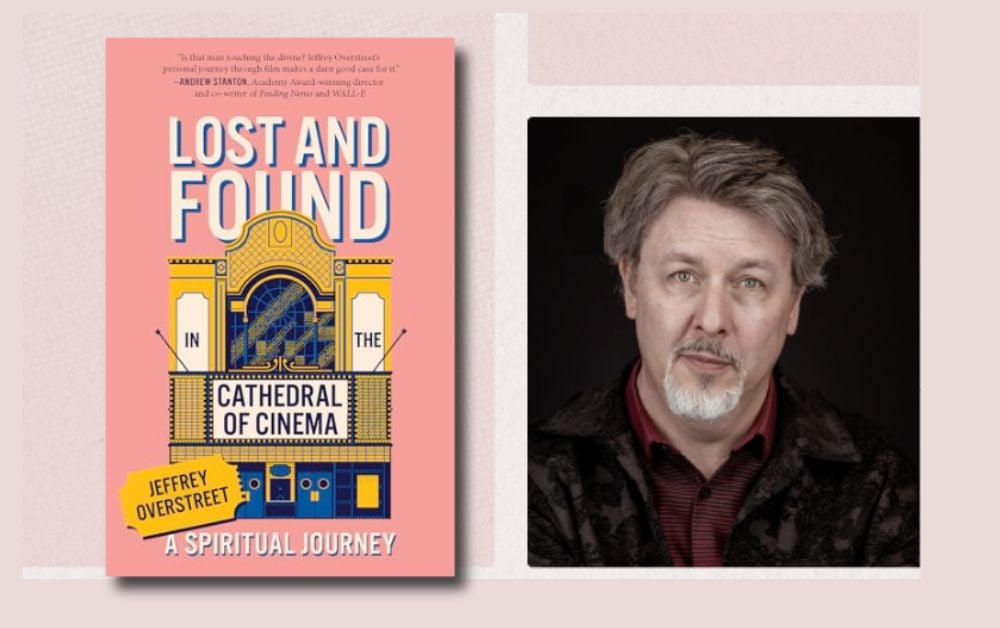
Reprinted with permission from Lost & Found in the Cathedral of Cinema: A Spiritual Journey by Jeffrey Overstreet. Copyright © 2026 Broadleaf Books.
Review from Publisher’s Weekly:
Overstreet (Through a Screen Darkly), a professor of creative writing at Seattle Pacific University, explores in this affecting memoir how movies have shaped his faith. Though he grew up in a strict Baptist church that warned against “worldly preoccupations” (cinema doors were gateways “through which the devil would lure people away from the safety of Christian communities”), he found in trips to the theater new ways of seeing the joys and brokenness of a morally complex world. Among the films discussed are Spike Lee’s Do the Right Thing, which recalls the biblical command to seek justice for the less privileged and revealed to the author how life “looked like a five-alarm fire through the eyes of a Black American artist,” and Peter Weir’s Dead Poets Society, in which the efforts of Robin Williams’s Mr. Keating to mentor his students out of “society’s narrow definition of success” and embrace art and imagination makes him an “imitation of Christ.” Overstreet’s graceful prose amplifies his resonant defense of art as a vehicle through which believers can construct a more flexible, complex, and rewarding relationship with God. Readers will be left with a richer understanding of both film and faith. Reviewed on 3/9/2026