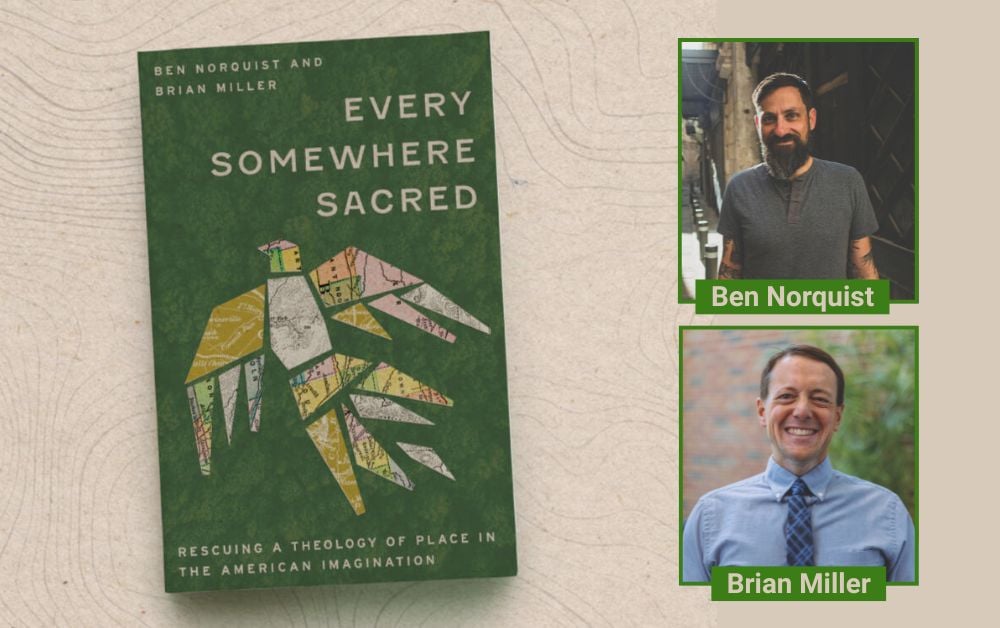
Adaptation from Every Somewhere Sacred by Ben Norquist and Brian Miller
American Christians have some uniquely American myths about land. With the historically unique relationship of Americans to land, and the particular ways groups have sought to build their place in the world to secure safety, resources, and prosperity, our myths express and respond to these histories.
Half-truth one: We are separate and distinct from the land.
This myth tells us we stand apart from creation, that we are not a constituent of the land, that we are fundamentally unlike the plants and animals through and through. Our theology tends to emphasize the special creation of humans. Theologians call this the imago Dei, the image of God in humans. God brings humans to life with his own breath—no other creature has that divine origin. But we can forget that when God made Adam, he used dirt. He reached into the earth and used what he found there to form the first human. The divine breath entered a dirt man. Though we are animated by divine breath, we are dirt people nonetheless.
We see readily that humans are a special creation. And yet, there are other ways in which we are just another part of the larger world, a creature among creatures. Land was created. Sea was created. Plants were created. Birds and fish were created. Animals were created. Humans were created. We are siblings in the family of created things, and our relationship with land should be one of kinship. Another way to put this is that Saint Francis of Assisi, thirteenth- century Italian friar, who loved animals, should be welcomed at our theological table. American Christians tend to treat Saint Francis as a story for children, not as a theologian for the church. We ask, Why should we pay attention to animals and nature when human souls need saving? Francis answers back. He says the sun, wind, and fire are our brothers; the moon, stars, water, and earth are our sisters (St. Francis of Assisi, Canticle of Brother Sun and Sister Moon).
We are members of the family of creation. Putting it another way, N. T. Wright discusses the overlap of heaven and earth rather than the separation of the two, where God is “out there” and humans are stuck in a material world. God created in the beginning with this overlap present, and the culmination of the Christian story is the full merging of heaven and earth in the new Jerusalem (N. T. Wright, Simply Christian: Why Christianity Makes Sense).
Half-truth two: We control the land, not the other way around.
Americans tame the frontier—that is one of our founding myths. That is who we perceive ourselves to be. We are intrepid. We forge a path. We civilize the wilderness. These are all expressions that make us the agents that act on the world around us, not the other way around. Our folk heroes exemplify this—Daniel Boone, Davy Crockett, Meriwether Lewis and William Clark, Laura Ingalls Wilder. Many of our founding fathers were surveyors, breaking the wilderness into units to be owned and managed by people—there are few clearer examples of human agency over the land (Andro Linklater, Measuring America: How the United States Was Shaped by the Greatest Land Sale in History).
But the world has a will and power to go with it. The world imposes lines on us too. Many aspects of places influence people. Climates and ecosystems influence the physiology of people. Prevailing cultural values in places influence people. Proximity to resources in places influences people. We think we extract from and manage places, but they also extract from and manage us (James K. A. Smith, Desiring the Kingdom: Worship, Worldview, and Cultural Formation).
Half-truth three: God has affection for people, not places.
In our well-founded belief that God loves people, it does not occur to us that God has deep affection for land and places too. But God does love places all over the world. As discussed earlier, we can go right back to the first three days of creation to see this. God repeatedly declared the light, the sky, the ocean, and the dry land good. God also made a place for Adam and Eve. Throughout the biblical narrative, God provides for the physical and spiritual needs of his people through the provision of land.
The vision the book of Revelation gives us of the end of history includes a meaningful place for place too. It gives us key hints of God’s plan for place. Indeed, in that vision, it is not only people who are resurrected from the dead; the earth itself is renewed, and this time it is forever. The new reality will include a new heaven and a new earth brought together with a city at its center. God’s redeemed creation is not an abstract, spiritual place; it is an embodied, physical reality.
Half-truth four: God’s purpose for land is for it to become property.
We approach land as if it were dead. Our default posture toward land is that it is capital, something that is owned and confers value to its owners. It can be used to generate wealth for its owners. It can be bought and sold, and its owners can put it to whatever use they see fit (relative to zoning laws). It is an investment. The land itself does not have any say in the matter. This way of approaching land reduces it to its economic functions and obscures its larger purpose in this divinely created world. It also intensifies conditions for wealth inequity because of differential access to ownership.
With land easily commodified, Americans approach places as if they were interchangeable, like components in a machine. Fully standardized, one place with given specs is as good as another with the same specs. The differences across places have been smoothed over until it does not matter where you are. It does not matter where the potato was grown. It does not matter where the beef was raised. It could all be the same.
This standardization advances in different ways. Think about chain restaurants. The difference between Hudson, Wisconsin, and Woodbury, Minnesota, is a little less pronounced with each McDonald’s, Applebee’s, and Starbucks that opens in both towns. The independent shops that are only available in one place close as the stronger chains move in. Standardization in building materials, layouts, and building techniques also seems to make space more interchangeable. The new buildings in different towns look alike (George Ritzer, The McDonaldization of Society). With increases in geographic mobility, people themselves may not be from the place where they live, certainly not to the same degree as in the past.
We seek to secure resources and safety over the resources and safety of others, and we accede to cultural mythologies that help normalize these conditions. That is why, as followers of Jesus, we need to renew our imagination and practices for the places around us.
Adapted from Every Somewhere Sacred by Ben Norquist and Brian Miller. Copyright © 2026 by Benjamin Eugene Norquist and Brian J. Miller. Used by permission of InterVarsity Press. www.ivpress.com.