When I was in my twenties, I finally acknowledged that my faith was breaking. For years, my belief in the God of the Bible and Jesus’s love had sustained me and given me purpose. It was terrifying to admit that the foundation of my life—my faith in God—was starting to crumble. But suppressing my doubts was no longer sustainable. I couldn’t pretend anymore; I let the pieces fall apart.
Surprisingly, this fracturing was not the end of the story. I had thought that rejecting the fundamentalist theology of my childhood would alienate me from Jesus forever. Instead, through the emboldening words of other Christians who had been marginalized by the power holders of religious institutions, I came to see that while my faith had shattered under the viselike grip of a very rigid version of Christianity, this was not the only way to have legitimate, authentic faith.
My newfound spiritual guides—many of whom I highlight in this book—revealed to me an expansive Christianity that is rooted in Christ’s love but allows room for mystery and lament and anger at the inequalities and suffering of this world. They showed me how to test the broken pieces of my faith against Jesus’s life and words, and to use the sound pieces to rebuild my faith with tender care. They encouraged me to free myself from fitting into a preconceived mold of a “good” Christian that didn’t account for my ancestral history, my mother tongue, or my family stories. What I thought was the death knell to my faith—this rupture—turned out to be a necessary step in the formation of something more steadfast, more nourishing, and more true.
No longer content to only hear from the Christians who had been selectively quoted by those preaching from the pulpit, I became curious to explore theology myself. I drank deeply from wells of wisdom that hadn’t been historically elevated—especially from women of faith and Christians of color—and I became intensely interested in Asian American theology. While there are many Asian American seminary professors, pastors, and leaders, a few of whom have broken into mainstream consciousness, the conversation of what constitutes Asian American theology has remained largely academic.
One night as I was reading Danté Stewart’s Shoutin’ in the Fire, a memoir about pastoring in evangelical churches where white normativity has co-opted the gospel message and reclaiming his faith and heritage by returning to his roots in the Black church, I thought, “Who is going to write this book for us?”
I desperately wanted to hear similar stories by Asian American Christians contending with theology and the church. But where were they? Certainly, I wasn’t the right person to write this book I so desired to read. I had never been to seminary nor been employed in ministry. I was a mother of three kids, a primary care physician serving Cantonese-speaking immigrants, and a hobbyist book reviewer. Yet I couldn’t shake the thought.
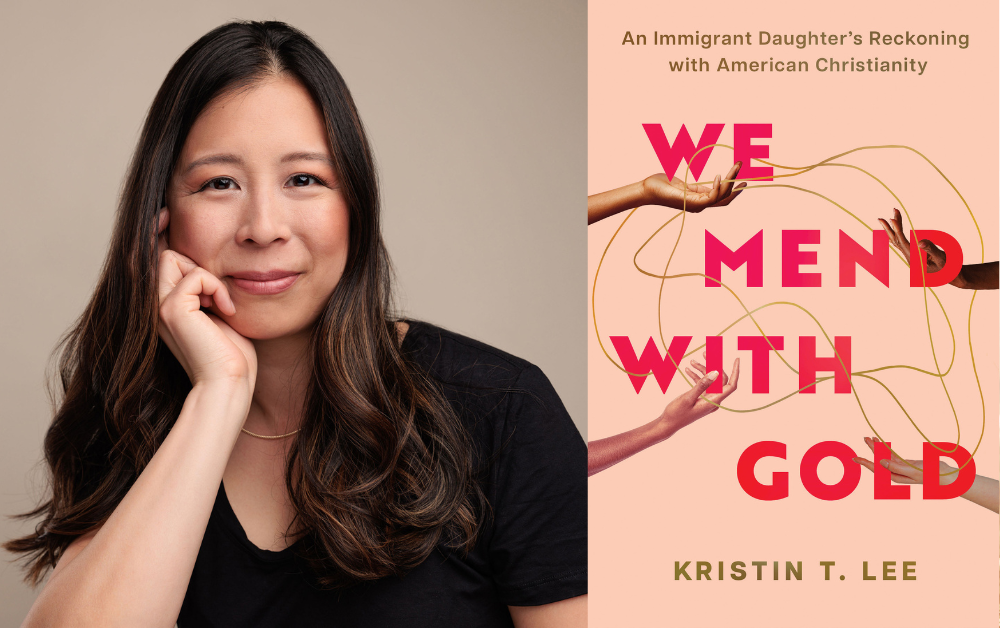
In the end, I wrote We Mend with Gold because I want to rejoice in the gifts that Asian American Christians bring. I want to start the conversation among ordinary people about what it means to be followers of Jesus and members of the Asian diaspora. I want one fewer soul to feel crushed under the weight of religious fundamentalism. I want to console the disconsolate and discomfit the comfortable. I want us to dream bigger than the American Dream.
In these pages, I draw on the Japanese art of kintsugi to illustrate the journey of faith. Kintsugi holds deep theological truths for us. It is an image through which we can bring Asian American theology to the greater church. In kintsugi, broken pottery is mended with gold lacquer. By highlighting rather than hiding fractures, kintsugi artists craft an exquisite kind of beauty. Only by acknowledging our brokenness as individuals and as a people can we repent, heal, and celebrate our humanity as well as God’s boundless love. Asian American Christians are uniquely positioned to embrace that brokenness, given the fractures in our collective and personal histories, as well as our liminal status in the United States. When we brush the golden paint of creativity, love, and liberation from conformity into the fissures, unexpected power emerges. Thus transformed, our liminality allows us to bring new theological insights to the church.
In the following chapters, I bring you through the formative spiritual experiences of my own life growing up as a second-generation Chinese American immigrant in Iowa. In pottery terms, the foundation of my faith was thrown by the Chinese immigrant church as well as by the white evangelical church, experiences that brought gifts as well as burdens. It wasn’t until adulthood that I began noticing the tendency of some Western church leaders to suppress all non white-male-dictated theology as fringe or heretical, thus cutting us off from how our own cultures and histories might inform our spirituality. It was when I began decolonizing my faith—excising the parts of Christianity informed more by Western imperialism and supremacy than by Jesus—that I was opened to experiencing the fullness of God in new ways.
While I was alarmed to let the initial mold of my faith break, it allowed for the rebirth, regeneration, and reconstruction of my faith in Jesus. I’ll introduce you to the modern prophets who gave me hope through their trailblazing examples of loving Jesus while critiquing the failings of the church, as well as to the Asian American theologians whose wisdom brings fresh insight into how we relate to God and to one another. I’ll also tell a few stories of the many Asian American Christians who are living out alternative scripts to the path of upward mobility—stories that give me courage to do likewise.
In reflecting on Asian American and Christian life, I keep coming back to family as a magnetic force, both due to how our families of origin shape us, and in how Scripture encourages us to view God’s family with more capacious and inclusive eyes. In the latter half of the book, I encourage readers to probe their family dynamics and ancestral wounds, as well as consider how we can open our homes and our lives to invite others to become family. If we follow Jesus’s radical example, we can magnify this widely practiced value of family to include those most overlooked by society, thereby manifesting God’s family here on earth. This is the beautiful result of breaking: breaking our captivity to culturally distorted theologies, breaking out of forces that pressure us to be model minorities pursuing the American Dream, and breaking the insularity of biological family. By making these necessary fractures, we open channels that can be filled with the restorative gold of Jesus’s love as we walk humbly in a mended life of faith.
Some caveats: There is no way that I can speak for the diversity of all Asian Americans, who range from Filipino Catholics to Korean Presbyterians to fifth-generation Japanese Americans. I am mindful of my very privileged social position, as well as of the tendency for East Asians to be overrepresented in conceptions of Asian America. I quote from a wide range of Asian and non-Asian writers and theologians, but this book doesn’t specifically address the biracial/mixed experience, nor the adoptee experience. I’m also cognizant of the dangers of essentialism, the practice of boiling down the heterogeneity of an ethnic or racial group into trite characteristics that rein force stereotypes. Throughout the text, I try to differentiate between shared experiences among all Asian Americans (such as migration and racialization) and my specific experiences, some of which may resonate, and some of which may not. Regardless, I hope the ideas presented here prompt you to reflect on your own spiritual journey with a new lens.
And while I’ve written this book specifically for Asian Americans, whether identifying as Christian or not (because we deserve books written just for us!), I’m thrilled when others enter into this space, too. It means a lot that you’re here. I hope you will get as much out of these pages as I did when I listened in on other Christians of color preaching to their own. We need each other.
This book is an invitation. Some of you may have never interacted with Asian American theology before, while others of you have made it your life’s work. I’m inviting you to join me in listening to the Spirit, reconnecting with our variegated histories, sharing in our common struggles, and imagining what Asian American theology—a relatively nascent field—might offer the world. We shape the lived theology of Asian Americans by the very choices we make in our lives: a privilege and a responsibility.
I hope this book makes you rejoice in our rich history. I hope you experience a deep sense of your own belovedness, acceptance, and belonging in God’s family as well as a renewed appreciation of the freedom we have in Christ. I hope it gives you greater purpose and connection to the invigorating diversity and dynamism of Asian American Christianity.
In We Measure the Earth with Our Bodies, Tsering Yangzom Lama writes, “This may be how we survive. Collecting the shards of ourselves and offering them with honesty to someone else.”
Here are my fractured pieces. Let’s mend together.
Reprinted with permission from We Mend with Gold: An Immigrant Daughter’s Reckoning with American Christianity by Kristin T. Lee. Copyright © 2026 Broadleaf Books.