
When I was growing up, I remember a widespread lament of restaurant waitstaff; they dreaded the Sunday “after-church” rush. The churchgoers were not only hard to please; they were notoriously bad tippers. In fact, some didn’t tip at all; instead, they left what was called a tract – a small booklet that told a person how to be “saved”, how to avoid the fires of hell, or some other teaching of the Christian church at the time.
One such tract I am familiar with used a train illustration to tell people how to live. The engine of the train represented facts (as in facts from the Bible, (sola Scriptura) and not those from psychology or science)– they were to lead the way – the engine of our life. The next car was faith in those facts, and the caboose of the train symbolized feelings – they were only acceptable as long as facts and faith came first.
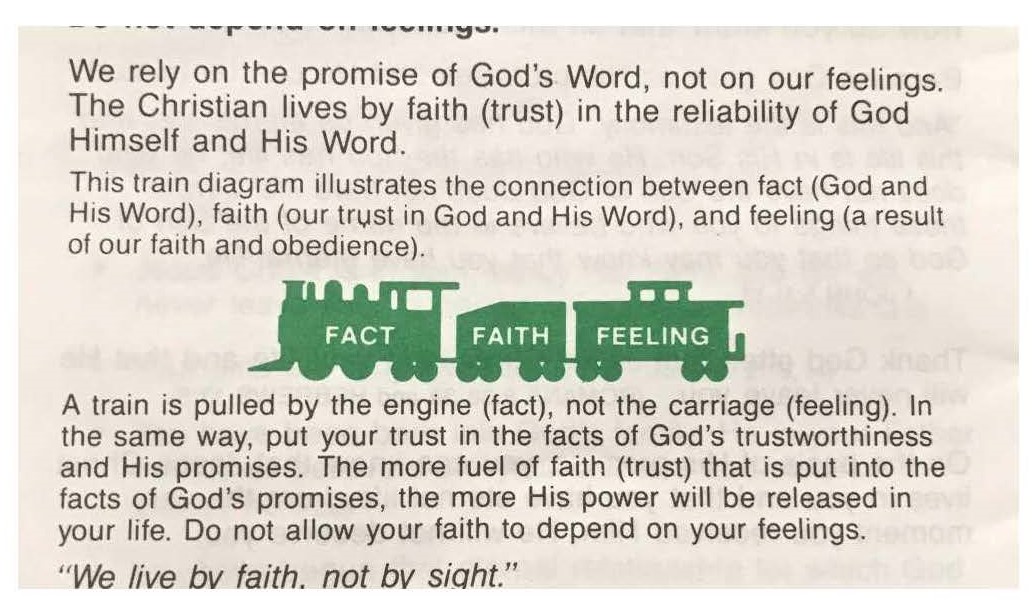
This kind of hierarchy defined how I lived and made decisions. It dictated what was acceptable and what was not. Emotions were almost always viewed with suspicion; often dismissed completely.
I believe this booklet and similar teachings of the time have conditioned Christians to become some of the most gullible people in the world.
I cannot help but wonder if we so readily believe the lies we are fed because we live from an incomplete or disconnected self that has refused to listen to our emotional intelligence. According to the American Psychological Association, this refers to “a type of intelligence that involves the ability to process emotional information and use it in reasoning and other cognitive activities”. (1) The aforementioned train tract discouraged this part of our intelligence.
*****************************************************************
Looking at the news, people’s reactions online, and the things we post, it’s clear Christians in the west are susceptible to all sorts of conspiracies and strange beliefs.
I am embarrassed by that – I don’t want to be counted as one of them. I would like to break my familial relationship with most believers. It is distressing to see what the church and her people have become when I look at Western Christianity – particularly evangelicalism in America that is married to a nationalist agenda.
Jesus knew the kind of world we would face. In Matthew 10:16, he says, “See, I am sending you out like sheep into the midst of wolves; so be wise as serpents and innocent as doves.”
We have missed the wise part.
Devotion to traditional beliefs has kept Christians from critically considering what they believe and why. We are too apt to follow whoever is leading, not trusting our own minds to discern truth. Comedian Emily Catalano says the worst sin according to Christians is critical thinking – seems uncomfortably close to the truth. The majority of white evangelicals have unquestionably aligned with Donald Trump (80%) and are fooled by a photo op with a Bible in hand and convinced he was saved from a bullet as proof of God’s favor. Typically, the same people hold unscientific and harmful beliefs around Covid, vaccines, climate change, LGBTQ+ issues, reproductive rights, support for Israel, and end-times theology. Western Christians believe they are being persecuted.
The past number of years have revealed evangelicals’ fanatical support of Donald Trump. Here is a leader, who stands against the virtues that have long been the measure of a life of faith. Many believe that he is God’s chosen one for such a time as this. It is a complete disconnect to think that the God who came to us in weakness and a giving away of power would align with a power-grabbing and immoral narcissist.
American Evangelicals are susceptible to the lure of power, the promotion of their idea of morality, and the desire for a king. During the days of Samuel the prophet, the ancient people of God, also wanted a king. These words of God to Samuel tell us what was really going on, “they have not rejected you, but they have rejected me from being king over them” (1 Sam. 8:7). When Christians are dependent on a political ruler to advance their way of life, they have rejected God as their leader. It certainly appears that Christian nationalists have placed their trust in their chosen one rather than the One chosen before time.
Close to forty percent of evangelicals believe that we are currently living in the end of times, with most convinced this end will occur within the next 20 years. (2) The end times theology that has permeated most of western Christianity is harmful and has no basis in Scripture. While living with our end in mind is a great practice if it helps us live more faithfully to the teachings of Jesus, it can lead us into a form of fatalism and apathy. This belief gives rise to anti-climate change beliefs and behaviors, a lack of concern for injustice, as well as cementing support for Israel. Many evangelicals believe that modern Israel is directly tied to the return of Christ and therefore, will deny atrocities they commit in order to preserve this notion. The recent war with Iran is being celebrated among evangelical Christians as a way to hasten the return of Christ.
Perhaps the most striking example of the gullibility of American Christians is their persecution complex. There is a willingness to attribute evil intent to anyone challenging their way of life. The civic laws which seek to ensure equality for all are viewed as a direct attack on believers.
The recent killing of Charlie Kirk stoked this persecution complex. He became a martyr to many, a symbol of the dangers of speaking publicly about faith. While we cannot know the heart condition of Mr. Kirk, his words and actions spoke hatred to the marginalized.
Persecution throughout the history of the church is widely documented. From the early church to the present day, Christians have been beaten, tortured, imprisoned, and executed. Churches have been destroyed and believers forced to abandon their homes. To assert that American Christians face persecution reveals a lack of understanding of our history and what oppression truly looks like.
Christian Nationalists’ quest to make Trump their leader and form a strictly Christian nation has put them in the position to persecute. They first laid the groundwork — restricting what people could read, mandating Chrisitan views be taught to all students regardless of beliefs, removing reproductive rights, actively passing laws to silence and contain LGBTQ+ folks, and spreading a campaign of othering. Now they are rounding up immigrants they have labeled criminals and bombing another country calling it “holy war”.
These Christians look more like the persecutors rather than the persecuted.
We need to stop and consider what has caused Western Christians to adopt views that are vastly different from the rest of the world. Why are we more gullible to conspiracy theories and unconditional support of a leader who is the antithesis of who Jesus is?
There are a host of reasons that might explain the Christian’s lack of discernment. One that I see missing from our conversations on this is our history of dismissing our emotions.
*****************************************************************
I was an emotional child. I would often get so excited about Christmas, that I would be physically sick on Christmas eve. I remember being told to not get so excited, then I wouldn’t get sick and I wouldn’t be disappointed. It was a small thing perhaps– this encouragement to shut down my emotions– but when layered with teachings from my evangelical upbringing it became cemented.
In church and at home we received a steady diet of teachings such as Jeremiah 17:9 says, “The human heart is the most deceitful of all things, and desperately wicked. Who really knows how bad it is?” (NLT) In a recent Instagram Post, Tyler Hill asserted this was the verse “that made an entire generation stop trusting themselves.” We also lived in an environment that was practically gnostic – where the spiritual is divorced from, and considered higher in value, than the physical. We have been taught not to trust ourselves – this is particularly true for women within a hierarchical system.
While I think the original intent of the train tract mentioned earlier was to encourage us not to depend on feelings as assurance that we are loved and forgiven, the message many of us received was that emotions were not to be trusted. Perhaps even that emotions had little to do with the life of faith and should be pushed aside rather than attended to.
Our emotions are part of what is true about us. They are God-given important cues to understanding ourselves and the world around us. When we shut down emotions, we deny the wisdom of our bodies. Emotions offer key information about our values, motivation, needs, and boundaries. To shut them off impedes our ability to discern fully.
The numerous stories of grooming and abuse in churches depended on the victim and those around to ignore bodily cues– the unsettled feelings, the doubts, the shame. We have been trained to disregard our gut feelings.
When our anger tries to tell us that a boundary has been crossed or a core value of ours has been trampled and we ignore it, we start to become estranged from our values. We easily become “tossed back and forth by the waves and blown here and there by every wind of teaching and by the cunning and craftiness of people in their deceitful scheming.” (3) We believe the lies those with power are telling.
Many of us have been taught to slap a platitude bandage on our difficult emotions. We “preach to ourselves” the words of the Bible to effectively gaslight ourselves to avoid discomfort.
We may have internalized an unspoken message that to feel despair, anger, disappointment, dissatisfaction, or doubt is a bad advertisement for God. We are required to hold up the image of a victorious, joy-filled Christian rather than an honest one.
Once, when I critiqued an event that felt heavy handed, manipulative, and coercive, I was told I was the voice of the evil one – the enemy within the body. This made me question whether I was merely cynical rather than discerning. When our moments of discernment are reframed as harmful or evil rather than wise and instructive, we begin to doubt ourselves and remain quiet.
Discernment relies on hearing from the heart, head, body, and spirit. Our decisions need to incorporate the physiological, emotional, and cognitive parts of the self. When all are involved, we can make decisions based on the whole self, rather than a fractured or incomplete self.
In the gospels we see how Jesus did not override his emotions. In the story of the raising of Lazarus, Jesus knew he would bring him back to life, yet he still felt and expressed his deep grief. He entered into mourning with Mary and Martha and all who had gathered. He could have bypassed his emotions. By choosing to be fully human, he gives us permission to do so as well.
Our ability to parse out truth from lies, to judge wisely and objectively depends on engaging the whole self. When we shut out our emotions from the decision-making process our ability to discern is weakened. Prominent journalist, author, and podcaster Ezra Klein says that feelings are our “first antennae” (4), the initial inklings of what is happening. When backed up by physiological and intellectual resonance, they become an important part of the discernment equation.
Studies on “decision-making have classically focused exclusively on its cognitive component. Recent research has shown that a further essential component of decisional processes is the emotional one. Indeed, the emotional route in decision-making plays a crucial role, especially in situations characterized by ambiguity, uncertainty, and risk.” (5) As we seek to decide who and what to believe, our emotions need to be part of the framework.
Further studies on patients whose emotional center had been damaged have proved that without emotions, a person had “no way to gauge what was important and what wasn’t, what mattered and what didn’t.” (6) In other words, discernment was no longer possible.
In this time of great division in our society and in our churches, we need wisdom more than ever. Our call is to remain open and awake to our own inner knowing from each of the centers of intelligence we have been gifted with. To pay attention to what our mind is telling us, what our emotions reveal, and what the sensations in our body might disclose.
(1) https://dictionary.apa.org/emotional-intelligence
(2) https://www.pewresearch.org/religion/2022/11/17/how-religion-intersects-with-americans-views-on-the-environment/
(3) Eph. 4:14
(4) https://www.nytimes.com/2025/10/03/opinion/ezra-klein-podcast-brian-eno.html?unlocked_article_code=1.N1A.qza2.1ISQr9kznHLO&smid=nytcore-ios-share
(5) https://pmc.ncbi.nlm.nih.gov/articles/PMC11274958/
(6) L. Cron, Wired for Story, Ten Speed Press, 2012, pg. 45-46