We all know people who have lived through the worst this life has to offer, who have witnessed the shield crack in two as tragedy marched in, who pleaded all night for rescue only to have the dawn break on their nightmares come true. In our own lives and in each day’s headlines, we have to acknowledge that the knight in shining armor doesn’t always appear to slay our dragons. This life is hard. We live in the tension between acute suffering and God’s promises of protection. In these fault lines, we can find wisdom in the voices of the seemingly overlooked, the ones who didn’t experience deliverance right away, from those who tore their clothing and covered themselves with ashes. We turn to the voices of those in exile.
If ever there were people who knew the sting of a yet-unfulfilled promise, it was the Israelites who were taken captive and brought to Babylon. The Message version of these verses in Lamentations captures their despair well:
All the people groaned, so desperate for food, so desperate to stay alive that they bartered their favorite things for a bit of breakfast. . . . And you passersby, look at me! Have you ever seen anything like this? Ever seen pain like my pain? . . . For all this I weep, weep buckets of tears, and not a soul within miles around cares for my soul. My children are wasted, my enemy got his way. Zion reached out for help, but no one helped. . . . My eyes are blind with tears, my stomach in a knot. My insides have turned to jelly over my people’s fate. (1:11–12, 16–17; 2:11)
These were a people who knew the despair of lost hope, which is perhaps why the prophet Isaiah didn’t only offer them the image of God as a warrior who “will come in fire . . . his chariots in a whirlwind” (Isa. 66:15). Because they were still waiting, because the warrior hadn’t yet come, Isaiah, in the same breath he used to speak of a battle-ready God, gave them a picture of a mother who was right there with them in their pain: “As a mother comforts her child, so I will comfort you” (Isa. 66:13).
These side-byside depictions of the nature of God tell us that there is more to God than the role of a protector who flings open the door and fills the dungeon with flaming light after having vanquished our captors. God is also there in the darkness with us, while we wait. In Psalm 23:4, we read, “Even though I walk through the darkest valley, I fear no evil, for you are with me.” The protection offered is God’s very presence, and it is a protection by preservation.
The Jewish concept of Shekhinah stems from the Hebrew root “to dwell.” In simplest terms, Shekhinah means divine presence; it shares a linguistic root with mishkan, the Hebrew word for tabernacle, the dwelling place of God. While the word doesn’t show up in the Torah (the first five books of the Bible), the concept does, and the term is often referenced in the Mishnah and Talmud, which are ancient and sacred Jewish texts that include the Torah as well as centuries’ worth of rabbinical interpretations and applications.
In one section of the Mishnah, we read that “if two sit together and there are words of Torah [spoken] between them, then the Shekhinah abides among them,” which may correspond to the promise of Jesus in Matthew 18:20: “For where two or three are gathered in my name, I am there among them.” And within the Talmud, we read that in every place that the Israelites were exiled—in Egypt and Babylon—the Divine Presence (Shekhinah) was there with them. This withness assured the exiles that in the future God would not simply bring the people back or cause the people to return, but he instead would “return together with them from the various exiles” (emphasis added). One interpretation of this segment reads this way: “The image of God coming back with us, alongside us, conveys a different kind of power. I cannot pretend to understand this power fully, but I understand the Rabbis to be teaching us that this power is rooted in connectedness, in being with the outcast, dwelling inside the ‘not yet.’”
The idea of “a different kind of power” illustrates the contrasting yet congruent images of God in Isaiah—warrior and mother—and speaks to a wider Jewish value of balance, like we find in Micah 6:8 when we are commanded to simultaneously practice justice and love mercy. While the early rabbis never explicitly correlated Shekhinah and mother, Jews have long appealed to the forgiving and gentle nature of God with the phrase chen v’chesed v’rachamim; this phrase is a theologically potent part of Jewish liturgy that broadly means the grace, the loving-kindness, and the womb-born rakhum compassion of God. Later, as Kabbalah Judaism emerged, it would directly compare Shekhinah to a bride, sister, daughter, and mother, viewing Shekhinah as one of the feminine characteristics or expressions of God that balances out more masculine aspects.
The Israelites, living in exile, longed for the fierce, masculine protection of a warrior to deliver them out of the oppression of the Babylonian empire. But what they had was the comforting, maternal protection of Shekhinah delivering them through, there with them in the dark, preserving them. In including images of a laboring, comforting mother in his messages to the Israelites, it’s almost as if Isaiah knew that the familiar high and lofty images of a transcendent God sitting on a holy throne was out of tune with a deeply wounded people who were experiencing horror, destruction, and death down in the dirt. They needed God with them in the pain; they needed Shekhinah.
I think most of us can relate to these tandem views of God’s power and protection in our own experience of being parented. Growing up, my dad worked long tenhour days doing construction and had the muscles to show for it. He had these big, strong arms that I knew were ready and willing to snap in half anyone who tried to hurt me. At night, I would lie in bed with my literaturefueled imagination running wild and my blankets tucked up to my chin in defense of closet monsters and the intruders I was certain I could hear outside my window. At those moments, I would picture my dad’s strong frame at the front door, blocking the way of anyone who intended us harm. The protection he offered was powerful—as strong and reliable as his calloused hands.
But the protection my mom offered stemmed from “a different kind of power”: a power born not of rescue but of preservation. The protection she offered me was the space and time to feel the full weight of my sadness, to cry and lament, and to be held. What she provided for me in my darkest valleys was her presence, her comfort, and sometimes her own shared tears. It was a protection born out of compassion and empathy rather than muscles and armor. And it was a protection that safeguarded the very core of who I was, because I knew that even within grief and rage, abandonment and heartbreak, despair and dejection, I was loved, and that I wasn’t alone.
When we reduce protection to only a male-driven warrior version of rescue and deliverance, we miss out on the maternal face of God in exile; we miss out on the preservation of our humanity that God-with-us, ever-present divine love, provides.
Shekhinah—the maternal, Divine Presence—is right beside us on the nights when we plead and sob for deliverance. Shekhinah holds us when we cry silent tears of exhaustion. Shekhinah mothers us in both small and significant ways as we walk through the valleys, shadows lurking all around us. Shekhinah protects and preserves us while we wait. Shekhinah reminds us that we are cared for and loved, even when hope is thin and despair creeps over us, because God’s presence, like a mother, is there with us.
In 1931, twin sisters Nellie and Wlodka Blit were born in Warsaw, Poland. Their mother was a scientist, and both parents were political activists. So when Hitler invaded Poland in 1939, the girls were sent to live with relatives while their parents fled with targets on their backs. But in a recorded interview from 1984, Nellie recalled how, after just a few months, their mother came back, unable to be away from her children any longer. She detailed the risk her mother took in returning and working at a kitchen to feed starving children from the Jewish ghetto; she recalled how German soldiers would throw stones at her mother on the street.
The girls continued living with their aunt and uncle as a protective measure, and they missed their mother terribly. Nellie reminisced about how they would wait by the window of the house, hoping to catch a glimpse of their mother as she walked to the soup kitchen. Every single day, she recalled, their mother would risk her own safety to walk by the house so her daughters could see her. Nellie reflected on these daily glimpses of her mother, “When my mother came back . . . we felt much more secure and happy.”
Presence matters.
Presence is love.
Presence is preservation.
And God is present with us, Shekhinah dwelling in and among us during our darkest days, protecting and preserving the core of who we are, like a mother.
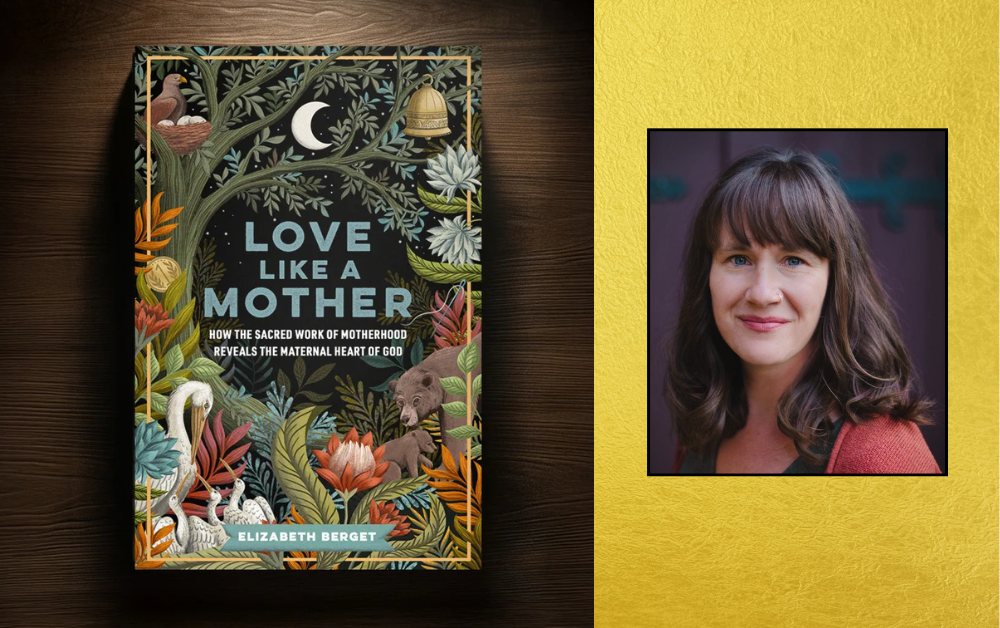
Content taken from Love Like a Mother by Elizabeth Berget ©2026. Used by permission of Brazos Press, a division of Baker Publishing Group.