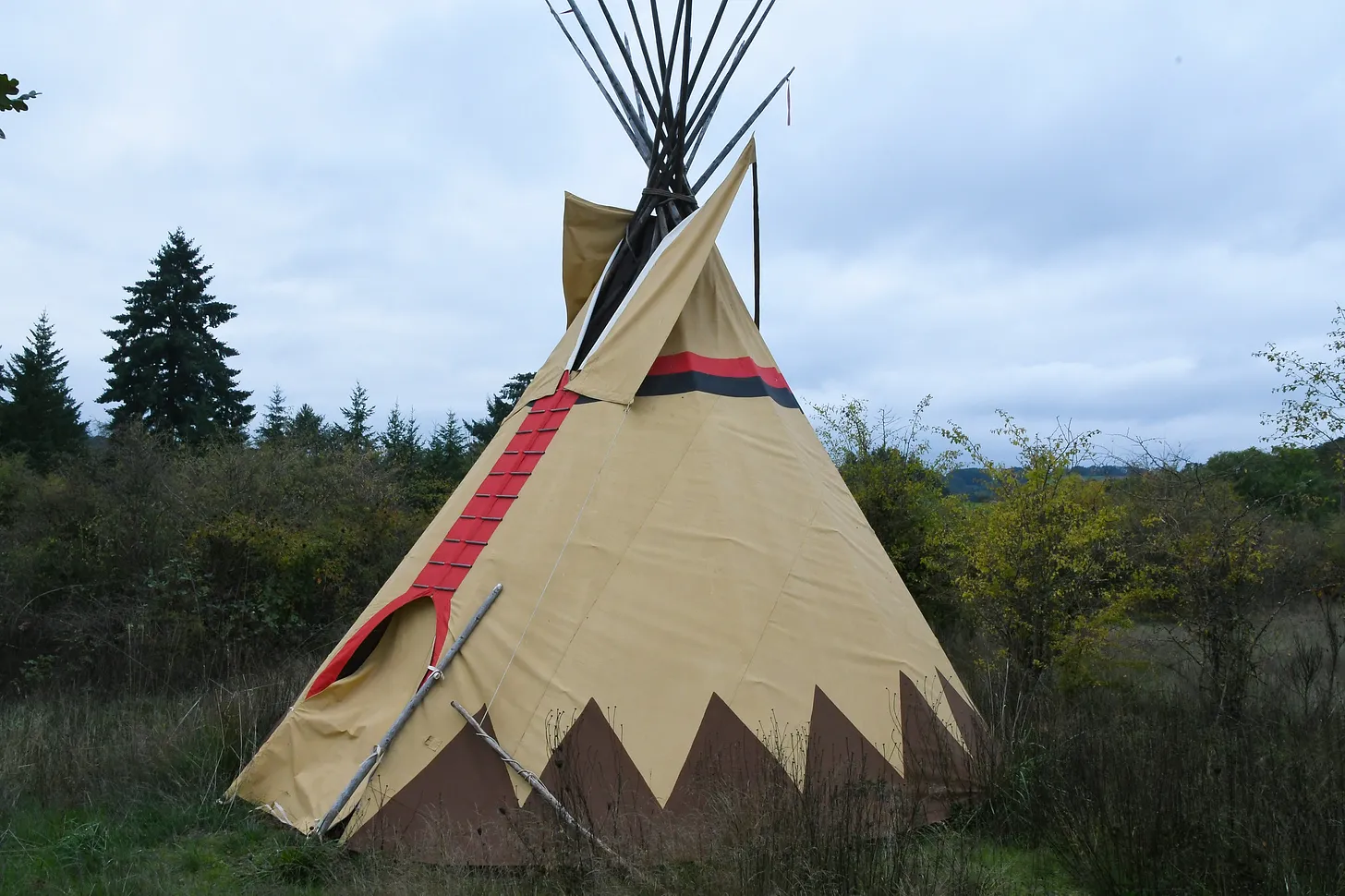
Editor’s Note: Previously published on Randy Woodley’s Substack on Jul 29, 2025. Photo: Tipi at Eloheh. Photo by Jim Sequeira.
Our Indigenous ancestors had a saying that roughly translates to “the time of choosing has come upon us.” Standing here in 2025, watching our democracy strain under the weight of authoritarian impulses and systemic injustice, I find myself returning to that ancient wisdom. Some of my friends are declaring it is war time—that we need, metaphorically speaking, military-style strategies with air support, ground troops, and coordinated campaigns. They’re not wrong about needing multiple approaches. But I want to suggest something different: it’s time for peace. It’s time for the kind of peace-making our Indigenous ancestors perfected over millennia. Not the passive kind that rolls over for oppression, but the active, strategic, sometimes confrontational peace that creates genuine harmony through justice.
You see, there’s a fundamental misunderstanding about Indigenous peace-making in America. The Hollywood version—and frankly, the history textbook version—painted our ancestors as either noble pacifists who got steamrolled into colonization or bloodthirsty savages who couldn’t be reasoned with. Both myths serve the same purpose: they obscure the sophisticated peace-making technologies that Indigenous peoples developed across this continent for thousands of years. These weren’t just feel-good ceremonies. They were practical, effective strategies for resolving conflict, redistributing power, and creating lasting harmony in diverse communities.
The Real History of Indigenous Peace-Making
The truth is that our ancestors were remarkably successful at peace. When Europeans first arrived, they encountered societies that had figured out how to live in relative harmony across vast trade networks spanning the continent. From the Haudenosaunee Confederacy in the Northeast to the complex diplomatic relationships between Southwestern pueblos, Indigenous peoples had developed what we might call “conflict transformation technologies” that made sustainable peace possible even among groups with different languages, customs, and interests.
Take the Cheyenne Peace Chiefs, for example. According to the teachings of Sweet Medicine, all forty-four Cheyenne chiefs had to be Peace Chiefs whose primary responsibility was keeping harmony and finding alternatives to war. These weren’t ceremonial positions—these men had real power and were held to extraordinary standards. If someone killed a Peace Chief’s son right in front of his lodge, the chief was expected to take out his pipe, smoke, and seek peaceful resolution rather than revenge. That’s not weakness; that’s strength beyond what most of us can imagine.
The Haudenosaunee had their Condolence Ceremony, still practiced today, that could transform grief and rage into renewed relationship. Among the Cherokee people they say was an annual Cementation Ceremony where anyone with a grievance was required to participate in a process that involved not just words of forgiveness, but practical restitution—stripping naked, exchanging clothes, sharing a feast sponsored by both sides. The ceremony ended with a vow never to bring up the offense again. Both symbolic and intensely practical.
Peace Through Creative Conflict
But here’s what’s crucial for our current moment: Indigenous peace-making wasn’t passive. It often involved what we might call “creative conflict.” When injustice existed, peace couldn’t be restored by ignoring it or papering over it with nice words. True harmony—what we call the Harmony Way and what Hebrew scripture calls shalom—sometimes requires dismantling the structures that prevent justice.
Among some tribes, it was the women’s councils who made the final decisions about going to war, because they had the most to lose. Imagine if we applied that principle today—if the people who would bear the real costs of conflict, rather than those who profit from it, made the decisions about when violence was necessary. Among many Eastern tribes, there were alternatives to war like stickball—”little brother to war”—where conflicts could be resolved through ritualized competition that honored the warrior spirit without the devastating costs of actual warfare.
The adoption ceremonies were perhaps the most sophisticated peace technology of all. Rather than simply ending conflicts, tribes would adopt members from rival groups, creating kinship bonds that made future warfare nearly impossible. You don’t attack a village where your relatives live. This wasn’t just about individuals—entire diplomatic networks were created through these adoption processes, weaving together diverse peoples into relationships of mutual obligation and care.
Strategies for Our Current Moment
Now, some folks might hear this and think I’m advocating for some kind of kumbaya approach to fascism. That’s not what I’m saying. What I’m suggesting is that our ancestors understood something modern Americans have forgotten: sustainable peace requires justice, and justice requires strategic disruption of unjust systems.
When I look at the current political moment—the assault on voting rights, the attacks on Indigenous sovereignty, the systematic dismantling of environmental protections, the weaponization of Christianity to justify oppression, the treatment of immigrants—I see the same imperial mindset that our ancestors faced for centuries. The same worldview that sees competition as the fundamental organizing principle of life, that believes some people are naturally superior to others, that treats the earth as a collection of resources to be extracted rather than a living system to be honored.
The good news is that people are already applying Indigenous-inspired strategies in modern forms. The economic boycotts against corporations that profit from oppression echo our ancestors’ understanding that cutting off trade relationships could force behavior change. When a people refused to trade with groups that violated agreements, it often brought them back to the negotiation table faster than warfare ever could.
The sanctuary state and city movements mirror our traditional practices of providing safe haven for those fleeing violence or persecution. Our ancestors understood that sometimes the most powerful act of resistance is simply refusing to participate in another’s oppression—creating spaces where different rules apply, where humanity is honored over imperial law.
The strategic protests and civil disobedience we’re seeing today follow the same logic as our “little brother to war” strategies—they create ritualized conflict that honors the warrior spirit while avoiding the devastating costs of actual violence. When thousands gather to protect water protectors at Standing Rock, or when communities organize to prevent ICE raids, they’re using the same principles our ancestors used: collective action, strategic disruption, and the power of putting bodies on the line for justice.
But our ancestors didn’t just survive this assault; they developed strategies that sometimes even turned colonizers into allies. Not by being passive, but by demonstrating alternative ways of organizing society that were so obviously superior that even some Europeans abandoned their “civilized” world to join Indigenous communities. Benjamin Franklin himself noted that many white captives chose to stay with their Indigenous communities when given the chance to return, while the reverse was almost never true.
Re-mythologizing and Relationship Building
The key was what I call the “re-mythologizing” strategy. Our ancestors understood that worldviews have power, and that changing how people understand reality is often more effective than trying to force behavioral change through violence. They created alternative narratives, demonstrated different possibilities, and invited transformation rather than demanding it.
This is what we need now. Not just resistance, but the demonstration of alternatives. Not just protests, but the creation of communities that embody the values we claim to believe in. Not just opposition to harmful policies, but the patient work of building relationships across difference that make new policies possible.
The hospitality traditions of Indigenous peoples weren’t just about being nice to strangers. They were strategic peace-building technologies. When you welcome someone into your family, feed them at your table, create bonds of obligation and care, you make it much harder for them to see you as an enemy. This doesn’t mean being naive about people who profit from injustice. It means being strategic about creating conditions where justice becomes possible.
I think about my own experience being adopted into multiple Indigenous families over the years. Each adoption created not just personal relationships, but networks of accountability and mutual aid that cross tribal boundaries. This is the kind of relationship-building that makes sustainable political change possible.
The tribes had a practice of sending family members to live with other tribes, specifically to prevent conflicts. When your relatives live in multiple communities, you have a vested interest in everyone’s wellbeing. We need to be thinking about how to create these kinds of cross-cutting loyalties in our current context—relationships that transcend party lines, racial boundaries, and economic classes.
The Time of Choosing
This doesn’t mean compromising with fascism or pretending that “both sides” are equally valid. It means being strategic about how we build power for justice. It means understanding that lasting change happens through relationship, not just through policy battles. More than anything though, it means getting our hands dirty by actively participating is some way, shape or form.
Our ancestors knew something that modern Americans have forgotten: peace is not the absence of conflict, but the presence of justice. And sometimes, creating justice requires stirring up the kind of creative conflict that makes transformation possible. Not the destructive violence that perpetuates cycles of harm, but the kind of strategic disruption that opens up space for new possibilities.
The time of choosing has indeed come upon us. We can choose the ways of imperial violence, where might makes right and the powerful prey on the vulnerable. Or we can choose the ancient ways of our ancestors, who understood that true strength lies not in the ability to dominate others, but in the ability to create conditions where everyone can thrive.
This is what time it is: time to remember who we really are, and what we’re really capable of when we organize our lives around the principle that all beings are related, that the earth is sacred, and that true security comes not from building walls but from building relationships of justice and mutual care.
The strategies are ancient. The need is urgent. The choice is ours.