When the floor fell out from underneath our Family, I found myself left in the lurch by folks who’d told me they’d stick by me. I found myself waiting for visits or phone calls from people I’d hoped would check on me. I found myself humiliated by things I heard said about me by people I thought had room for my shortcomings. The loss and absence of those connections ushered me into the darkest and deepest Low of my life. It was as if someone dropped a Wile E. Coyote–sized anvil through the floor of my soul’s architecture and the whole house fell in.
In the halfdrunken two-ish years of that Low, I learned a few things.
First, I realized there really are systems and forces working to keep me disconnected. That was what my pastoral training friend was pointing out—not that people are intrinsically awful, but that we are often unknowingly complicit in systems that work against our best interests. Every system is self-interested. Every. Single. One. And we set a terrible trap for ourselves when we ignore that truth by offering the best of ourselves to plans, schemes, and systems that are not held by the calloused, wounded hands of the betrayed and crucified Christ.
Second, I learned just how vital those loving relationships are and how hungrily my soul pursues them. When I lost the church community that I’d considered Family, I lost the ability to see myself clearly as well as the ability to recognize God. I didn’t just feel lonely; I felt abandoned. Scott often says that a relationship with another human being is an invitation to see God. When those people were gone from my life, it was less of a social bummer and more of a full-blown existential crisis. I am now radically aware of the way my God connection is tied to my people connection.
More than anything else, I learned that what happened to me in the past isn’t just part of my past; it’s part of who I am now, and it changes how I connect with the world around me. That knowledge has reframed the way I understand woundedness. Being wounded is not just an unfortunate experience, like stepping on a piece of broken glass I might have avoided had I just been paying attention. Disappointment and injury are unavoidable and integral aspects of healthy human connection.
You and I
are going to be hurt
by other people.
You and I
are going to hurt
other people.
All of this
is part of what it means
to be whole, together.
One of the gifts of true friendship is the oddly sacred opportunity to act out of our worst selves, hurt one another, and then find out we are still loved. And not loved despite our dark side but loved in a way that includes the lower and lesser aspects of ourselves. We don’t get to have healthy connections without hurt. We don’t get to become the best, fullest “version” of ourselves without injury. We don’t get new life without death.
It is entirely understandable for us to want to avoid interpersonal pain. But avoiding pain is often one of the reasons we avoid relationships in general, and that leaves us lonely.
During the Low that followed the disintegration of my church Family, I actively sought to fill the empty space in me with alcohol. But contrary to the two-dimensional narratives of film and television, I didn’t drink to avoid my feelings; I drank in order to feel. I wanted permission to be sad and very, very angry. Alcohol provided a shadow of the gracious permission true friendship offers, a warm welcome to whatever was going on in me. But I’m not designed to offer my feelings and thoughts in isolation and certainly not while intoxicated. I sought the feeling of connection while avoiding the people my soul wanted to connect with. The fear of being hurt kept me from connecting, leaving me lonely. I eventually tired of emoting by myself and admitted how badly I needed other voices. Sober ones. Kind ones. Forgiving ones.
A year and a half into the hardest season I’ve lived thus far, I looked up long enough to notice the few folks who had stuck by me. It was a short list, Beloved, made up of people I did not expect. I’d hurt some of them. And some of them had hurt me. Yet, there we were, saying “I’m still here. I choose you.” After the proverbial dust settled, the social space around me was far emptier than it had ever been. And in that emptier space, I found people who had been disappointed and injured by me and were willing to call me “friend.” I found people who had injured me whom I sincerely wanted to reconnect with.
All of which reminded me of the warning I’d received in pastoral training, “Do not expect to make a lot of friends; you will end up hurt.” What the trainer said ended up being true, in a way. I had been hurt. I’d also hurt people. And none of us have ever been the same. But he was wrong to suggest that not getting hurt was a worthy goal. The good and bad that happen between us are both part of who we are in the same way the scars on Jesus’s hands, feet, sides, and back are part of who Jesus is; in fact, those scars were how his closest friends recognized him in his newness.
May it be so
with you and me
that what happened to us in the past
finds a home
in the expansive, rich soil
of our becoming.
Let’s pray.
Welcome, welcome, welcome.
I welcome everything that comes to me today, because I know it’s for my healing.
I welcome all thoughts, feelings, emotions, persons, situations, and conditions.
I let go of my desire for power and control.
I let go of my desire for affection, esteem, approval, and pleasure.
I let go of my desire for survival and security.
I let go of my desire to change any situation, condition, person or myself.
I open to the love and presence of God and God’s action within.
Amen.
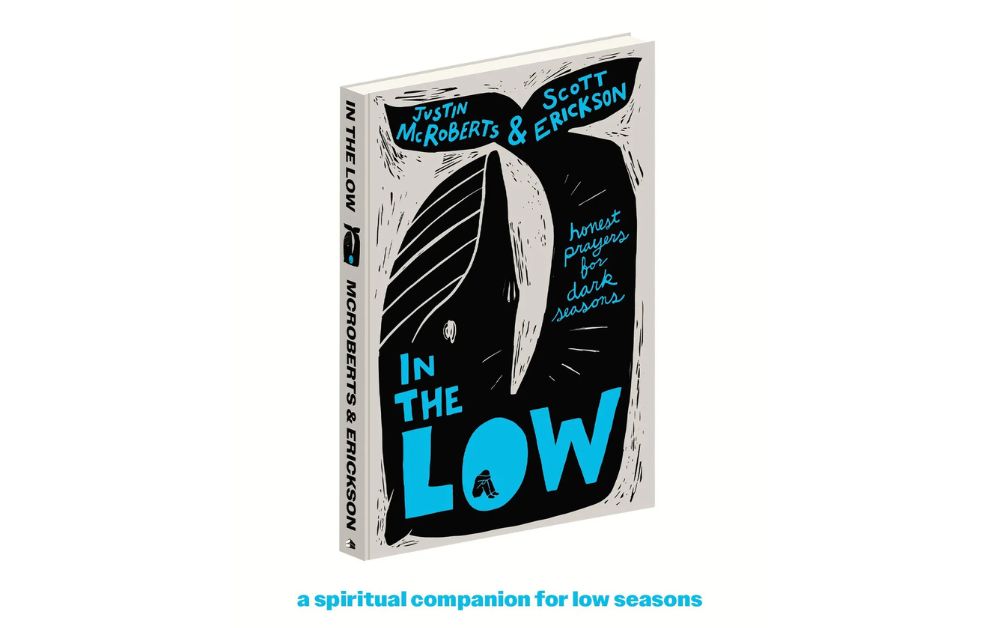
Content taken from In the Low by Justin McRoberts and Scott Erickson, ©2025. Used by permission of Brazos Press.