Editor’s Note: First published on Public Theology with Zach W. Lambert on September 9, 2025.
When it comes to Jesus’ table, there has long been debate about who is invited and who is not. Candidly, it’s baffling to me that this is still being argued about when Jesus explicitly settled it during his time on earth; he spoke to this very subject throughout his public ministry.
Here is one of many examples, this one from the book of Luke:
Later, as Jesus left the town, he saw a tax collector named Levi sitting at his tax collector’s booth. “Follow me and be my disciple,” Jesus said to him. So Levi got up, left everything, and followed him.
Later, Levi held a banquet in his home with Jesus as the guest of honor. Many of Levi’s fellow tax collectors and other guests also ate with them. But the Pharisees and their teachers of religious law complained bitterly to Jesus’ disciples, “Why do you eat and drink with such scum?” Luke 5:27-30
Scum is a pretty harsh thing to call someone, right? Other Bible translations say “tax collectors and sinners,” but I think “scum” gets us to the point a little quicker. “Tax collectors and sinners” was a broad category used to group together anyone deemed unworthy of something called table fellowship.
Why was Jesus’ choice of company such a big deal to the religious leaders?
In our Western culture our first thought in eating is to satisfy hunger. There may be other reasons we eat, but essentially we eat together because it is meal time, and we are hungry. In the countries of the Middle East eating was (and still is) a relational event. One ate bread to declare, establish, nurture, and seal a covenant relationship. To eat with someone was called ‘table fellowship’ and meant that the persons eating at the table now stood in covenant solidarity with each other. – Malcolm Smith
So in the story, Jesus finds himself at Levi’s house sharing a table with those broadly considered unworthy of it. According to the religious leaders and the culture at large, these folks were unclean, unacceptable, and undeserving. But Jesus didn’t see them that way. So when they asked why he was eating with “such scum” Jesus replied:
“Healthy people don’t need a doctor—sick people do. I have come to call not those who think they are righteous, but those who know they are sinners and need to repent.” – Luke 5:31-32
Jesus tells the religious leaders, “You guys think that you’re righteous, but you’re not. Y’all think you have it all together, but you don’t. Everybody needs the forgiveness, love, and life that I’m offering. The only difference between you and these people you consider unworthy is that they know it and you don’t.”
I love this story because it’s like the religious leaders assume Jesus must not know what he’s doing. He must be so ignorant or so backwoods that he just kind of stumbled into this dinner party with these sinners and tax collectors and he needs help finding his way out. But that couldn’t be further from the truth.
For Jesus to eat with tax collectors was not a social blunder done in ignorance; it was not a political gaffe of a newcomer to religious politics. He ate with them intentionally in a deliberate public act, sending a clear message that He knew could not be misunderstood by anyone. He was announcing that He was the friend of tax collectors and sinners. – Malcolm Smith
Jesus was declaring, establishing, nurturing, and sealing a covenant relationship with some of the most marginalized people in their world, and it was a really big deal. R.T. France calls it “the scandal of Jesus’ disreputable entourage.” By eating with these folks who were considered “unclean,” Jesus is violating centuries of tradition and breaking Jewish purity laws.
In Contagious Holiness, New Testament scholar Dr. Craig Blomberg surveys how table fellowship was viewed throughout the Old Testament, Greco-Roman culture, and Jewish religious law. The Old Testament clearly encourages sharing meals with friends, but warns people to avoid eating with their enemies. This same idea is also found in extra-biblical sources from the Ancient Near East.
Eating with the right people brings blessing, but eating with the wrong people brings a curse. Dr. Blomberg compares this understanding of “table fellowship” to how Jesus used the table during his ministry on earth.
Jesus uses table fellowship as the setting for redrawing the religious boundaries of his world. Jesus thus behaves toward these outsiders, these unclean, contemptible persons of ignoble status, as though they were acceptable, as though they were his own kin. As he does so, many of them choose to follow him and indeed become kin, as new members in Christ’s spiritual family. – Craig Blomberg
In other words, Jesus not only defied religious laws and cultural norms when he welcomed sinners to his table, he actually flipped the old way of doing things completely upside down. The upside down kingdom, as we often call it. Jesus explains this in detail in the very next verse as the exchange between him and the religious leaders continues.
They said to him, “John the Baptist’s disciples fast and pray regularly, and so do the disciples of the Pharisees. Why are your disciples always eating and drinking?” Jesus responded, “Do wedding guests fast while celebrating with the groom? Of course not. But someday the groom will be taken away from them, and then they will fast.”
Then Jesus gave them this illustration: “No one tears a piece of cloth from a new garment and uses it to patch an old garment. For then the new garment would be ruined, and the new patch wouldn’t even match the old garment. And no one puts new wine into old wineskins. For the new wine would burst the wineskins, spilling the wine and ruining the skins. New wine must be stored in new wineskins.”
– Luke 5:33-38
Jesus wasn’t just pushing back on the old way of doing things, he was creating something completely new.
Trying to take the new and combine it with the old wasn’t going to work. So many religious leaders, then and now, don’t realize that the table doesn’t belong to them. It doesn’t belong to any of us. We don’t get to decide who is allowed to have a seat and who isn’t. The table belongs to Jesus and he has made it abundantly clear who gets to sit with him— absolutely anyone who wants to.
And Jesus didn’t just trade one exclusionary stand for another. This is what we often do. When we feel excluded, we have a tendency to exclude the excluders right back. We build our own table, tell anyone we don’t like that they can’t sit with us, and pretend like it’s justice.
But this is not the way of Jesus. He doesn’t trade one exclusive table for another. He created the very first truly inclusive table of all— a place where prostitutes and tax collectors sit next to Pharisees and priests, a place where he calls everyone to set aside their biases, take up their crosses, and follow him.
Thankfully, this dinner party at Levi’s house wasn’t a one and done event. Jesus partied with these kinds of folks so much that the religious elites accused him of being “a glutton and a drunkard.”1 This phrase doesn’t really mean much to us, but it had incredible significance for the Jewish people. Listen to this law from the Old Testament:
If someone has a stubborn and rebellious son who does not obey his father and mother and will not listen to them when they discipline him, his father and mother shall take hold of him and bring him to the elders at the gate of his town.
They shall say to the elders, “This son of ours is stubborn and rebellious. He will not obey us. He is a glutton and a drunkard.” Then all the men of his town are to stone him to death. You must purge the evil from among you. – Deuteronomy 21:18-21
The religious elite were very purposefully using this language for Jesus. They called him a “glutton and a drunkard” to insinuate that he was a rebellious son worthy of death, all because he opened up his table to everyone. This is still happening today.
But the threat of death and even death itself couldn’t stop Jesus from making sure that everyone had a seat as his table, even the religious leaders who didn’t want to sit amongst the “scum.”
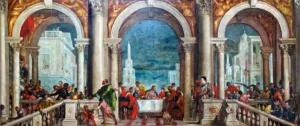
This truth was immortalized in 1573 by a Venetian painter named Paolo Veronese. Veronese was commissioned to paint a mural of the Last Supper for the convent of San Giovanni Basilica in Venice, Italy. In an effort to make it one of the largest paintings of its kind, Veronese was given a canvas that was eighteen and a half feet tall by forty three feet wide.
Veronese took several months to paint the mural and returned with a larger than life depiction of Jesus in his final days. If you know much about the Last Supper or have seen one of the countless pieces of art depicting that moment, you probably noticed that there are a few more people than usual in this picture. In addition to Jesus and the apostles, Veronese decided to include people of all kinds: jesters, servants, royalty, children, and even animals. Outcast and noblemen alike made it in.
It’s important to note that, following the Reformation in 1517, the Catholic Church began something called the Counter-Reformation which sought to root out and punish anything deemed outside of Catholicism within the Catholic Church. Veronese’s painting fell into that category. So, shortly after the picture was completed, he was summoned to appear before a Roman Catholic Tribunal to defend himself against charges of heresy. This was a really big deal, because this Tribunal had been given the power to exercise all forms of punishment, including the death penalty.
The entire transcript of Paolo Veronese’s trial can be found online, but here’s my favorite part:
Roman Catholic Tribunal: “What is the subject of the picture you are speaking of?”
Veronese: “It is a painting of the Last Supper, with Jesus Christ with his Apostles in the house of Simon.”
Tribunal: “Who do you believe was at the Last Supper?”
Veronese: “Christ was there with his Apostles. But there was more space, so I included other figures that I created.”
Amazingly, though this Tribunal has the power to sentence him to death, Veronese doesn’t back down. Instead, he tells these religious leaders turned tribunal, “There was extra room at Jesus’ table, so I included more people.”
The Tribunal decided to give Veronese three months to remove the extra guests from his painting. Guess who he decided to remove? No one. Not one single person. Not even the animals. In fact, he didn’t change anything at all about the painting. Instead, he simply changed the name of it from “The Last Supper” to “The Feast at the House of Levi.” Frustrated, but unable to press the matter any further, the Tribunal dropped the charges. Today, Paolo’s incredibly painting hangs in a Venice museum for all to see.
I so desperately want to live my life like Paolo Veronese. No matter what anyone says and regardless of what the consequences may be, I’m going to keep welcoming anyone and everyone to Jesus’ table. Here’s what Veronese understood that the Tribunal didn’t: Jesus’ table was always open to anyone and everyone who wanted to sit with him. If there was extra space at the table, Jesus was going to invite more people to join in. Since there was extra space in the painting, Veronese metaphorically invited more people to sit with Jesus.
And here’s what the tax collectors and sinners understood that the religious leaders didn’t: its Jesus’ table, not ours. We don’t police it, we don’t control it, and we don’t regulate it.
It is Jesus’ table. Our only job is to make sure anyone who wants a seat finds one.
Jesus has made it abundantly clear: his table is a place for everyone. There is a seat with my name on it and there’s one with yours, too. There’s even a seat with the name of the person you think is least deserving to sit there.
What a relief that we are not in charge of who comes and goes. Our lives are simply meant to pull out a chair to anyone who wants it and say, “Come, there’s room for everyone,” just as Jesus did.