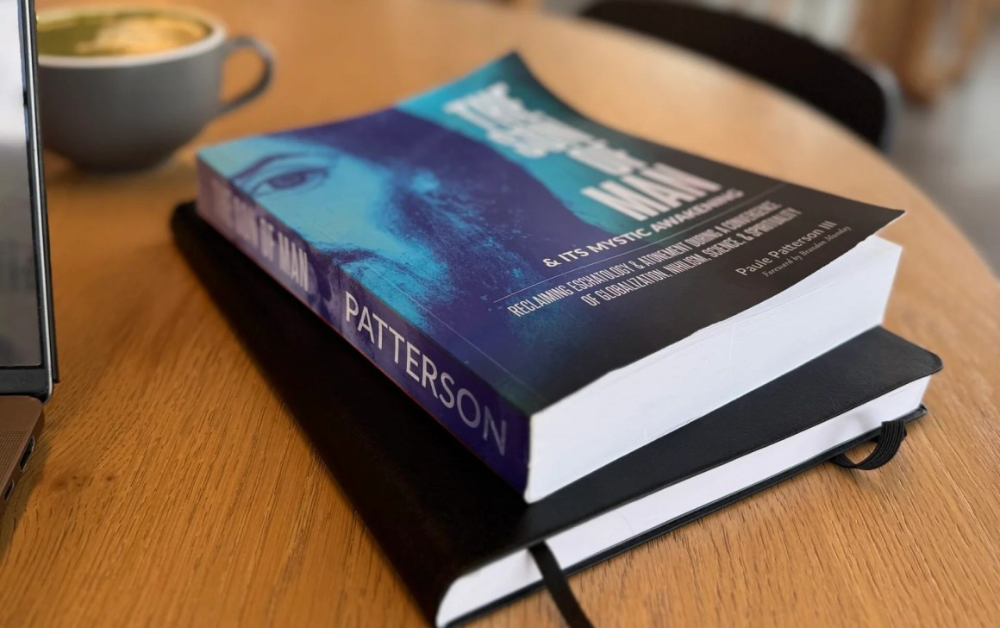
The following excerpt is adapted from the book, The Son of Man & Its Mystic Awakening: Reclaiming Eschatology & Atonement During A Convergence of Globalization, Nihilism, Science, and Spirituality, copyright 2025 by Paule Patterson III. Reprinted here with permission.
This shift isn’t theoretical; it’s deeply practical. In psychology, ego fragmentation underlies anxiety, projection, and maladaptive behavior. In social work, resistance to healing often stems from over-identification with old narratives and roles. In leadership, the inability to self-regulate or see beyond one’s perspective creates organizational toxicity. Leadership and Self-Deception names it: living “in the box” is justification-based blindness.
And in business, flow theory (Csikszentmihalyi) suggests we enter optimal states not through control, but through surrender, losing self-consciousness to gain creative attunement. Philosophically, the problem of the modern subject is not simply moral but perceptual. It’s not that we’re bad, it’s that we’re miswired. Reducing left-hemisphere dominance isn’t about denying logic. It’s about getting out of our own way so Reality can breathe through.
Recent research into psychedelic substances such as psilocybin, DMT, mescaline, and LSD provides additional insights into the mechanisms of consciousness expansion. Neuroimaging studies show that these compounds create a state of hyperconnectivity in the brain, temporarily dissolving rigid neural pathways and allowing for an experience of unity and radical perspective shifts. Many participants in psychedelic research studies describe encounters that echo mystical and eschatological visions, suggesting that the brain possesses the latent potential for transcendent experience when freed from its habitual constraints.
It’s worth noting that William James, a pioneer in the study of religious experience, also explored the potential of altered states of consciousness to provide insights into the nature of reality. These experiences, while not without potential risks, highlight the brain’s capacity for non-ordinary modes of perception.
Nirvana, Holy Spirit, & the Right Brain
Empirical research into the neural basis of mystical experience reveals that the subjective states often described as enlightenment, salvation, or inner peace have measurable correlates in brain function. In My Stroke of Insight, Dr. Jill Bolte Taylor describes how her left hemisphere stroke temporarily disrupted her language and analytic processing, leaving her with an experience that many have likened to a “mystical” state—a direct encounter with a form of oneness and timelessness. Although her account is anecdotal, it aligns with findings from meditation research showing that certain nonverbal, holistic states can emerge when the usual patterns of cognitive processing are altered.
Neuroimaging studies of long-term meditators have found that deep contemplative practices are accompanied by altered activity in brain regions involved in self-referential processing. For example, reduced activation in parts of the parietal cortex, which contribute to the perception of individual boundaries, has been associated with the experience of “self-transcendence.” This suggests that when the brain’s usual analytic processes are not dominating, the more integrative, spatial, and affective functions (commonly ascribed to right-hemisphere systems) can contribute to a reconfigured sense of self. Such findings do not imply a simple “switch” between hemispheres but rather a complex rebalancing among various neural circuits, including the prefrontal cortex, limbic system, and subcortical structures.
Return to the Brain of Eden contributes to this dialogue by reviewing research on the evolutionary development of brain function. Although the authors propose a theory linking diet to changes in neural integration, the empirical work cited—such as studies on nonverbal processing and spatial awareness—indicates that the right hemisphere plays a central role in constructing a holistic perception of the world. Research on split-brain patients, for instance, has demonstrated that while the left hemisphere handles language and sequential processing, the right hemisphere excels in processing visual, spatial, and nonverbal emotional information. This evidence underscores that mystical experiences, often characterized by a loss of strict self-boundaries and a heightened sense of connection, are likely rooted in the capacity of right-hemisphere networks to integrate diverse sensory and emotional inputs.
Furthermore, contemporary studies in neurotheology (the relationship between brain and religion) suggest that the experiential qualities of mystical states, such as the “absence of chatter” or a reduction in internal verbalization, may allow for a direct, unfiltered perception of one’s surroundings. Rather than being relegated solely to the realm of afterlife promises or doctrinal symbolism, these states emerge as part of a measurable, neurobiologically based process. In the context of spiritual transformation, practices like contemplative prayer and meditation may facilitate a temporary recalibration of these neural systems, providing a window into a mode of consciousness that is both deeply personal and universally resonant.
In sum, while the debate about hemispheric dominance remains complex, the converging evidence from clinical observation, neuroimaging, and cognitive neuroscience suggests that the right hemisphere’s contribution to holistic, nonverbal, and integrative processing is a key piece of the puzzle. This research invites us to rethink traditional boundaries between scientific inquiry and spiritual experience—and to recognize that the profound states of inner peace and unity described in mystical literature have a tangible basis in our brain’s structure and function.
The paradox of modern mysticism exists at the intersection of subjective encounter and objective reality—not just a feeling or a theological abstraction, but a lived epistemology that science is finally bringing into view. Sarah Coakley writes, “The mystic’s apophatic silence isn’t a negation of reason. It’s a radical expansion of its domain.”
Stories dramatize this better than theorizing ever could. Harry Potter’s King’s Cross scene in Deathly Hallows is a case in point. After Harry uses the Resurrection Stone, drops his wand, and faces Voldemort’s Killing Curse, he collapses into darkness. When he returns to consciousness, he finds himself naked on a floor surrounded by bright white mist that resolves into what looks like King’s Cross station except empty, silent, and weightless. A small, wounded, childlike creature whimpers under a bench. Harry instinctively wants to help but hesitates, disgusted and unsure.
Then Dumbledore appears and sits beside him. He tells Harry that the creature is a fragment of Voldemort’s soul borne inside him as a Horcrux and that Voldemort’s curse destroyed it. Dumbledore says, “Of course it is happening inside your head, Harry—but why on earth should that mean it is not real?” Harry asks whether he truly died and wonders if life is over. Dumbledore replies, “I think not.” He explains that by willingly sacrificing himself, Harry performed an act of love that echoed his mother’s protective power. Voldemort’s use of Harry’s blood tethered Harry to life, even while Voldemort remained alive. Harry’s subsequent choice—to board a train or return—shows integration of meaning over doctrine. He chooses love and service. When he wakes, he brings more than survival: He brings peace. It’s a resurrection of perception and understanding.