To paraphrase Voltaire’s famous saying about God, if fathers did not exist, it would be necessary to invent them. And if the fathers who do exist do not father us—if our dads don’t dad—we might make someone who will. That’s what I was doing with Papa Friend. He was not just an imaginary being. He was a prototype, a first model of the many father figures I would go on to create.
All my life, I have been a maker of father figures. I’ve met men at church and school and work, friends of friends, guys who attend the same professional conferences. I’ve admired them, felt drawn to them. I’ve wanted them in my life. I’ve struck up friendships that became mentorships that have a chance to become something deeper—a relationship with a man who could be there, always there.
We don’t tend to think of father figures this way, as things we make. We tend to think of them as things that already exist in the world. They are archetypes created by artists—King Lear, Atticus Finch, Marlin the clownfish. They are images in our life’s landscape—coaches, teachers, bosses, elders. Father figures don’t have to recognize us or even know us. They are publicly available representations of ideal dads. We obtain their benefit from afar.
But in my experience, father figures are also an active pursuit. They are a noun that is also a verb: You father figure people, collecting the wisdom and ways of being that your child self still needs. Do you do it on purpose? Are you even aware? Not necessarily. Father figures can be made by a reflexive act of our hearts, as involuntary as a yawn. Before we know we’ve done it, we’ve shaped our images of the people we know into the dads we need them to be.
When you father figure someone you know, you hope it’s reciprocal—that this guy will see the child in you just as you see the dad in him. Some of the men I’ll mention in what follows surely saw themselves as mentors, ministers, big-brother types who were down to teach me a thing or two. But for me, they were more. In my imaginative heart, I figured them as father and me as child, wishing to be raised in the way I should go. A wandering pilgrim, I wanted to be led, but I also wanted to be nurtured. I wanted to be known in the way a father knows his child.
It has taken me an embarrassing number of hours to summon up the nerve to write the last few paragraphs. Putting his out there feels risky. Sure, young boys and men looking up to older men is the most normal thing in the world. But that doesn’t make it easy to talk about the longing. I take pride in being transparent with my closest friends, but very few of them have ever heard the story of Papa Friend. I don’t talk about my lifelong, profligate father-figuring.
But I’m shaking off the sense of shame, because shame doesn’t tell us the truth. There is nothing wrong—or even weird—about trying to fill our dad-sized gaps. We can hardly do otherwise. We are baby sea turtles making our way to the water. We don’t know why we’re doing it. We’re just being, and being requires certain things of us. One thing being requires is fathering.
I mean this in the least patriarchal way possible.
The evolutionary anthropologist Anna Machin of Oxford University argues that the phenomenon of fathering as we know it is rooted in our very DNA. In The Life of Dad: The Making of the Modern Father (Simon & Schuster, 2018), she lays out a story of human fatherhood that begins over five hundred thousand years ago, well before Homo sapiens even existed. One of our ape ancestors, the Homo heidelbergensis, became the first primate to feature what Machin calls “investing fathers”—dads who stuck around. Most male primates, she jokes, screw and flew, like in most other species. But males in Homo heidelbergensis families got involved in the care and feeding of their offspring.
Why did this happen? Evolutionarily speaking, it had to—the survival of the species depended on it. Babies like us are born, says Machin, with “the helplessness of a puppy but the open eyes and ears of a chimp.” We’re a lot to handle—“ dependent, immobile, energy-hungry.” If babies like this were going to survive against the odds, primate moms needed primate dads to stay close and do things for the kids—make and control fire, hunt for high-protein sources of food, co-operate with others . . . and teach their kids to do the same.
Machin’s research also shows that fatherhood is about more than mere survival. It’s about flourishing. Multiple studies indicate that the extended presence of fathers is associated with all sorts of positive outcomes. Infants breastfeed better and gain weight more regularly when fathers are around. With invested dads, babies are more likely to form proper emotional bonds. Then, they’re more likely to pursue advanced education, find stable jobs, and experience mental wellness.
It can be hard to talk about these things without sounding like a family values scold. Fatherless families and bad-father families are as common as can be. The United States—ground zero of family values sloganeering—has more single-parent households than any country in the world. Here, one in four children are growing up in a one-parent household, the vast majority of which—80 percent—are led by mothers. Those numbers do not even include families like the one I grew up in, where the dad is home but might as well be gone—too addicted, addled, or otherwise checked out to do any decent fathering.
Families can rise above all kinds of fatherlessness in all kinds of ways. Mothers can be more than strong enough to do the raising, should they have to go it alone. Mine was, and you’ll soon see her strength overtake these pages, just as it overtook my life. Her mom was more than strong enough too—Mom’s dad died when she was five years old, leaving behind a young wife with four kids ages six and under. She had to go it alone too.
Other relatives may also step up to do the raising— grandparents, aunts and uncles, even siblings take up fathering slack. My sister sure did. Born five years before me, Kaysie had it worse than I did, as firstborns often do in dysfunctional families. But for her brother’s sake, Kaysie met the challenge of her ass of a dad. Dad would start to teach me something but lack the patience or sobriety to stick it out. Kaysie kept coming up from behind to finish the job. She was the one who taught me to climb those trees I got into with Papa Friend. She was the one who taught me to ride a bicycle. All my childhood memories of wrestling and tug-of-warring and tossing around balls are with her. She taught me to read. She taught me to write by hand. When I turned fifteen, she was the one who got me behind the wheel of a car. Later, she taught me to drive a stick.
With a sister like that, who needs a dad?
Apparently, we all do. I’ve tried—lordy, I’ve tried—to deny it. For years, I whistled my way through the father void in my life. But it’s high time I admit that there’s no ignoring it. Like it or not, the loss, absence, or negligence of a father cannot help but leave an impact. It is a wound that nature will try to heal. And by “nature,” I mean our nature, our own raw material.
If we haven’t had proper fathering, we’re going to go looking for it. We’re going to seek repair. And we can repair—fatherlessness is not an injury that puts us out of commission. It’s just a wound we have to treat.
We have to make some Papa Friends.
The Years the Locusts Ate
Mom believed in God for many things. Material things— debts cleared, groceries to fill the pantry, new shoes and jackets just in time for the school year. Abstract things—that he was present, he loved her, and he was watching over her children and grandchildren. However dire our straits, Mom chose to believe that better days were coming. “We are hard-pressed on every side, yet not crushed,” it says in 2 Corinthians 4:8–9, a passage she marked on repeat over the years with underlines and circles and check marks, plus one red ink smudge bearing the mark of a teardrop. “We are perplexed, yet not in despair; persecuted, but not forsaken; struck down, but not destroyed.”
The older I got, the more I pressed her on this belief. How do you know? What makes you think that’s even possible, given all you’ve gone through? How much longer do we need to put up with this man in our lives?
“The Lord will return to me the years that the locusts have eaten,” she told me.
She got the phrase from the last few verses of Joel 2.
It comes at the close of a fever-pitched passage of prophecy describing a dreadful, backbreaking “day of the Lord”—heaven and earth trembling, God’s army consuming the land. But all of a sudden, as if in a fit of holy whimsy, the Lord’s vengeance flips to mercy: “Who knows? He may turn and relent and leave behind a blessing.” Israel repents with all their hearts, and the winter turns to spring—rain falls, pastures spring up, fruit trees bend with bounty. God clears his own debts with his chosen people: “I will repay you for the years the locusts have eaten . . . my great army that I sent among you.”
The passage contains a terrible recognition: The locusts are from God too. So what can you do to make the locusts go away? Is repentance the only available pesticide? And what if you’ve already been repenting for some time? Can you make a move? Or can you only wait on the Lord to move things for you? How do you know when he is going to turn and relent?
In Mom’s Bible, Joel 2 bursts with the ink of several pens—red, black, blue, purple. The marks span decades, as early as 1979 and running through 2017. The margins around the passage bear lengthy notes: “God gave this promise to me many years ago—and recently,” says one. “Thank you, Father God! You have dealt wondrously with me all my life!” says another.
Two of the specific dates in these margins are familiar to me.
January 2007—she must have marked it on the morning she finally found the resolution she’d long been looking for.
In early February of that year, Mom called her brother, Mike, asked him to come pick her up, and left my dad for good. April 2010—with bright red ink, Mom marked the month her second marriage began, the date Mom believed God’s report had finally come to pass. “Mine and Jack’s wedding day!” she wrote. “Praise God!”
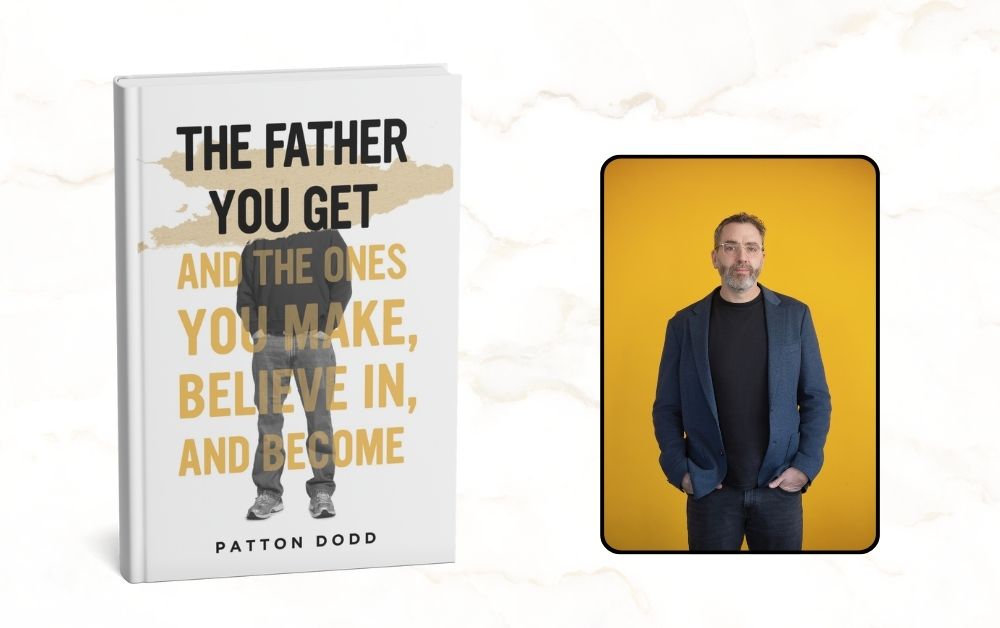
Reprinted with permission from The Father You Get: And the Ones You Make, Believe In, and Become by Patton Dodd copyright © 2025 Broadleaf Books.