We all enter creation barefooted: slick and wet, covered in fluid from the primordial womb that births us. As we grow, our feet develop and change, allowing many of us to balance, to stand, to walk, and to run. Our bare feet test the world around us with each step. They feel the searing heat of August sand on the beach and the intense cold of February snow.
Bare feet remind us that we are indeed vulnerable. The soles of our feet toughen up as we walk and run. Our tender skin thickens with calluses from the friction of the skin against dirt, grass, rocks, and the rest of the debris that gets between us and the earth. Calluses on human feet have, through the eons, provided protection for this vulnerable part of our body.
But just so much protection. The archaeological record suggests that about fifty thousand years ago, our ancestors began wrapping skins around their feet to safeguard them from the cold weather and brutal terrain. Walking built up calluses, but our ancestors realized that they needed more protection because the world is filled with sharp, hard, and even dangerous things.
My personal history with shoes is a storied one. The process of shopping for shoes has been harrowing for me, even traumatic. My childhood and teenage years happened long before the internet, with its ease of shopping for difficult sizes from your own home. Odd-sized shoes existed in sensible loafers and practical pumps designed for the woman over forty, but not for the child or teenager with a long, slim foot.
Nothing fit. My heel would slip. When the salesperson asked me how it fit and I told the truth—it didn’t—they would try again with a different style. Except most shoes didn’t come narrow enough for my slim feet, and after several pairs, the sales clerk would give an exasperated sigh. The whole upsetting experience of shopping for shoes became traumatic when my father came along. On the rare times he came shopping with the family, he would tell me that the next pair better fit … or else. And I knew that everyone’s life would be better if I just settled.
Everyone’s life except mine.
One summer afternoon when we were back-to-school shopping, the salesperson brought out a brown pair of lace-up loafers that had a lion on the sole. They slipped when I walked, but the glare from my father silenced me, so I just nodded that they were okay. I stayed quiet in the discomfort.
I wore them my entire third-grade year. They rubbed holes in the heels of dozens of pairs of socks that school year because of the constant slipping. On the last day of school, I threw them in the neighbor’s trash can so I’d never have to wear them again. I had to wear shoes that rarely fit. One pair after another after another rubbed blisters on my soul as well as my soles. Shoes became a thing that told me to settle, to conform, and to suffer. Being honest would just make others mad.
I had to wear shoes that rarely fit. One pair after another after another rubbed blisters on my soul as well as my soles. Shoes became a thing that told me to settle, to conform, and to suffer. Being honest would just make others mad.
I grew up wearing functional shoes that sometimes fit but mostly did not. Sneakers with two pairs of thick socks were a regular option until the warmth of spring and summer let me wear sandals or run free in lavishly bare feet.
I would have forgone shoes completely as a child except for social mores and burweed, also known as stickers. Burweed grows in the fall and winter in the South with a delicate, feathery leaf that carpets the ground. In the spring, burweed grows stickers with an amazing capacity to find the most sensitive part of feet. The Legos of the plant world, apparently.
Still, I loved living in bare feet. Mud and dirt slid around my narrow heel and between my toes. Grass cushioned calloused balls and tender arches. Running around in bare feet meant my blisters from the school year could heal. The earth fit my feet. That holy fit—bare foot on summer soil—offered an earthy sense of protection I needed.
Shoes, these things created for protection, did the opposite for me. I was a little human in need of protection, in need of adults to understand when I said shoes didn’t fit, and in need of being believed.
Instead, I was learning, shoe-shopping trip by shoe-shopping trip, that speaking my truth was not safe. I was learning that vulnerability was dangerous, that it was better to settle, to agree, to comply. I learned to protect myself. Protection, then, became as painful as vulnerability.

Lessons we learn about vulnerability and protection as children stay with us. They imprint on us, and they become very hard to relearn as we grow.
Tao Te Ching said, “When the student is ready, the teacher will appear.” I’m not sure I was completely ready when a local drag queen who attended the New York church where I served introduced me to a shoe store. But I’m grateful they appeared.
The shoe shop specialized in different sizes and widths. “It’s where lots of drag queens get their shoes,” they told me, pointing down to the snazzy red pumps they’d worn for our Pentecost celebration.
So off I went to the store on Fifth Avenue, and soon I found a pair of black patent leather Mary Jane pumps. The sales clerk measured my foot, and I expected the usual “We don’t have your width, but maybe we can add some pads.”
Except no! The sales clerk brought out a slim pair and slipped them on my feet. I took a few steps and realized they f it gloriously and perfectly. No slipping. No added pads. No anything extra! I didn’t even have to lie to the clerk or myself or try to convince myself that they fit, because they did. I stood there, looking in the mirror at my feet adorned in a pair of stylish, fancy, mostly impractical shoes. They looked gorgeous.
I wore those black patent Mary Jane pumps to every dressy occasion. I wore them at casual events. I probably even wore them with sweatpants. And then I returned to the store and bought another pair that fit. Then another.
One day I realized I could take the shoes I owned that didn’t fit and give them away. Giving away those shoes that didn’t fit was the next part of a lesson about vulnerability.
Between an excellent pair of stack-heeled Mary Janes and a drag queen, I slowly began to realize I did not have to live with discomfort as protection. I could wear shoes, and even wear a life, that fit.
We humans, when our vulnerabilities are exploited and discounted, will find ways to protect ourselves. We will nod and agree. We will build defenses and learn to cry when no one sees us. We will settle for something that feels safe, even when what we consider safety is mostly just staying in the same pair of shoes we’ve worn for years, whether they fit or not.
Vulnerability means we need protection, even if just to feel safe about being vulnerable. And we humans are a vulnerable bunch. I’m not sure we like that truth about ourselves: just how vulnerable we are, just how tender our bodies and our souls are. How susceptible we are to the pain of words of those who refuse to hear and see us.
When we feel the pain inflicted by our vulnerabilities, the holy response is to feel that pain and discomfort, to sit with it and let it inform us. But for many of us, so much of this pain was perpetrated when we were too vulnerable, too young, or too powerless to let the discomfort instruct us.
So we did what our ancestors have done for eons: we found ways to protect ourselves. We pulled on shoes that didn’t really fit, but we made do. We put on emotional armor to defend ourselves from hateful words. We developed practices and responses to keep the peace so we wouldn’t be on the receiving end of rage. We created so many defenses, personas, and identities because we needed protection.
Some of the ways we tried to protect ourselves were profoundly helpful. Some were not. When we were grasping for protection and unable to find it, we wrapped ourselves in whatever protections we could find. There’s a reason children have teddy bears and blankets and snuggies to embrace when the dark feels scary.
When you retrace your steps to a place where the world was risky or even dangerous for you, what made you vulnerable? How did you find protection? What did you embrace when the world felt too scary? Maybe the object was a helpful one that reminds you of safety, love, and security.
Maybe the object was helpful at the time but doesn’t fit anymore. Perhaps that thing you grabbed that seemed to comfort, to guard, to protect did exactly the opposite. Those things often remind us of a vulnerability that was scary, that cost us part of our souls.
Sometimes, even, the things we grasp to feel safe are the very things that lead us to profound vulnerability. Sometimes God calls us to put them down, and we haltingly say yes.
When Moses encounters God in the burning bush, Moses has been wandering around in the wilderness—hiding, I suspect, from the life he left in Egypt. He is vulnerable in many ways. He’s a wanted man because he killed an Egyptian who was beating a Hebrew. He has fled life as a member of the royal household to marry into a shepherding tribe. I can imagine he has figured out by now that the life that he was born into did not protect him as he’d hoped.
Moses has clothed himself in the protective accoutrements of his life as a shepherd and husband, probably right down to his shoes. The shoes of his Egyptian court life are long gone. Moses, now wearing the shoes of a shepherd, sees an unusual and even spellbinding thing: a burning bush that doesn’t burn up. Maybe he’s mesmerized by it the way we are by campfires. Entranced by this holy phenomenon, he strolls over and encounters God.
God tells Moses to remove his shoes. Remove the trappings of the roles you’ve embraced, God says. You’ve had reasons to embrace those roles—some good and some sketchy—but now stand barefooted in this holy place.
Moses does. He takes off the protections of his life and stands vulnerable before God.
In the Gospel of John, Jesus gathers with his disciples on the night before he is crucified. They eat a meal, and then Jesus begins to teach them. Love one another, as I have loved you, he says. Love like this is deeply and profoundly vulnerable and unspeakably beautiful. It is the love that we as humans need to function and, more so, to thrive.
Then Jesus washes his disciples’ bare feet. I’ve always imagined Jesus himself to be barefooted too. I suspect that he becomes deeply vulnerable in this way—even with those he knows will abandon and betray him. This incarnate vulnerability in Jesus touches the dusty, dirty feet of the men who say they love him too—and then will leave him bleeding.
Like Moses, like Jesus, we too are called to go to holy places of vulnerability in our lives of faith. We unlace, unbuckle, kick off, and toss aside the inventions that we assume will protect us. We step out of convention and expectation. We kick off the things of beauty that complete our outfit—the external costume we put on to embellish the roles we inhabit day in and day out. We finally take off the shoes that don’t fit and let the bones and tendons and flesh of our selves and souls connect with the earth.
We may deliberately seek out these holy encounters. But often we stumble into them, having walked down roads that seemed benign at first, even exciting. Then we realize the prayer we’ve prayed is answered. God really does mean for us to love our neighbor as ourselves, even the one supporting a different political agenda. God really does want us to care for the outcasts, even when doing so means we have to venture out of our own comfortable places. God really does mean to love when love means we have to be vulnerable to those with whom we are in relationship.
When we encounter God, a time may come when God asks us to take off our shoes—to step out of the things that protect us and into holy vulnerability. God will ask us to stand in bare feet. God will ask us to feel the ground underneath us, all of it. Feel the softness that gives under the pressures of our heels. Feel the rocks that poke and stab. Feel the comfortable and uncomfortable, the logical and the mysterious, the rich soil and the slimy mud.
Stand in the holiness of bare feet and feel all of creation. Connect to the earth that God creates—the dusty, dirty, holy ground that God called forth.
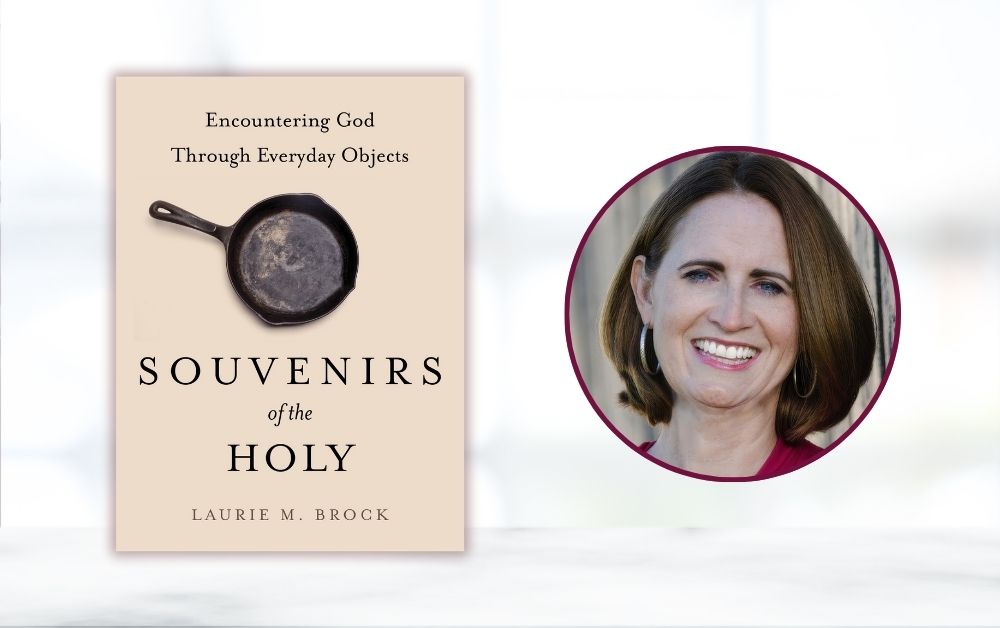
Excerpted from Souvenirs of the Holy: Encountering God Through Everyday Objects, written by Laurie M. Brock. Copyright © 2025 Broadleaf Books. Reproduced by permission.