Over the past few years of pandemic and polarization, as the ugliness of the world swelled around me in disappointing waves, my secret garden expanded. My need to create beauty, to nurture life-giving things out of the ground, to see abundance rise from seeds the size of pinheads, is the best manifestation of hope I can envision. I cling to it, praying that as tiny seeds of goodness are scattered and sown, some will take root and communities will flourish in the midst of chaos. And so I decided to make an addition to my secret garden by creating an enormous room filled with vegetable beds in whimsical patterns with a meditation platform in the center.
“Are you sure you want that much garden!?” Bryan half asked and half exclaimed. “That’s going to be a LOT of work to maintain.”
“Work? Nonsense,” I responded matter-of-factly. “Working our piece of ground, making it sing with flowers for the bees, butterflies, and hummingbirds, is a therapeutic act of worship. Coaxing food from the ground is a liturgy that brings me joy.” This is true … most of the time. Sometimes when weeds swell out of the soil there’s grumbling under my breath—especially when the heat and humidity rise higher than a steeple.
In my eagerness, I filled my seed trays early in the sea son, labeled them in my best penmanship, and laid them out like a well-ordered army in the greenhouse. Talk of a late Michigan frost meant keeping them in the seed plugs longer than I wanted, longer than they should have been. Their roots began butting up against confining walls, which prevented them from stretching into the deeper and more diverse soil they needed to grow fully.
Held back from their potential, I feared their growth would be stunted.
I had planted them in seed trays to begin with because seeds planted in trays in a controlled environment have a higher chance of making it from seed to seedling.
Seeds planted in the ground after the last frost might flourish, but they have a greater chance of being damaged by various factors around them. Jesus pointed all this out in the parable of the sower. Birds sometimes pluck them out of the dirt. One hard rain can wash away the topsoil and the seeds with it, while a hot sun has the potential to roast exposed seeds, frying the life out of them.
The safe space of a seed tray is beneficial.
Until it isn’t.
Seedlings that never leave the tight confines of the seed tray rarely reach their potential. Their leaves shrivel in on themselves and their fruit shows up small and mangled, if it ever comes to bear at all. Roots ball and snarl around each other—gnawing and clawing, fighting among themselves for whatever nutrients they can find in the small space they are stuck in. Eventually, they will die.
My tomatoes were getting too close for comfort in their little seed plugs. I carefully and lovingly bent over the seed lings, transplanting each one into a larger container in the greenhouse to give them additional space to grow while we waited for the threat of frost to pass.

In addition to plants, I have a passion for beach stones. Some might classify it as more of an addiction than a passion. (Apologies if you’re one of the people who has helped us move over the years, but think how much stronger you are today because of all those boxes labeled “stones.”)
I especially love simple smooth stones. Smooth stones relax me. Their weight and shape are a comfort in the hand. Th at smooth calm settles with ease into my flesh, infusing perfect peace deep into my bones. We have a lot of stones lying around—on windowsills, on my desk, on the counter, on shelves, on tables, in candy dishes, in the garden. They’re everywhere. I frequently hold them. Admire them. Gratefully accept the peace they offer.
Stones take millions of years to be pressed and formed. Those that roll around in lakes and rivers and oceans get their sharp edges ground and smoothed down and eventually, if I’m lucky, wash up on some beach I happen to be meandering down. Such a long arduous journey for these tiny wonders I’ve plucked from the sand and tucked inside my pocket.
Stones teach me patience.
Stones remind me of process.
There was a time in my life when all I wanted to find was the official Michigan state stone, the elusive Petoskey stone—a petrified coral that existed millions of years ago in only a few small areas across the world. And find them I did. The longer I chased after them the more expertly trained my eyes became at spotting them. We were traveling around the Leelanau Peninsula in Northern Michigan one summer and my husband finally said, “We have enough Petoskey stones now, don’t you think? It would be nice to leave the rest for other people to find and move on to hunt for something else.”
It was an idea worth considering. But what would I do on a Leelanau beach if I wasn’t hunting for Petoskey stones? I had no idea. I sat on the shore with these thoughts moving through my head. Lake Michigan licked my toes with her cool wet tongue as I ran my hands over the stones scattered around me to see what other interesting things I could find. Beach glass was interesting. Then I uncovered a small agate. Those are pretty. There were lovely striped stones and smooth round stones in a variety of solid colors: black, white, red, green. Plain and simple. They were gorgeous. I picked up a chain coral fossil and studied its intricacies. Amazing. I found a couple Charlevoix stones, too. And then there were stones that resembled the color and texture of Brach’s caramels. There were so many gorgeous little treasures rolling around I was a little disappointed that I had missed them for so long, having only trained my eyes to see and search for Petoskey stones.
My stone world opened wide, and I decided to follow this new curiosity and see where it led. I learned that while walking the beach, the brain and eyes have a difficult time searching for more than one specific type of stone. I had to decide if I was looking for beach glass, or agates, or the caramels. One kind at a time, not all kinds at once.
In order to really see the abundance at my feet, I had to sit down and make a thorough study of all that had washed up on shore. It required curiosity. It took a little bit of work and time to pause and dig and sift through one small pile of stones to see and appreciate the variety.
Looking back, I see how my faith had been so much like my tomato plants, stuck in the plugs too long, with an inability to grow to its potential. I stayed in place long enough to feel the tangle of roots beginning to squeeze in, blinding my vision, choking out my purpose—worse, binding up the power of God in my life, tying God’s hands. God was only allowed to move in my world by the rules and interpretations of the one tiny seed pod I was confined to. There were frequent struggles among the roots in my container that sapped my time, life, and energy. This made God small.
The rules in my seed pod were shaped by a very particular way of reading the Bible in a very particular culture, built by a very particular set of doctrines written by very particular people in very particular times, responding to very particular historical events. My particular seed plug was only one out of thousands that had each developed as a result of their own unique circumstances, one out of thousands of ways of understanding and defining the mystery of the Divine. My tiny container provided one pair of dim glasses through which I read and understood the Bible.
For me, it was beneficial to be in the seed pod. Until it wasn’t.
Like my long habit of hunting only for Petoskey stones while ignoring the richness scattered at my feet, I had been searching the depths and layers and piles of wisdom in the Bible only looking for affirmation of the singular narrative I already believed to be true. I didn’t have eyes to see the richness outside a singular way of understanding. I was trained to see “other” as bad. What was acceptable and “good” in my container lacked curiosity. It feared discovering something different, something more beautiful and more expansive. It feared the humility that could come if curiosity led to the discovery that perhaps I had been wrong about something. The Holy Spirit was only allowed to move in the narrow confines of my seed pod.
One of my vocations over the last decade has been nurturing civil political dialogue among people of faith. I’ve led workshops and seminars and spoken in a variety of contexts about how to model Christ-like attitudes and behaviors as we address complex, controversial topics. One of the life-giving shifts I encourage people to make is to move away from toxic tribalism toward communal belonging.
Both toxic tribalism and communal belonging meet an important need by providing a sense of belonging and purpose. However, there is a significant difference between them. Toxic tribalism requires an enemy. It craves a sense of rightness and it needs to demonize, dismiss, and condemn anyone who doesn’t get in line with the beliefs of the tribe. People who actively participate in toxic tribalism experience and can have addictive qualities, leading to even deeper toxicity.
Within toxic tribalism, those who are the loudest in their condemnation of others tend to be the most rewarded and celebrated within their tribe (also more dopamine!). Those who question the tribe are punished—typically shut down into submission by experiencing a loss of power, having privileges removed, or perhaps by being kicked out altogether.
Communal belonging, in contrast, doesn’t view everyone who isn’t in precise alignment as the enemy. It expects questions. It embodies curiosity and fosters a willingness to exchange ideas. It acknowledges nuance and complexity and is hospitable. It knows that no group of humans has ever had everything exactly right, so there is care about what sorts of words are used because those words can hurt people.
There are differing views of God as well. Communal belonging acknowledges both the vastness of God and humanity’s inability to precisely pin God down in formulations and theologies. It acknowledges how deep and wide and mysterious is the love and mercy of God—beyond anything we can imagine or comprehend. It errs on the side of embodying that love and mercy as a reflection of who God is, as Jesus himself taught and demonstrated.
Communal belonging requires deep inner humility (not false public humility), something that does not come easy and requires constant nurture. Toxic tribalism, on the other hand, is so certain of itself it will harm others in the name of God.
Staying in the seed tray too long led me to toxic tribalism. The roots of my faith had become stunted, my world view one thing—affirmation of what I had been told was true in my small seed tray, affirmation of what I already believed was the truth. I was willing to condemn and dismiss anyone who didn’t see and understand as my tribe did. I felt wholly righteous and justified in doing so, because I was defending God.
I had lost the gospel plot and was doing harm to God’s precious created ones in God’s name.
I grew up in a tribe where, for the most part, everyone looked like me, thought like me, believed like me, and saw the world like me. I was certain my tribe had the truest understanding of everything, truer than anyone else ever had. Looking back, it’s easy to see now how absurd, egocentric, and un-Christ-like my attitude was. God’s image-bearers exist everywhere. They are beautiful and broken and precious and beloved, same as me. I only needed to open my eyes, sit where the water licks and laps at my toes, and sift my fingers through God’s abundance and beauty to see it.
Every morning I rise with the sun, head to the quiet kitchen, put a pot of water on, and gently touch each of the rocks on the windowsill over the kitchen sink. I bless them for the many long and varied journeys they’ve taken toward being the unique beauties they have become. I’m grateful for the peace, the curiosity, the wonder, and the sense of calm they bring me. Then I head out to the garden with a steaming cup of coffee for some silence and meditation. Looking out over my plants, I call them by their names and consider how best to care for each one that day. And I wonder, could it all be that simple?
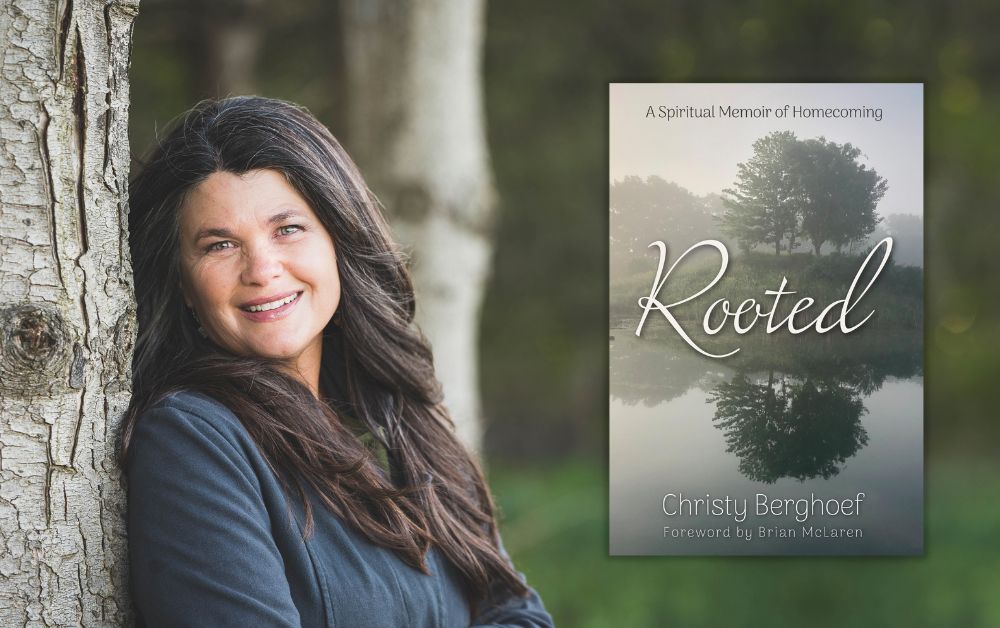
Excerpted from Rooted: A Spiritual Memoir of Homecoming written by Christine Berghoef. Copyright © 2025 Reformed Journal Books. Publishing services provided by Front Edge Publishing. Reproduced by permission.