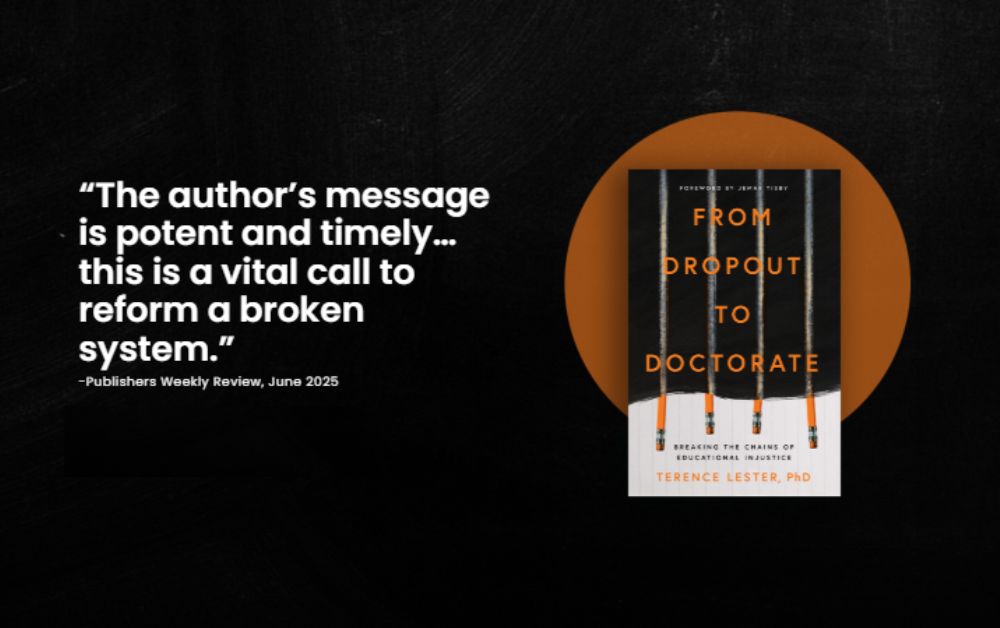
Taken from From Dropout to Doctorate by Terence Lester. Copyright (c) 2025 by Terence Brandon Lester. Used by permission of InterVarsity Press. www.ivpress.com
In April 2014, educator Joshua T. Dickerson was inspired to write a poem titled “Cause I Ain’t Got a Pencil” after witnessing an incident involving a student who asked his teacher for a pencil in an Atlanta school, realizing he did not have one. Instead of being socially aware and trauma informed, the teacher proceeded to ask the student to exchange one of his shoes for a pencil. Dickerson described what happened next as “heartbreaking” and said it became the inspiration for the now-viral poem. In an interview, Dickerson shared that, “The child took off the shoe and he had a dirty sock on, and it caused the other students in the class to laugh at him . . . I wrote a story about what I imagined happened prior to that moment.”
Dickerson went on to explain that students navigating a community with concentrated poverty and underresourced schools could find themselves wrestling not only with their living conditions outside school but also with those challenges following them while trying to excel academically. The poem itself explores the depths of what any student in such circumstances would have to endure while revealing the story behind the student’s simple request for a pencil from a teacher.
I woke myself up
Because we ain’t got an alarm clock Dug in the dirty clothes basket,
Cause ain’t nobody washed my uniform
Brushed my hair and teeth in the dark,
Cause the lights ain’t on
Even got my baby sister ready,
Cause my mama wasn’t home.
Got us both to school on time,
To eat us a good breakfast.
Then when I got to class the teacher fussed
Cause I ain’t got no pencil.
My first time reading both the story and the poem resulted in a flood of tears. It just reminded me so much of my own childhood. I too remember the laughter of my peers when I attended classes wearing older shoes, hand-me-down clothes, and knock-off brands from the flea market, items my mother and sometimes my father bought because we couldn’t afford anything else. I also remember the social climate we lived in and how poverty was a constant burden on my mother. I know that the weight of those experiences shaped me as a student.
Dickerson’s poem brilliantly and painfully captures the depths of poverty in a way that helps people understand that poverty isn’t just a surface-level experience or just about the lack of a pencil. It communicates that poverty’s reach extends beyond the lack of material goods in front of you and can create educational barriers. The child’s dirty sock is evidence of the lack of a washing machine and the struggle of the child’s family, which results in a lack of support from peers in the classroom and the teacher’s failure to understand the real reasons the student came unprepared. Poverty, which can also be social in nature, shows up in this poem through the lack of empathy in the laughter of the other students. All this likely added to the emotional pain this student must have felt, through no fault of their own.
One can clearly see that poverty carries with it the weight of numerous burdens that make schooling challenging for students navigating these realities when they converge simultaneously.
My heart went out to this student and to the countless other children who enter schools where educators are unaware of all that was being carried by the children and how their living conditions affect their performance. When an educator is not aware or trauma informed, they can only see the surface of students without recognizing the myriad obstacles they have overcome just to appear in a classroom. Their lack of awareness can cause missed opportunities for the educator to care in ways that are more supportive of their students—even if it is providing connection to resources.
I fear that we have forgotten the heaviness and trauma that accompanies poverty when it comes to understanding the educational challenges of students who may still find themselves wrestling with poverty around the country and even the world. I fear we have not given our all as a society to ensure that students who are journeying through this reality feel safe enough to show up to learn, regardless of the stories they bring from their living conditions. We must remember that poverty is violent, and it is my belief that we need not only more trauma-informed schools and informed educators and pedagogy but also the freedom to create more safe spaces and support for students. This support could consist of students not being in fear of punishment or embarrassment if they don’t have a pencil or show up in dirty socks, but it could also take the form of more concern being shown for the student’s stories beyond the classroom. It is my belief that understanding poverty as a form of trauma is crucial in creating the support and resources needed to change the trajectories of those who face built in barriers due to their social environments and the lack of access to essential support and sustainable opportunities. We must have the poverty conversation when it comes to education because poverty itself is a large reason why many people are fighting on a path that is already designed for their academic failure.
And because I have a faith tradition that I claim, it is also my ethical responsibility to challenge those who identify as Christian, or as following any faith tradition, to wrestle with the concepts of being trauma informed. We must not ignore the ways in which poverty, historical trauma, and social living conditions can impact people and their educational trajectories. Christians in particular are often not trauma informed and tend to use faith language to rush people past their experiences with trauma, which can lead to religious trauma. Instead, Christians must learn how to create stable environments that provide spaces for people to heal and flourish.
Yet, when we look at the life and ministry of Jesus, we see a model of what it means to be deeply attuned to the pain and experiences of others—we see a clear model of this practice, even in the midst of his own experiences with trauma. For example, Jesus experienced displacement, a form of trauma, when King Herod issued a decree to eliminate male children under age two, forcing his family to flee to Egypt for safety (Matthew 2:13-15).
He faced labeling, another form of trauma, as he was dismissed as merely the carpenter’s son (Matthew 13:55) and questioned— “Can anything good come from Nazareth?” (John 1:46). He was even called unwell and accused of being “out of his mind” (Mark 3:21). When he returned to Nazareth, he faced rejection and disbelief from those who had known him since childhood (Luke 4:16-30). Despite this personal rejection, he continued to preach the good news, embodying resilience and compassion.
From his compassionate engagement with the woman at the well to his gentle care for the man suffering from being possessed, Jesus consistently recognized the humanity of those who were hurting and responded with love, dignity, and healing. The Gospels are filled with moments when Jesus meets people in their trauma, creating spaces of safety and solidarity. His approach was one of deep awareness, showing us that being trauma informed is not only practical but profoundly like the historical Jesus of Nazareth.
Poverty transcends mere financial deprivation but is connected directly to social, environmental, and generational trauma. Social trauma exists and it can hinder those who find themselves trapped in environments that were seemingly designed for them to fail. This itself creates educational barriers and challenges for many students. It is my hope that we get to a place where we start to see poverty as an evil force that claims lives and hinders brilliant minds from reaching the heights of higher education—and may we be moved to do something about it long before students say, “cause I ain’t got no pencil.”
Adapted from From Dropout to Doctorate by Terence Lester. ©2025 by Terence Lester. Used by permission of InterVarsity Press. www.ivpress.com.