*Note: The following article contains spoilers for the Marvel movie, Fantastic Four: First Steps*
Last month, I wrote an article about the principles of non-violence as seen in Marvel’s Thunderbolts* and how the movie came so close to showing us the factual reality that non-violent action is more effective than violent action as a means of protest and revolution. Ultimately, though, the film pivoted in its denouement returning the heroes to the place of those who defend—and Avenge—through violence. As modern mythology, these superhero stories reveal a bit about our own culture. We long for a different way of being. We have the capacity to imagine a world where evil is defeated through non-violent means, but once imagined we reject it as idealistic and unworkable—or maybe just not as cool.
Walking into Fantastic Four: First Steps, I didn’t have any notions of trying to mine the movie for a follow-up article. But coming out of the film, I found myself pondering how Marvel could have gotten so close once again, only to pivot back once again to a more traditional story. While, in Thunderbolts*, Marvel nearly grasped the efficacy of non-violence, in Fantastic Four they nearly grasped the efficacy of community.
The basic premise of the film is that Galactus—a worlds-consuming cosmic entity—is coming to devour the Earth and only the Fantastic Four can stop him. Set in a retro-futuristic world, part of Marvel’s multiverse, this world is apparently devoid of all other Marvel superheroes. Here there are no Avengers, no Guardians of the Galaxy, not even a ragtag team of mercenaries. Instead, there are the Fantastic Four—husband and wife Reed Richard and Sue Storm along with Ben Grimm and Johnny Storm—regular humans whose exposure to celestial radiation has given them supernatural abilities. The hope and salvation of all the everyday, ordinary people lies in the four leaders of this world who are fantastic.
The Fantastic Four launch an expedition to meet Galactus in the stars. The meeting goes awry with Galactus agreeing to not destroy the earth if they will give him Reed and Sue’s unborn child. Galactus, it seems, is weary of world-eating and sees within Sue’s body a lifeform that—for some reason—could satiate him forever. (It’s not well-explained in the film, but in the comics, Franklin Richards has the power to create new realities and whole universes. In some versions, he becomes the successor of Galactus.)
The team barely escapes, returning to earth to face the imminent, encroaching threat of annihilation. As you might imagine, the people of earth are less than pleased and all too ready to sacrifice the child for the sake of the world. All of this leads Sue to address the world and, in the film’s most powerful line, says: “I will not sacrifice my child for this world, but I will not sacrifice this world for my child. We will face this together, as a family.”
Reed sets out an audacious plan. He’s invented teleportation. Why not just teleport the earth to a different location? Find another sun-like star and move the earth somewhere where Galactus cannot find them. All he needs is the cooperation of the entire world. And, remarkably—in this universe—everyone joins together. I really thought that the conflict of the film going into this last half would be humanity’s inability to work together. They’ll have to build towers throughout the world that will serve as energy points to cover the earth in the teleportation field. They’ll have to ration electricity to power the grid that’ll enable the teleportation engine to work. They’ll even have to evacuate all of New York City into Subterranea, the underground empire of the classic Fantastic Four villain the Mole Man. Villains and heroes, the fantastic and the ordinary, must all come together to prevent their destruction by this galactic threat.
That’s a decidedly anti-superhero message. In superhero movies, the problems are solved by the heroes. The are the privileged, the chosen, the powerful who alone have the ability to keep us safe. Whether they are gods or men, whether their superpowers are innate or learned, there is something about them that sets them apart from the rest of us and places them in the position as our saviors. But in Fantastic Four, the four are not enough. They have to rely on the community. And the community pulls through.
In their book Why Civil Resistance Works: The Strategic Logic of Non-Violent Conflict, Erica Chenoweth and Maria Stephan make the case that non-violent resistance is more successful than violent resistance. Their study showed that non-violent resistance was fully or partially successful 80% of the time while violent resistance was fully or partially successful only 33% of the time. So when Jesus commands us, in the Sermon on the Mount, to engage in creative nonviolent acts of protests, it isn’t just about idealism. Nonviolence works.
But why?
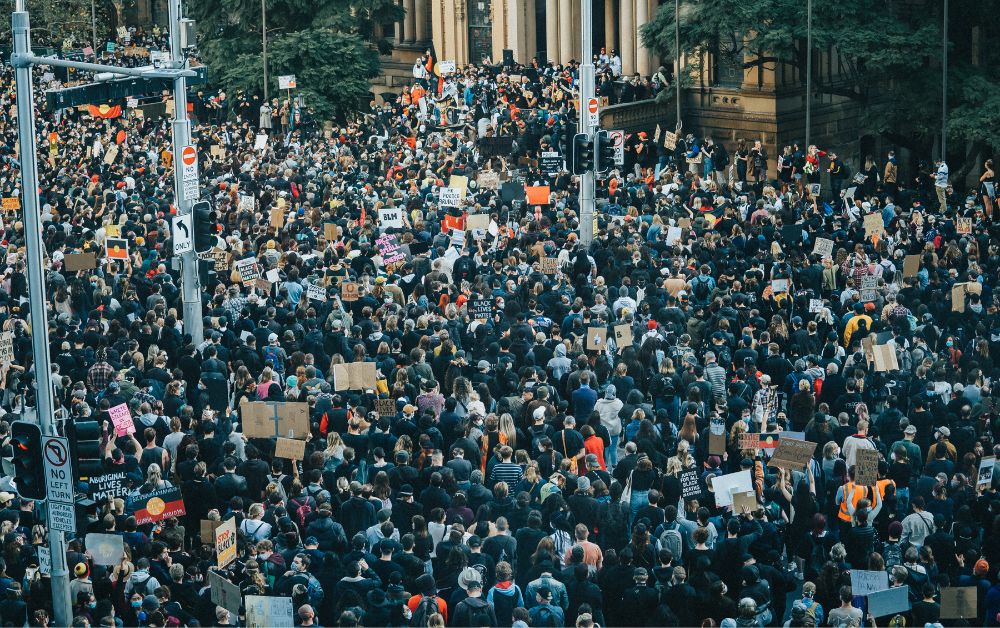
Chenoweth and Stephan think they have the answer. Very simply, nonviolent campaigns are more likely to have higher rates of participation. The barrier to participation is lower. With violence, one can only participate with violence. With nonviolence, one can participate in a plethora of ways that fit a diverse range of talents and abilities. They write that “A critical source of the success of nonviolent resistance is mass participation, which can erode or remove a regime’s main sources of power when the participants represent diverse sectors of society.”
Based on this research, Chenoweth found that if only 3.5% of the population engaged in sustained and active nonviolent resistance, success was nearly inevitable. She writes that “The ‘3.5% rule’ is the idea that no revolutions have failed once 3.5% of the population has actively participated in an observable peak event.” You can also surmise that if this percentage of the population are actively participating, they represent a much larger number of folks who may not be publicly participating but still support the goals of the resistance.
Revolutionary change doesn’t happen because those in power decree it. The powerful, very often, are loathe to change the systems of empire that have placed them into power in the first place. Nor does revolutionary change occur because powerful people stand against it. The fantastic amongst us—the Gandhis and Kings and Wałęsas—still require the work of the ordinary to give power to their voices. It is not only the Fantastic that save us, but the strength and solidarity of community.
When the community comes together, planet-shaking events can occur. Galactic threats can be defeated. This is the message of the Gospel. Unlike Sue Reed, God does indeed sacrifice their son for the world. Not to the consuming powers of death to become like them or serve them—as Galactus wanted—but to overcome it. The sacrifice of Jesus was not so he would become like or subject to the principalities and powers of this world. Rather, Jesus is given to us, for us. Through us, Christ becomes our community. The powers cosmic or fantastic flow out into us all. We consume him. His body the bread, his blood the wine, his presence our comforter—Christ in us, the hope of glory.
We cannot resist the principalities and powers of this world alone, not even if we are fantastic. Rather, it is in community that we find success. When we join together, actively and nonviolently, against the forces of death that inhabit our systems—of immigration, of policing, of economics, of ecology, of politics, of healthcare—we can defeat the evil that would consume us.
Of course, for the sake of story, that communal endeavor is shattered. The herald of Galactus, the Silver Surfer, destroys all but one portal and, in the end, it is our heroes who push Galactus through the portal and out into the unknown. In the worlds of superheroes, the might of the powerful few must always win. But, even if it was only for a moment, Fantastic Four allowed us to imagine a reality where it is the ordinary and not the fantastic whose power stops the forces of death.