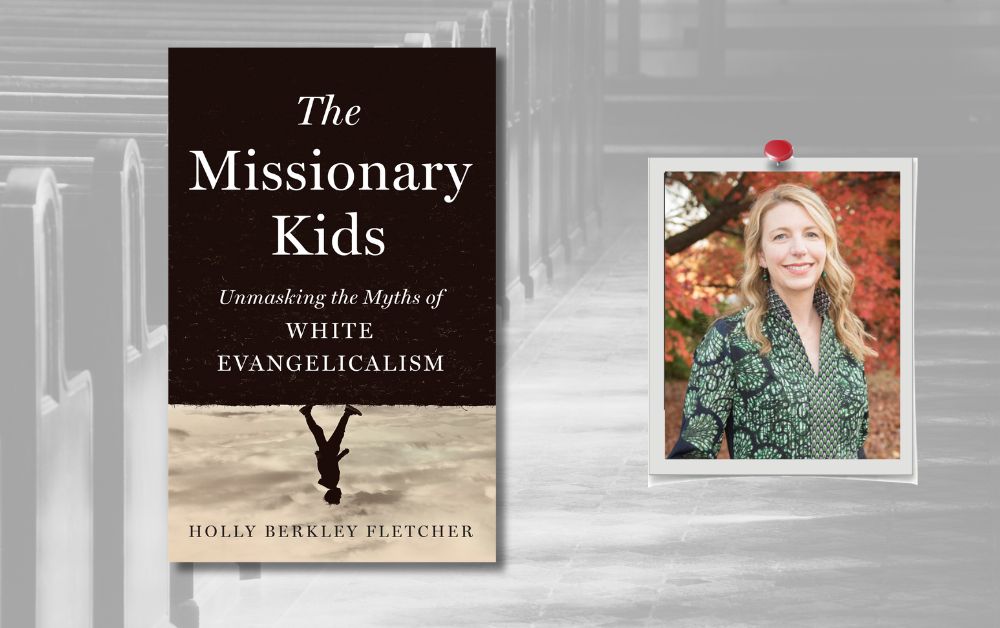
Editor’s Note: Content taken from The Missionary Kids: Unmasking the Myths of White Evangelicalism by Holly Berkley Fletcher (Author), ©2025. Used by permission of Broadleaf Books.
Helen is tired.
She has a world-weariness far beyond her twenty-something years. As we speak, her young child crawls all over her and fusses. Her husband eventually arrives to take the child off her hands, puts him to bed ,and then returns to listen in on our conversation, occasionally chiming in with words of support and empathy. As I listen to her story, I find myself thankful she has him.
Helen’s early childhood was happy. She was born in Uzbekistan and lived there until she was eleven, with the exception of a few years in the United States when her mother and brother needed treatment for severe hepatitis. In Uzbekistan, she had plenty of friends, both other MKs and locals, and plenty of freedom. She played outside, ran around town with other kids, and picked up the language easily.
But then the Uzbek government cracked down on missionaries. The country is a secular but overwhelmingly Muslim state, and proselytizing is illegal. Helen’s family had ten days to leave, a sudden parting with a place to which she still feels a strong connection. Such short-circuited goodbyes, as a result of political forces or family turmoil, are some of the most dreaded of MK experiences and often result in profound heartbreak. Helen did grieve, but what came next was the bigger challenge. “That was a big turning point in my life,” she says. “Life got very serious.”
Her dad had long had “a passion for Afghanistan”—a calling, he believed—and decided that was the family’s next move. It was 2005, and security in the country was slipping again after a brief pax Americana following the US military invasion. Helen overheard family friends telling her parents it wasn’t safe to take children there. “I was scared but wanted to be agreeable,” Helen recalls. “I was aware of 9/11 and the war, but I didn’t really connect it to where we were going.” Their family’s security or their daughter’s fears did not ultimately discourage them. After all, they had been called by God. He would take care of them.
The family moved to a village a ten-hour drive north of Kabul. Although not as violent as some other parts of the country, there Helen’s life became one of anxiety and loneliness. As a girl, she didn’t have the freedom and companionship she’d had in Uzbekistan. The Afghan girls around her were strictly controlled or married off very young. She didn’t have local playmates and didn’t learn the language as easily. As she approached puberty, she also became acutely self-conscious and aware of the terrible realities of Afghan women’s lives. She overhead a conversation about old men marrying girls her age. She recalls being “disgusted” and subsequently “terrified” of men. She watched with foreboding as her own body changed, and she became afraid of being seen at all. Being a foreign girl made her even more conspicuous.
Wearing a full burka started as a requirement for attending school, but she came to experience it as a safe haven. “I enjoyed people not seeing my face,” she says. “I was able to make it fun.” This “fun” was, of course, highly relative. Helen didn’t believe she could express how she felt without making things more difficult for her parents. “It wasn’t safe for me to just feel sad,” she says.
As a young adult back in the United States, she felt lost and disconnected from her emotions. “I was startled by anger, grief. I had resentment, but it scared me to think about it,” Helen recounts.
She returned to Afghanistan, where her parents still lived, a few years after high school as a missionary of sorts—even though she didn’t like it there—because she didn’t know what else to do. She worked as a homeschool teacher for other MKs. She ended up in an abusive, sexual relationship with another missionary, someone from whom she was receiving counseling. This compounded her depression and shame, particularly because the therapist was a woman. She told her parents, who seemed paralyzed about what to do. She felt they blamed her and expected her to find her own way out.
A few years later, Helen is still trying to find her way. She’s married to a good man now, and she has a baby and a life she is creating for herself. She tells me her story in a blunt, detached manner, occasionally making light of things with a smile and easy but exhausted laughter. Maybe it’s just from being the mother of a young child; I remember those days. But she admits she remains more distant from her emotions and those of others than she would wish, and she has trouble expressing compassion and empathy.
Helen is particularly annoyed by American evangelicals’ attitude toward missions, though she is still an evangelical Christian herself. “They think it [missions] is this holy thing,” she says dismissively. “I think people do it for themselves. What’s good for them. It’s like, ‘I have my own problems, maybe I need to work on that in another country?’” She shrugs. “I think missions is just the Christian life. Friendship, opening our lives to people. Doing life together.”
Then she corrects herself. “But I’m not going to judge others’ calling unless asked.”
* * *
Calling remains a pervasive yet ambiguous concept in present-day American evangelicalism. It is often claimed, rarely explained, and almost never scrutinized. The myth of calling is that a person can receive clear, unequivocal guidance from God—divorced from ego needs and not subject to critical analysis or communal discernment—to take a specific action and that the rest of one’s life and everyone in it must be subsumed beneath it. The culture and messaging surrounding American evangelical missions, as well as many other areas of evangelical life, is shot through with this myth. And maintaining this myth can result in devastating consequences, particularly for the children involved.
My own run-ins with calling go from the humorous to the disastrous. I figured out at a young age the power of “calling,” as a concept, for getting buy-in for massive, possibly crazy decisions. When my dad declared he was retiring from the army and moving us all to Kenya to be Southern Baptist missionaries, my parents became instant rock stars in our Christian circles. The only people who seemed to question them were my heathen grandparents, and my parents probably saw their disapproval as a good sign they were doing the right thing. Well, at first my mother wasn’t too keen on my dad’s calling, either. But she quickly submitted (at least in technical terms) like a good Southern Baptist wife. In my admittedly hazy memory, everyone at our church fell all over themselves with excitement, like they were at the Oprah show when she gives out cars.
So when I wanted to make a massive, possibly crazy decision at age ten and needed some parental buy-in, I knew the language in which to couch my desire. In this case, I wanted to follow my older sister to boarding school. Our family lived in a mid-sized Kenyan town, and I attended a local primary school that was absolutely fine. I wasn’t unhappy, I learned things, and I had fun. But my older sister was too old to go there and had no other appealing options. So she went to Rift Valley Academy (RVA), a boarding school a few hours away, run by an American evangelical mission. And I missed her. She was my best friend, and I missed her.
Now, I could have just gone to my parents and said that God had called me to go. But it’s better if you have some connective tissue in there: a vision, a strange coincidence, a Bible verse. On the latter front, there was a school of thought that the Bible could be used as a kind of Magic 8 ball. You asked God to give you guidance, and then you propped the Bible up on its spine and let it fall open. With eyes shut tightly, you plopped your finger on the page, and wherever it landed was the word God had for you.
My dad had used this very method as one of several ways to verify his calling to missions. It was as good an exposition of calling as I had found at the time, so I decided this was the way to go. I got out my Bible and let the Christian magic happen.
I closed my eyes and put my finger on the page. The first few attempts were confusing: “The rock badger is unclean to you because it chews the cud even though its hoof is not divided” (Leviticus 11:5 NET). Weird. What is a rock badger? They have hooves? What? I tried again.
“Because of the suffering your enemy will inflict on you during the siege, you will eat the fruit of the womb, the flesh of the sons and daughters the Lord your God has given you” (Deuteronomy 28:53). Well, that’s just disturbing. Next.
“The Lord had said to Abram, ‘Go from your country, your people and your father’s household to the land I will show you’” (Genesis 12:1). BINGO. My name’s not Abram, but other than that, this is the definitive word: leave your father’s house and go to the land. Doesn’t get any clearer than that.
Armed with the Word of the Lord, I went to my parents to pitch the idea. “Mom and Dad, I know we planned for me to go to Mt. Kenya Academy for another few years,” I began. “But I have received a Word from the Lord. God has told me he wants me to go to RVA.”
“Is that right,” said my mom skeptically.
“Yes, that is right. I prayed and asked God for guidance, and he gave me this verse.” I handed my open Bible over to my dad and pointed to the verse. (I did not mention that this was actually the third Word from the Lord I had gotten and that I had opted against eating rock badgers or my own children.)
“Well, how about that,” Dad said. “It does say that pretty clearly.”
And that was that. God said it, we believed it, and that settled it. I went to boarding school at age ten, which was absolutely not the right decision, I think my parents would now agree.
So perhaps I am not the best one to speak about calling. But who is, because what even is it? How is it different from just living a life of love and virtue wherever the road may take you?
You can fulfill that Christian calling anywhere. You can do that as a fast-food worker. Personally, and I mean this sincerely, I have been deeply blessed by many fast-food workers. Anyone who offers a harried parent a break from meal prep has a very high calling from the Lord indeed.
In many ways, our concept of calling is a pretty modern, Western idea—one of many at the heart of American evangelicalism—and the result of an overabundance of choice that simply doesn’t exist for most of the world’s or history’s people. I imagine even the most devout nomadic herder in a remote part of Kenya spends no more time trying to discern God’s exact, “special” plan for their lives than they do on what to cook for dinner. Americans are awash in choice, and making the decisions that define our lives gives us a sense of agency and destiny. But also anxiety. What if we go down a less-than-ideal path? What if we miss a better option? What if we waste our lives? Or worse, what if we are disobedient to God?
For those blessed with such an extensive menu of life options, how do you know when God is calling you to do something versus when you want to do something for your own reasons? And if it’s the latter, is that a bad thing?
I believe all of us, whether we are religious or not, are gifted with certain talents and traits, guided by passions and joys, prompted by misery and frustration to change course, and nudged along by the unexpected twists and turns of our lives and the people we meet along the way. And what we want— as long as it is an expression of love of self and others, not of unfounded fear or loathing—is instructive. Desire is not necessarily a bad thing. Ego is not necessarily a bad thing. Certainly it’s unavoidable; it just needs to be kept on a leash. In secular contexts, we are honest about our motivations: I want that job because it’s interesting to me, I am qualified for it, or it pays well and I enjoy buying new shoes. I want that job because I want it, I need it, to fuel my body and fund my life.
But what if that job lies in a war zone to which I’d have to take my kids? If I were going to that area just to make some money, you’d probably have a problem with that. But what if I tell you God has called me there, because people are going to hell and so it’s worth the risk? It’s far less likely that any American evangelical would bat an eye and more likely that they would hold a big farewell party for me. John Piper would be so proud. In practical terms, however, there’s no difference. I’m taking my children to a dangerous place where they probably will experience trauma. But one version is celebrated.
Few Christians question a missionary’s calling, because it’s hard to imagine there could be any ego in missions. If someone wasn’t called by God, many think, why on earth would they go? Historian João Chaves offers this devastating assessment by a Southern Baptist missionary to Brazil in the early twentieth century regarding some of his colleagues’ calling: “I firmly believe there are missionaries here who came because they were not capable of commanding a decent job at home.” (1) I’m not going to endorse that harsh take. I will say that, in my experience, missionary life can have real appeal. Certainly for adult MKs, many of whom become missionaries, it’s familiar and all they’ve ever known. Several of the MKs I interviewed, including two who became missionaries, echoed this theme of missions as an escape or, for MKs, a default career option. “I didn’t understand work-wise what I could do to make a living,” one said. “Sometimes it feels like people are chasing an experience,” said another.
MK, pastor’s wife, and therapist Jennifer Christian told me that for too many people in ministry, including missionaries, their sense of calling can arise from a lack of awareness and healing from past trauma. A calling to ministry can become a Band-Aid or an avoidance tactic that can create further harm as the person plunges into a pursuit of sainthood. “I see in ministry families a culture of martyrdom,” she explains. “It’s pursuing God’s will, full steam ahead, out of a sense of ‘God needs me to save these people.’ People rarely, if ever, pause to consider the possible harm to self or others in their wake.” (2) She says that with conscious awareness, our sense of calling is a healthy, thoughtful, constructive outgrowth of who God has made us to be, but without it, the result is too often an unhealthy, destructive manifestation of unmet needs, unhealed hurts, and unloved hearts.
(1) João B. Chaves, The Global Mission of the Jim Crow South: Southern Baptist Missionaries and the Shaping of Latin American Evangelicalism (Macon, GA: Mercer University Press, 2022), 93.
(2) Interview with the author, April 27, 2022.
Editor’s Note: Content taken from The Missionary Kids: Unmasking the Myths of White Evangelicalism by Holly Berkley Fletcher (Author), ©2025. Used by permission of Broadleaf Books.