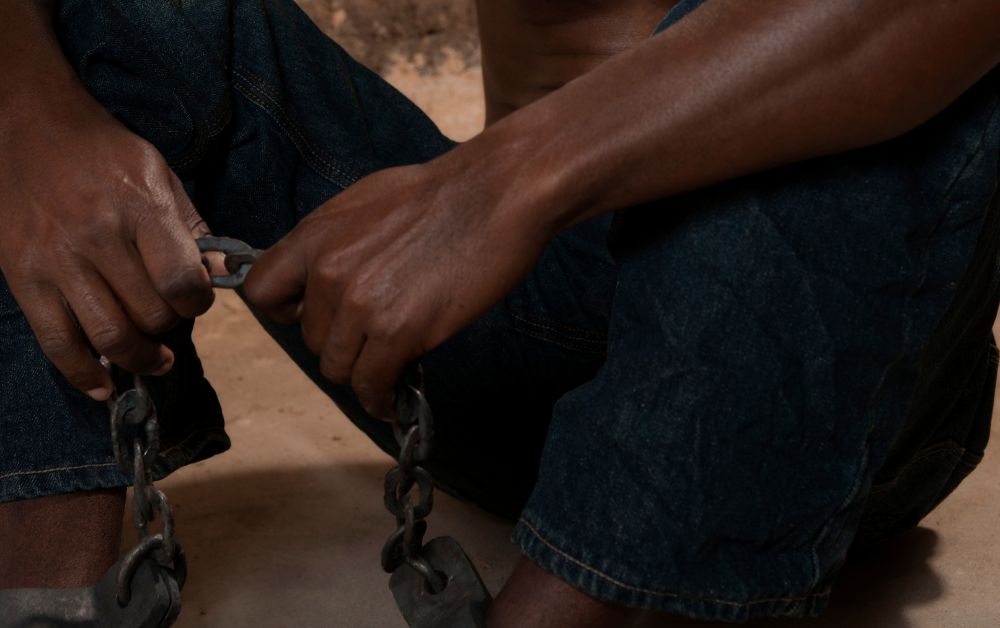
In May, I spent a couple of days over a weekend at a retreat that marked the end of an 8-month spiritual formation cohort. On the first night, at our first gathering as a group, we were invited to share a response to the question “What are you carrying?” In that sacred time and sacred space, we all listened as a number of our fellows openly shared from their hearts the concerns, fears, wrestlings, uncertainties—the weight—of life that they were carrying with them. While I did not share at the time, my answer remains the same: grief.
Recently, on social media, I shared that “I cried today.” It certainly was not the first time, and it will not be the last time. Over a week ago, I came across a video of Immigration and Customs Enforcement (ICE) reportedly showing up at a construction site in Richmond, VA. This definitely was not the first time I had seen a video like this. But on that day, watching men and women running—scattering—hurriedly jumping and packing into vehicles—fleeing—while the person filming the scene laughs and jests was unbearable. And I cried. After a few minutes, I wiped my tears, got up, and dressed myself to go to work. Moving on and moving about in the world as if nothing happened. Meanwhile, all around, people’s worlds, if not the world, are falling apart.
A couple of days after the day I cried, as ICE agents continued to deploy and make raids across Los Angeles, there came more media coverage and more stories. One story resonated with me deeply. Howard Eady Jr., a behavior specialist for children and adults with autism, working at a Los Angeles school, shared his own unexpectedly emotional response to ICE in his school community. Eady describes a report of ICE showing up to a neighboring elementary school graduation. ICE’s presence caused parents (presumably undocumented immigrants) to rush out of the graduation for fear of being detained, leaving behind their children (presumably U.S. citizens), who are then left crying and clinging to teachers, fearing that they may not see their parents when they get home. Eady then goes on to mention that ICE had detained 15 people at Home Depot. According to the Los Angeles Times:
“The arrests outside Home Depot targeted day laborers hired by the chain’s customers, including homeowners and contractors who rely on undocumented workers for home repair and construction jobs.”
Fighting through his own tears, Eady pointedly asks, “What type of s*** is this? . . . What the f*** is this?”
I first heard of the concept of “linked fate” in 2019, while reading a Psychology Today article (“The Science of Why Black People Root for Everybody Black”) by Dr. Marisa D. Franco. “Linked fate is why harm to one Black person is often felt by all Black people,” writes Franco, “but also why Black people are rooting for everybody Black.” Franco continues, “Black people experience a collective emotional world.” As Michael C. Dawson, the political scientist who developed the concept of linked fate, writes in his book, Behind the Mule: Race and Class in African-American Politics:
“In African Americans’ historical experience, life chances have been linked to the ascriptive feature of race in all spheres of life.”
The concept of linked fate explains why the Black community experiences collective pain when, for example, we bear witness to an individual Black person experiencing distress, harm, and injury that is inextricably connected to their being Black. Rodney King. Eric Garner. Atatiana Jefferson. Breonna Taylor. Amadou Diallo. Philando Castile. Trayvon Martin. Sandra Bland. Ahmaud Arbery. The list of names goes on and on. And generations upon generations of Black Americans have personalized and internalized the trauma and grief, because we view our individual fate as being linked to theirs. What happened to them can happen to us.
As a Black immigrant living in America, I have long linked my fate to that of fellow immigrants, particularly the most marginalized immigrants: refugees, asylum seekers, and the undocumented. The continued and escalating violence against these immigrant communities are particularly heartbreaking. Under different circumstances, that could be me. And even under current circumstances, all immigrants, including legal permanent residents and naturalized citizens, are at risk. Meanwhile, there are some Black Americans who think and believe that fighting for justice on behalf of immigrants, particularly Latino immigrants, is “not their fight.” So, to answer the question: What am I carrying? I am carrying grief—a lot of grief.
I am carrying the grief of bearing witness to violence and cruelty to immigrant communities. I am carrying the grief of bearing witness to immigrants being kidnapped and disappeared by agents of the state. I am carrying the grief of immigrants losing Temporary Protected Status (TPS). I am carrying the grief of immigrants losing humanitarian parole with the termination of the CHNV (Cuba, Haiti, Nicaragua, and Venezuela) Parole Program. I am carrying the grief of the families, friends, loved ones, and neighbors of immigrants who are besieged, bewildered, and beleaguered. And I am carrying the grief of knowing that this violence and cruelty is both tacitly and explicitly supported and sanctioned by millions of people who profess to follow Jesus Christ.
The weight of grief is heavy. The weight of linked fate is wearisome. Taking deep breaths, drinking water, exercising, and sleep are important, especially in an era awash with an ethos of self-care. However, as good as those tools are, they are just tools. As a follower of the Way of Jesus, I am fully aware of Christ’s invitation: “Come to me, all you that are weary and are carrying heavy burdens, and I will give you rest.” That said, with rising authoritarianism, living under a fascist regime, and witnessing the fallout, rest—rest for my soul—often feels elusive. Yet still I carry on.
Editor’s Note: Previously published on Mark Wrote It Substack on June 13, 2025.