Stories and themes from the Bible that most of us would rather not hear
I have long had an idea for a book that would detail all the ideas and scriptures from the Bible that we know we would never hear a sermon on.
Here’s one promising premise from what many of us know as the New Testament.
When men are absent…
The Bible, for a variety of reasons, tells stories that are often gender defined – the well-known prodigal son (Luke 15:11–32) story for example, holds no female characters.
As does the familiar “Good Samaritan” story (Luke 10:30-37) which, features a cast of four unnamed players; one a victim, one a rescuer and two “righteous” men who, largely because of their “righteousness” refuse to help a stranger in need.
Does that ratio sound familiar? One decent and helpful male out of four?
And the majority who, for their own reasons and justifications, and presumably with a clear conscience, neglect a fellow human being in need.
Most of us can picture the statements that emerge from a furtive glance at homeless people or panhandlers. “They made bad decisions” or “They deserve it” or anything else to put distance between us and them.
But the bottom line is that these are people, not so different from most us, who, if we think about it are only a few paychecks away from such a state.
These are people in need, in crisis.
How many women, in scripture or in real life, would walk by a fellow human being in such distress?
But what about those Biblical scenes and stories with a focus on women?
There are several.
From the crucifixion itself, when the disciples fled (Mark 14:50) but the women stayed (John 19:25) to the woman caught in adultery (John 8:1-11) portrayals of male cowardice and avoidance are all across scripture.
Fun fact: Adultery, by definition, involves two people – a male and a female – at least one of which is married.
In this story, only the woman is “caught” or at least publicly shamed, while the male partner either gets away or is, by some accounts, absorbed into the condemning crowd.
And, if recent history is any indication, and if “boys will be boys” or even presidential “locker-room talk, was, as now, a universal theme, the male involved was probably cheered and egged on toward further adventures and escapes.
I passionately hate that possibility, but if you know boys (of all ages) you know how likely it is to be true.
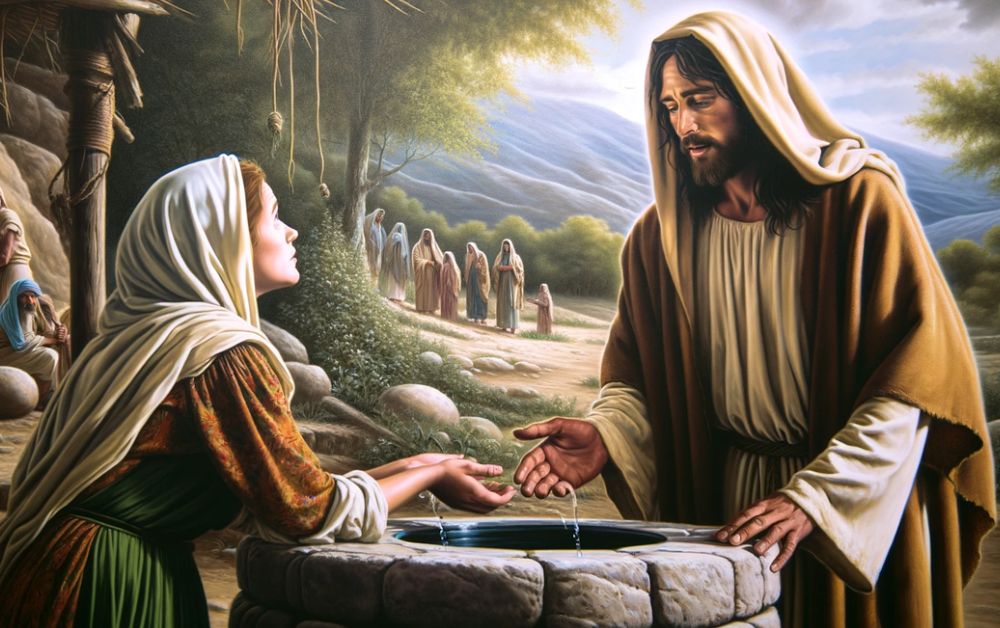
But the best “when men are absent” story is from John (John 4:1-42, to be exact).
According to many scholars, this was the portrayal of the very first Christian missionary in action – yes, a woman.
This is the well-known “woman at the well” story. The “woman”, as in most cases in scripture, is not named, and, as often happens with Jesus, the real action is when the disciples are gone.
The disciples, you may have noticed, often feel obligated to keep Jesus reined in; he, after all, has a long reputation for talking to the most undesirable people, those most “good people” would avoid, and he had a tendency to annoy public officials – especially those of his own people and faith.
But surely, the disciples probably thought, leaving him by a well, in the heat of the day, with no one around, Jesus could not cause much of a stir…
But as always, the disciples missed what “good trouble” Jesus could stir up – even with one ostracized woman with a bad reputation.
In quick summary, Jesus was Jewish – and Jews at the time did not associate with Samaritans – in any context. Samaritans were considered step-children – unwelcome in polite company – or any public setting.
And this unnamed woman was unwelcome – or at least reluctantly tolerated within her own community. Women with multiple husbands tend to generate that response.
But Jesus strikes up a conversation with her – and she, well aware of the social dynamics, keeps her distance.
He doesn’t seem to care about the stigma and shame she has lived with. He listens to her. And he seems to read her story on her face and by her words.
When the guys come back, they immediately show their disapproval.
She, at their arrival, runs back to the village and tells everyone that they have to see this guy – this guy she just met but who somehow sees everything about who she is.
The text gives no hints about what happened next, only that she went to round people up to hear her story documented.
But one can imagine the disciples, in a state of weary “not this again” response as people gather around grasping – and certainly remembering for life – every word – but not from them.
They, his special followers, as was often the case, had nothing to say, nothing to add, nothing but blank, baffled faces.
“Eat something” they say. But he, filled by the immensity, and yes, the sheer absurdity of the situation, has no appetite for standard food.
I’ve been in that situation – where something so bizarre, unreal and unexpected happened that I just have to breathe, or even laugh, but the thought of eating is so banal and so mundane that I can’t even think about it.
The woman at the well was the last person anyone in her village expected to have anything positive and memorable to say. The disciples wanted her to leave their teacher alone.
But he saw something in her. He saw a story embedded in, but somehow beyond, her lived experience.
We are, after all, the life we have lived – so far.
But one unexpected conversation can remind us of a lost vision– or steer us into a completely different track or territory. One that no one, our neighbors, our family, even that fierce critic in the mirror, thought could be there -or have anything interesting to say.
She is rarely recognized as the first Christian missionary, though she clearly is.
She is not even named. The woman at the well – the one with five husbands – and currently with a man not her husband.
Hardly a theme for a stained-glass window or a family-friendly Sunday School lesson.
In other words, it’s my kind of Bible story; no glistening heroes, no multi-syllabic theology, no guilt or shame inducing condescension, no threats of condemnation, just a guy who listened and saw the person behind the gossip, trauma and contempt.
Maybe that’s the miracle of it; no dogma, no moral to the story, just a rejected woman lifted up into a new life by a stranger’s kindness.
Maybe it’s just me, but I can’t help wishing there was a faith tradition based on stories like that…
Editor’s Note: Previously published on Morf’s Substack on July 6, 2025.