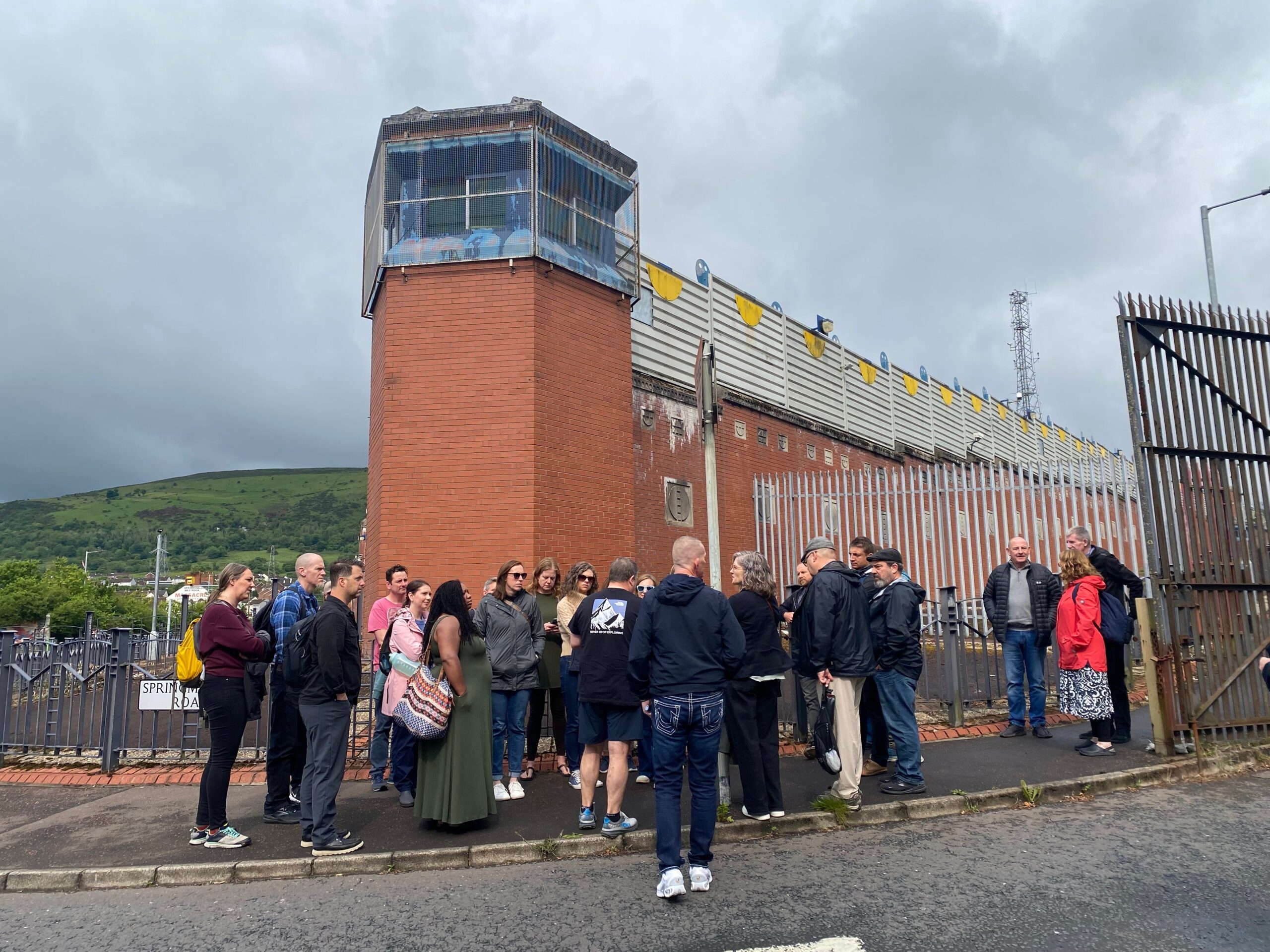
I write these words from Belfast, Northern Ireland, standing shoulder to shoulder with a delegation of U.S. faith leaders and our kin in this land. We’re here listening to the stories of peacebuilders, Catholic and Protestant, who spent decades resisting the pull of violence, choosing instead to forge a costly peace amid profound division. Their scars are real, their wisdom hard-earned, and their stories, unsettlingly familiar.
As I scroll the news from home, I see footage of protests evolving to riots in LA, political rallies turned battlegrounds, culture war skirmishes escalating into real harm, and neighborhoods bracing for unrest. There’s a rising cadence of rage in the United States, one that echoes the decades-long Troubles that tormented this land.
And I can’t unsee the parallels.
What unfolded in Northern Ireland wasn’t simply a “religious conflict” between Catholics and Protestants. It was a colonially-imposed division. One side given dominance. The other, disempowered. For generations, Catholic identity was criminalized, neighborhoods were segregated, and militarized force enforced the illusion of peace. In such a climate, suspicion became survival, and the other side’s dehumanization became a necessary logic.

The United States is not Ireland. But our divisions between conservatives and progressives, red and blue, urban and rural, are no longer just ideological. They are increasingly tribal, entrenched, and justified by the same dehumanizing logic that fueled this island’s darkest days.
In both Northern Ireland and the U.S., religious language was, and is, often hijacked to baptize conflict. “God is on our side” becomes the rallying cry that justifies domination, exclusion, and in many cases, bloodshed. But here in Belfast, I’ve sat across from people who once carried guns in the name of God, and who now carry the burdens of memory, remorse, and a renewed commitment to peace. These are people who have every reason to hate, but instead choose to humanize those who have harmed them.
They remind me that peace does not come through the erasure of difference or the triumph of one side over the other. Peace comes through rehumanization.
It begins when we see the person across the divide not as a problem to be solved or an enemy to be defeated, but as beloved kin, someone with a story, a family, a fear, and a future. That’s what happened here: former enemies learned to listen, to lament, to tell the truth, and to build something new together. They do this, not despite their pain, but because of it.
This is not naïve idealism. It is blood-soaked realism. And it calls us, especially those of us who claim to follow the crucified Christ, to a different way. Jesus didn’t just tolerate his enemies; he loved them, sat with them, and forgave them while they were still harming him.
I fear we’ve forgotten that in the U.S. I fear we’ve baptized our ideologies and crucified our neighbors.
So what now?
We must become the kinds of people who resist the seductive power of dehumanization. We must walk in proximity to and in presence with those we’ve been trained to fear. We must tell the truth about how power has been hoarded and whom it has hurt. We must become ambassadors of peace, not just in word, but in body.
And we must pray. Because what we’re facing is not just a political divide. It is the stuff of powers and principalities that require deliverance.
The hope? It’s real. I’ve seen it here. Former combatants breaking bread. Children growing up without the shadow of armed patrols. Churches that once blessed war now blessing one another.
If it happened here, it can happen in the U.S. But only if we, like them, choose the costly work of peace.