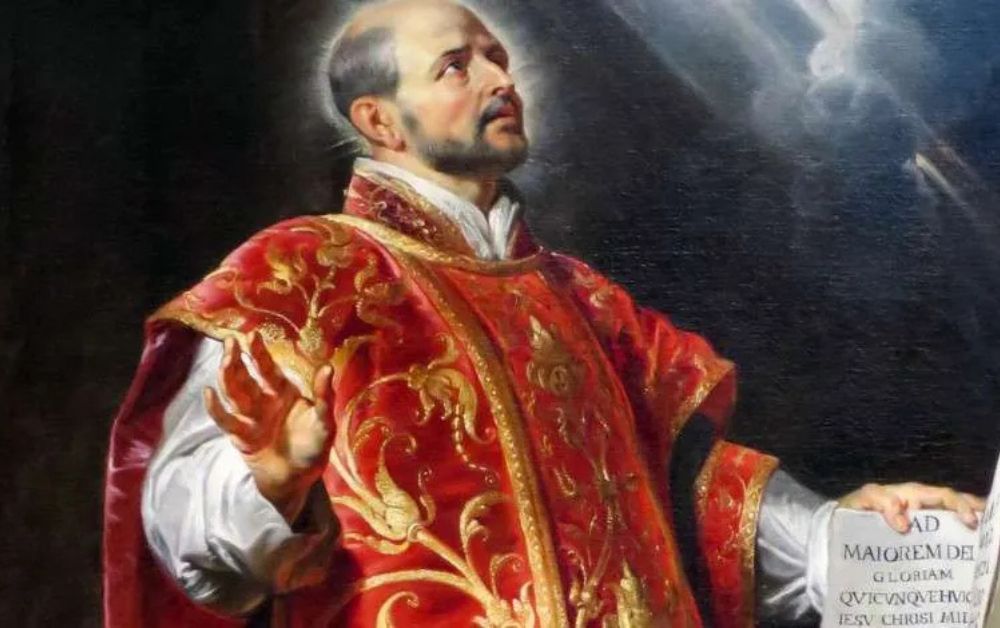
A 16th-century soldier-saint may not seem like the first place to look when trying to cultivate a spirituality of peace that can meet the demands of the present moment. But St. Ignatius of Loyola has more to teach us about peace than we might first expect. The saint’s own response to extreme violence and trauma in his life provides us with the spiritual tools to begin to do the same in ours.
Ignatius was the quintessential Spanish man about court in the early 1500s. He was brash, violent, prone to chasing women and gambling, and utterly unable to imagine himself failing. That’s why, when his battalion was overwhelmed at the Battle of Pamplona in 1521 by superior French forces, Ignatius argued against his superior, insisting that the Spanish troops fight on.
The results of Ignatius’ overweening pride were tragic. Ignatius was struck by a cannonball, earning himself grievous injuries to his legs and a limp that would last the rest of his life. The vast majority of his fellow soldiers were killed.
From this moment of profound violence, Ignatius was carried home, forced to rest for eleven months as his body begrudgingly recovered. We can imagine the kinds of thoughts that haunted the wounded man, the voices and faces that visited his dreams, his sense of responsibility for the tragedy that unfolded.
Here, we might begin to see common ground with the struggling Ignatius. How many of us have been met with overwhelming failure and been forced to carry on all the same? How many of us bear the wounds—physical, emotional, spiritual—of that failure, struggling to make ourselves whole?
This moment in Ignatius’ story is crucial—and it gives us an essential tool for cultivating peace. Ignatius had a choice while lying on that bed. He had to choose between two kinds of stories.
The first story was that of his old life, society’s status quo. Would he go back to the way things were? Could he? After all, no matter how many times he had his legs rebroken and reset, the limp still remained. And that old life had failed him. As he reflected back on his days of waging war and wooing women, he felt empty. Desolate.
But there was a second story offered to him by way of two books: one on the life of the saints and one on the life of Christ. These books provided new raw material for his daydreams. Could he instead become great like these saints? Could he imitate the selfless life of Christ? When he posed these questions to himself, he found that he felt energized. Consoled.
What does this teach us about peace? Violence and ever-escalating conflict are never the answer, as Ignatius himself quickly learned. Yet, they are too often our go-to solution. Perhaps we don’t stand on the parapets of Pamplona, sword drawn and ready. But we do lash out in anger rather than temper our words with kindness. We prioritize incarceration over rehabilitation. We build up walls that separate instead of seek out those in need of a loving embrace.
We try to keep our own discomfort and suffering at bay by any means necessary rather than risk and allow glimmers of peace to penetrate our hearts. It’s easier; after all, so much of our lives are already set up to perpetuate this status quo. We seek comfort so as to avoid any hint of suffering. But that reality is a lie; it cannot hold.
What if, when we inevitably face suffering and sadness, rather than lash out and try to protect what’s ours, we instead pause? What if we took stock of the old ways, the old stories, the old and broken status quo and imagined something new?
That’s what St. Ignatius did during those months of recovery. That’s what ultimately put him on the path of sainthood. He wasn’t canonized because a cannonball shattered his legs; it was the holy courage he found within himself to imagine a new way of living that put him on the path of sainthood. He abandoned his sword and picked up a pilgrim staff.
What are the swords that we cling to in our lives? How might we set them down? What might we pick up in their stead?
Cultivating a disposition of peace isn’t a magic trick or some task reserved for foreign diplomats. Peace demands that we recognize that the old ways are not working, that we’ve grown numb to the violence done in our name, done to our communities, done to our very bodies and souls. Peace demands that, instead of ignoring our wounds, rushing their healing, we instead imagine what they might be trying to teach us, what new world they may be inviting us to step into.
Peace demands that we then act—and do so for our shared, common good.
Finding Peace Here and Now can be purchased anywhere you buy books Finding Peace Here and Now – Baker Book House