“The times are urgent,” philosopher Bayo Akomolafe tells us. “Let us slow down.” He writes of fault lines—those hidden, shifting cracks beneath our feet—and how we are called not to flee rupture, but to face it, to “turn toward the wound.” adrienne maree brown reminds us that movements must be fractal: “how we are at the small scale is how we are at the large scale.” She tells us to learn from plants—especially dandelions, whose seeds scatter far and wide, taking root where we cannot yet imagine.
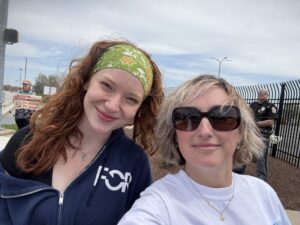
This Good Friday, I tried to live into that wisdom. I was arrested outside Lockheed Martin, across the street from the King of Prussia Mall, the largest shopping center in the country. One side sells handbags and luxury watches. The other manufactures F-35s and Hellfire missiles. Between them, we knelt to pray.
I was one of 25 arrested that day, as part of an interfaith action organized by the Fellowship of Reconciliation, where I work, alongside Red Letter Christians and other longtime organizers. We came to grieve and to pray—deliberately, visibly, and together.
Ariel Gold, our Executive Director, opened with a reflection from her Jewish tradition. It was Passover, and she placed a banner near the Lockheed fence depicting a seder plate, altered to include a watermelon, a symbol of Palestinian survival. She asked us to remember what liberation truly means.
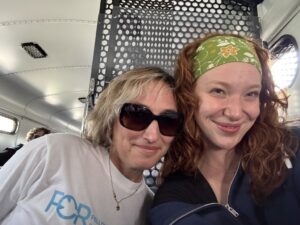
Susan Smith, our Director of Operations, spoke as a Muslim. She reminded us that Ramadan and Passover alike are seasons of deliverance—calling us to walk away from empire, from injustice, from inner violence.
Shane Claiborne offered a Christian reflection rooted in the Gospel’s radical message. He reminded us that Good Friday is not only the story of an execution—it is empire’s attempt to destroy love. And the story of its eventual failure. Jesus turned toward grief. Toward the wound. Toward the machinery of violence. In doing so, he did something deeply human and deeply divine: he refused to let death pass unmarked.
A few of us sat by the roadside as we listened and drew chalk images. I sat next to a group of kids and sketched big mandala flowers with orange and purple, cascading leaves in green, and the words “Saoirse don Phalaistín” (the Irish for Free Palestine).
Cars passed—some honking in support, others cursing. One woman stopped. She pulled up in a Porsche. Her mother stayed in the backseat tending to a small baby. The woman stepped out, trembling, and pressed some money into our hands. “Thank you for saying something,” she said, tears in her voice. Then she hugged me. I don’t know what brought her there or what moved her to stop. But like a dandelion seed, she carried something fragile and lasting.
I was beside Susan as we processed to the gates. Lockheed had closed its campus that day in anticipation of the action—evidence of the long-term impact of persistent protest by the Brandywine Peace Community.
The press release accompanying our action made our reasons clear:
“C-130 Hercules transport planes to support the ground invasion of Gaza, and AGM-114 Hellfire missiles for Israel’s deadly Apache helicopters… F-16 and F-35 fighter jets comprise nearly 80% of Israel’s fighter-bomber force and are disproportionately responsible for turning nearly 70% of Gaza into rubble, by United Nations estimates. Lockheed Martin’s profits have skyrocketed while at least 50,000 people in Gaza have been killed.”
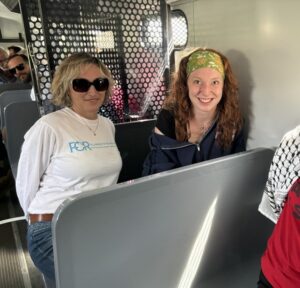
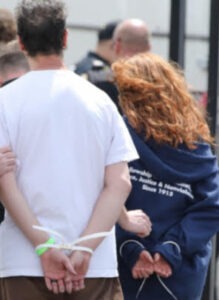
The police had a bus waiting behind the gates. After a brief warning, we were arrested and brought to a local precinct, where we were processed in the basement and quickly released. This May, Ariel and I returned to King of Prussia for our court date.
We explained our intent: to pray, to bear witness, to act with integrity. The judge responded emotionally, likening us to the 2017 white supremacist rally in Charlottesville, a neo-Nazi event in Nashville, and recent student protests at Tulane.
Though a police barrier had blocked the gates long before we arrived and we posed no threat, he claimed we had endangered officers by failing to remain on the sidewalk. He sentenced us to 50 hours of community service—harsher than the penalties given to last year’s protestors.
Still, I’ve thought about writing to him. Not to further argue my innocence, but to ask if we might talk. Not to change his mind, but to turn toward the fault line that opened between us in that courtroom. If justice means anything, it must include space for dialogue. Because I have contradictions to account for too.
Our nonprofit’s 401(k) is invested through Vanguard, a majority holder of Lockheed stock. The money I earn protesting weapons is growing in the very industry I oppose. This is what adrienne maree brown means by fractals. The systems we critique live within us. Yet so do their antidotes.
I remember driving to our Airbnb the night before the action. In North Philly, unfinished luxury apartments loomed like carcasses—bare drywall and gaping windows where affordable homes once stood. On the next block, six police cruisers circled a group of Black teenagers, laughing and leaning against parked cars. The logic of empire plays out in every neighborhood. It doesn’t just drop bombs in Gaza. It stalks joy here, too.
What can we do?
We can slow down. We can stay rooted, like plants. We can notice where we are, who we’re with, and how our actions align—or don’t—with our values. Protest isn’t an endpoint. It’s a form of practice. Compost for the world we want.
Compost isn’t glamorous. It’s decay, rot, the relinquishing of form. But it feeds the soil. It holds memory. It teaches that death is not an end, but a turning. Jesus didn’t return in defiance of decomposition—he passed through it. Resurrection is not a reversal of death but a transformation by it. We cannot bypass grief. We have to live in it. With it. Through it.
At Lockheed’s gates, I tried to practice alignment—not just symbolically, but somatically. I wanted my body to reflect my grief. I wanted my presence to say: I do not consent.
That won’t stop the missiles. But I believe the dandelion knows something we don’t. I believe Bayo is right—that the wound is also a portal. And I believe the woman in the car wasn’t just thanking us. She was offering something. A trace of the world we might scatter into being.