I was born “other.”
Around age five I knew I was different than other people. I cannot tell you how I knew so young. Yet it is not uncommon for some gay, bi-sexual, and transgender people to know at such an early age.
At age eighteen, I could no longer deny who I was, and I told my parents. With the intention of changing me, they sent me to a physician who sexually molested me. Then I was locked in a psychiatric hospital because they thought I was depressed. Of course I was depressed. I had just been sexually violated, and the two people who were supposed to love me unconditionally told me I was going to hell and had broken their hearts.
Sadly, my parents’ Christian religious experience taught them to detest gay people, while at the same time they had to make sense of contradictory messages, such as Thou shall not judge and Treat people as you want to be treated. So when I confessed my big secret, they faced their worst nightmare, too.
There is a happy ending to this part of my story, as Mom and Dad turned out to be two of my biggest fans and best friends. Faced with the truth of who I was born to be, they came to a place of unconditional love by bravely questioning their beliefs. When they did, they found love to be stronger than fear.
My parents chose to evolve spiritually – to align themselves more closely with Jesus’ love and acceptance. But there remain countless numbers of people who proclaim devotion to a loving and inclusive “Christ” who point the finger of judgment outward, rather than turn the mirror of honest assessment around to ask themselves: “If I don’t listen to the stories of those impacted, or care that my beliefs wound people, isn’t this living in a consequence-free ivory tower of self-righteousness?”
Those on the religious right who label me “other” and therefore, in their mind worthy of their condemnation, quote seven “clobber” verses in the Bible about same-sex relations. They believe the Bible is the infallable word of God, never-changing and final. But to love an inclusive Jesus, don’t all Christians need to fast-forward to the 21st Century and acknowledge Biblical times were light-years different from our own time?
There is a tremendous amount of scholarship on this topic for those who are willing to consider it. A devout Christian friend of mine discovered during research for her thesis in seminary that when nations waged war against each other in ancient times, the (male) soldiers often raped the losing army. This act of violence and humiliation toward the weaker nation seems to have been one foundation for the verses in the Bible about same-sex relationships.
Matthew Vines, an openly gay, evangelical Christian and the author of God and the Gay Christian: The Biblical Case in Support of Same-Sex Relationships, provides other plausible historical explanations for verses in the Bible about same-sex relationships. He writes:
Paul uses two Greek words—malakoi and arsenokoitai—that likely refer to some forms of male same-sex behavior, but not the modern concept of homosexuality. The predominant forms of same-sex behavior in the ancient world were sex between masters and slaves, sex between adult men and adolescent boys, and prostitution. In all those cases, men used sex to express power, dominance and lustfulness, not self-giving love and mutuality. Committed same-sex unions between social equals represent very different values than the types of same-sex behavior Paul would have had in view in 1 Corinthians 6. (1)
None of the ancient Bible verses refer to LGBTQIA+ orientations as they are now understood. As modern biblical scholars advise us, the verses regarding same-sex relationships throughout ancient religious texts need to be kept within the context of the ancient societies which produced them. We understand the science of biology and genetics more fully now, and the medical, psychological, and educational communities of today acknowledge the impact of their role in sexuality.
Steven Novella, MD, executive editor of Science-Based Medicine and clinical neurologist and associate professor at the Yale University School of Medicine writes:
Those who opposed gay rights in the past claimed (and some still claim) that homosexuality is a choice, or a product of social influences, perhaps even a mental disorder or pathology. Years of research have led to the conclusion that sexual orientation among humans is simply more fluid than old-school strictly binary concepts. People are heterosexual, homosexual, bisexual, pansexual (romantic feelings that are blind to sex or gender), asexual, and everything in between. (2)
We are all born the way we are because of our genetic-makeup. Certainly, there are other influences, such as our physical and social environment, that can influence the way we develop, but everyone exhibits traits based on their unique biological profile.
The religious right conveniently ignores the truth that Jesus said nothing about race or gender being important to save one‘s soul. In fact, he actively welcomed Samaritans, who were ethnically different from the Jews. Likewise, Jesus never said that heterosexuality was essential for salvation, either.
With logic and love, let’s honestly consider this question: If a heterosexual orientation, and none other, is a central component to spiritual salvation, wouldn’t God have said something along the lines of the following?
Jesus, I’m going to need you to address the gay thing head-on. While you’re at it, Son, go ahead and address transgender, bisexual, asexual, pansexual, lesbian, intersex, twin-spirit, and a host of other biological circumstances, as these will come up in a few thousand years or so. And while you’re on a roll, make clear My views on environmental destruction, the exploitation of workers, child-labor, war as a business, the manufacturing and selling of weapons of war to civilians, the intentional mass incarceration of people of color, the fallacy of race, suppression of women, vilification of the press, misogyny, dictators, corruption, and the blatant disregard for the ever-changing landscape of scientific and intellectual knowledge. Got it? Good. We’ve already lined up a sermon on the mount and a sermon on the plain; maybe let’s make this the sermon on the plateau.
Many Christians have moved beyond a creation of six literal days, as well as the idea that any physical or emotional ailment is demonic in origin. Shouldn’t the same apply for issues related to human sexuality?
Anyone can be dehumanized—LGBTQIA+, people of Color, women, the poor, divorced people, immigrants, non-believers, followers of another faith, or even another branch of Christianity.
Those within institutionalized Christianity that continue to persecute all who they consider to be “other,” must have a “come to Jesus moment,” and understand they are not doing God’s will. In the words of John Dominic Crossan, a New Testament scholar and former Catholic priest, “My point is not that those ancient people told literal stories and we are now smart enough to take them symbolically, but that they told them symbolically and we are now dumb enough to take them literally.” (3)
Too many, who call themselves Christian, are complicit in an unjust, illogical, and harmful system. The key to changing any damaging system is to grow our empathy for the plight of other people, as Jesus would encourage us to do.
To save our democracy, and create the world he envisioned, we must bravely call out and separate ourselves from those who use their misguided beliefs to abuse anyone in the name of Christ, who would most definitely stand with all who are thought of as, “other.”
Jesus would remind us the Bible should not be used as a weapon when he was an ambassador of love.
(1) Kaltenback, Caleb and Matthew Vines. “Debating Bible Verses on Homosexuality.” New York Times, June 8, 2015. www.nytimes.com/interactive/2015/06/05/us/samesex-scriptures.html. Accessed September 2018.
(2) Novella, Steven. “The Science of Biological Sex: What Does the Science Actually Say about Biological Sex?” Science-based Medicine, July 13, 2022. https://sciencebasedmedicine.org/the-science-of-biological-sex/?utm_source=substack&utm_medium=email. Accessed July 19, 2022.
(3) Nichols, Rev. David. Mount Tabor Lutheran Church Pastoral Ponderings… https://mttaborslc.org/pastoral-ponderings-March. Accessed February 2024.
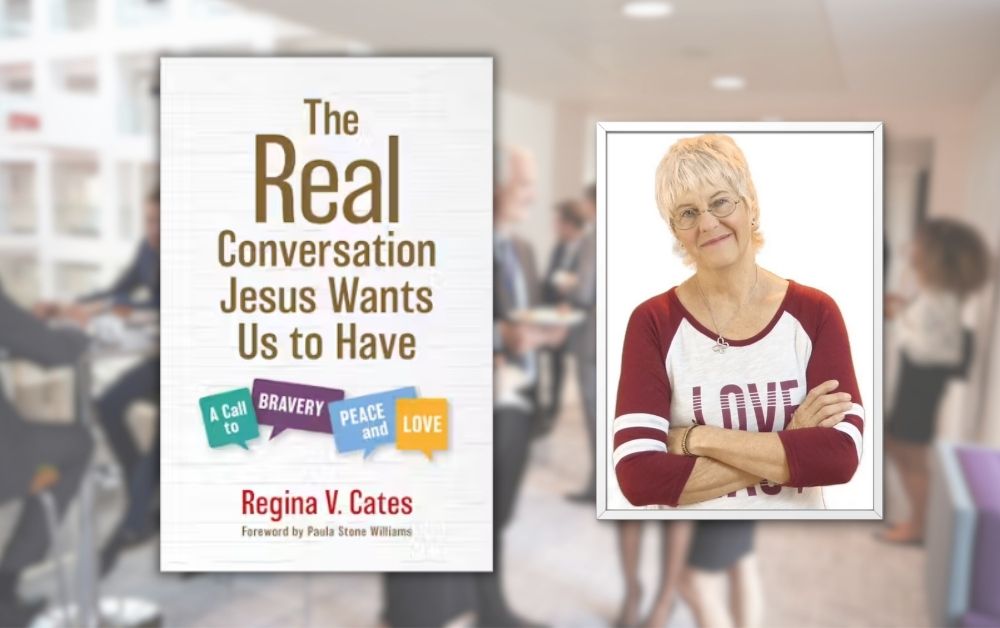
Excerpted from The Real Conversation Jesus Wants Us to Have: A Call to Bravery, Peace, and Love by Regina V. Cates ©2025 (Wm. B. Eerdmans Publishing Co.). Reprinted by permission from the publisher.