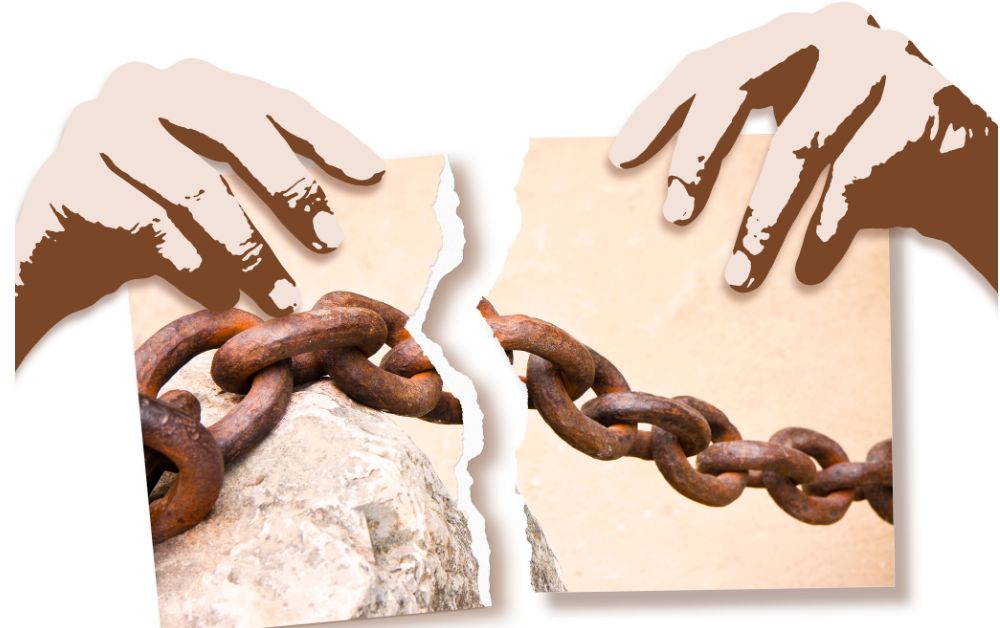
In a recent article in Christianity Today, Justin Giboney, cofounder and president of the AND Campaign, writes: “Our divisions rob the church of credibility.” He continues:
“Not everyone is ready to move forward constructively, but we need a remnant—a coalition of the faithful who are willing to overcome past slights to pick up the cross.”
In keeping with the same subject of Christian unity the AND Campaign posted the following:
“Many have turned away from the idea of reconciliation, seeing it as ineffective or divisive. But ignoring division doesn’t glorify Christ. Christian unity is still a biblical command—and we are better at serving our communities together.”
In her book, This Here Flesh: Spirituality, Liberation, and the Stories That Make Us, Cole Arthur Riley writes:
“Reconciliation cannot be forced if it is to last. And unity should not come at the expense of the vulnerable. Its integrity depends upon its ability to make the union safe and honorable. How can you become one with a person or system who will not acknowledge or relent in their torment of you? This is not unity; it’s annihilation.”
I have great respect for Justin Giboney, his witness, advocacy, and work both with and beyond the AND Campaign. And while I understand his sentiments about the harm that division among Christians can and does pose, I think it is also possible for some divisions among Christians to imbue the Church with credibility. If the divisions that exist between Christians, for example, stem from people belonging to an oppressed class separating itself from people belonging to an oppressor class, then the Church tends to gain more credibility in the eyes of the oppressed in society. Why? Because Jesus makes his home at the margins, among the “least of these.”
On the subject of liberation theology, Guzman Gutiérrez writes:
“In liberation theology, we speak about the poor as the insignificant person: insignificant socially, but not insignificant in front of God before Whom no one is insignificant. . . . In the Bible, the poor are not only the economic poor, but considered inferior, the Samaritans, for example, in the time of Jesus.”
Throughout the history of America, white Christians and white churches—individuals and institutions—have been complicit in the subduing, subordinating, and subjugation of Black people. As I have previously written:
“Whether from agents of the state such as law enforcement or from members of terrorist organizations such as the Ku Klux Klan, white Christians generally have either directly participated in or silently stood by as the homes, churches, and businesses of their Black neighbors were torched and bombed, as Black men, women, and children were lynched, and as Black communities were devastated by the systematic divestment of economic resources.”
The physical, mental, social, and economic violence committed against Black people and other marginalized groups, including Indigenous, Latino, and Asian people, all in service to and the advancement of white supremacy, are not “past slights” to be simply overcome or overlooked. That violence persists to this very day; it is embedded and ever present in our communities. Yet still, despite these stark realities, Christians from and within these oppressed communities have largely remained faithful to the cross of Christ and the way of Jesus. Though deemed “insignificant” and “inferior” by a dominant class committed to domination and hierarchy, the “least of these” of within these societies have continually fought for collective freedom—liberation.
Malcolm X once said, “If you stick a knife in my back nine inches and pull it out six inches, there’s no progress.” He goes on to say, “If you pull it all the way out that’s not progress.” So what then is progress? “Progress is healing the wound that the blow made.” Unfortunately, as Malcolm X says, generally speaking, white Americans “won’t even admit the knife is there.” There can be no reconciliation without liberation. How can it be otherwise? Imagine hugging someone, embracing them, exchanging pleasantries—all while a knife is sticking out of that person’s back? Such a scene would be preposterous. And that is how it looks when we speak of reconciliation before, much less without, liberation.
“Theology is marked by historical moments captured by human language,” writes Gustavo Gutiérrez, “to help Christian communities proclaim the evangelical message.” While some Christians may eschew the language of the oppressed versus the oppressor, the Scriptures themselves say much about the oppressed. For example, in pursuit of reconciliation with the nation of Israel, among the Lord’s opening words to the prophet Isaiah, he instructs the people, “learn to do good; seek justice, rescue the oppressed, defend the orphan, plead for the widow” (Isaiah 1:17 NRSV). Liberation must precede reconciliation.
Liberation is for everyone, both the oppressed and the oppressor. Those belonging to an oppressed class must be liberated from oppression. Here, “oppression” is not figurative; the oppressed class must be liberated from literal oppression. Those belonging to an oppressor class must be liberated from oppressing. Here, “oppressing” is not figurative; the oppressor class must be liberated from literally oppressing others. Thus, in the context of America, white Christians, in particular, must be liberated from the ways of American Empire and the ways of whiteness under which they were likely spiritually formed. When white Christians, as individuals and as a collective, resolve to be committed to liberation, perhaps calls for reconciliation will find fertile soil rather than barren ground.