So many of the stories we hear today are about a world falling out of being. Falling away. Falling from grace. The US Fish and Wildlife Service proposes declaring twenty-three species extinct. Weather and climate disasters—including floods, hurricanes, tornadoes, severe cold, drought, wildfires, and heat waves—cause nearly five hundred deaths and incurred a cost of $92.9 billion in a single year. The Earth could be out of topsoil in as few as sixty years. The number of people displaced by climate-related disasters is predicted to reach 1.2 billion by 2050.
These are stories of the mass-scale unraveling that is taking place as we pull more and more threads out of the Earth’s ancient pattern to weave something that is entirely of our own making. Biodiversity and balance are sacrificed in the upkeep of a global, capitalist-driven civilization. Forests are felled to heat our homes and grow our food. The Earth is carved open to manufacture our phones, our weapons. Aquifers are drained, disrupting the migration patterns of sandhill cranes, as warming oceans change the migratory seasons of humpback whales. In doing all of this, humanity is building a world that is, increasingly, a reflection only of ourselves: our needs, desires, and wants. We continue this hungry work even as the stunted design we are creating spells our own demise.
In Linda Hogan’s book Dwellings: A Spiritual History of the Living World, she travels to the Boundary Waters, where a group of wildlife biologists is studying a vulnerable population of timber wolves. Hogan is there with several other visitors who have come to tour the region, with the hope of glimpsing a wolf in its native habitat. But the first up-close glimpse of a wolf that they get is in the form of a carcass, pulled out of the back of a pickup truck. Many of these visitors are neither ecologists nor what one might classify as conservationists. Some hunt and trap wolves, others are curious, and others are what might be called ecotourists. But Hogan is struck by the fact that none of them can resist the urge to reach out and stroke the pelt of this animal, or to pose with it for photographs, in order to “touch a lost piece of the wild earth.” To connect with something that we have severed from ourselves.
One night, the group is walking outside in the cold, wanting to hear the howl of a wolf. At last, a long howl breaks through the moonlight. A hush falls over them. Then there is another howl. But the second howl, they realize, is coming from one of the men in their party, who is calling back to the wolves “in a language he only pretends to know,” and the group of people surrounding him—as well as the woods, and the wolves, and the world beyond—answer with silence. Linda writes: “We wait. We are waiting for the wolves to answer. We want a healing, I think, a cure for anguish, a remedy that will heal the wound between us and the world that contains our broken histories.”
Is it possible, I wonder, to build a bridge between these broken histories and an uncertain, deeply troubled future?
Here are the paradoxes that I hold as a new mother: I believe that the world can simultaneously fall out of being and come into being. I believe that the cracks and chasms of our fragmenting civilization will widen and deepen in my lifetime, and certainly in our daughter’s. I believe that bringing new life into a world in collapse is still a morally sound choice—and that the decision not to bring new life into the world is morally sound as well. I believe that even
our limited languages might lead us—if we continue to listen and reach for knowing—to a truer expression. I don’t believe there is any cure for our anguish that will stop our present downfall; but I do believe there is a cure.
The cure, the healing, is that which will bring us back into a deep, loving, entwined relationship with the living world. And this, I believe, is the work of mothering.
Again, by “mother” I do not mean only the noun that refers to a female with a uterus and children. I mean a way of being that is open to any gender, any age, perhaps even any species. As Robin Wall Kimmerer writes in Braiding Sweetgrass, “A good mother . . . [knows] that her work doesn’t end until she creates a home where all of life’s beings can flourish.” I mean “mother” as a verb, and “mothering” as the good work of being in service to “all of life’s
beings.”
I don’t pretend to know what the future will look like. But I believe that, more than anything, it will need mothers.
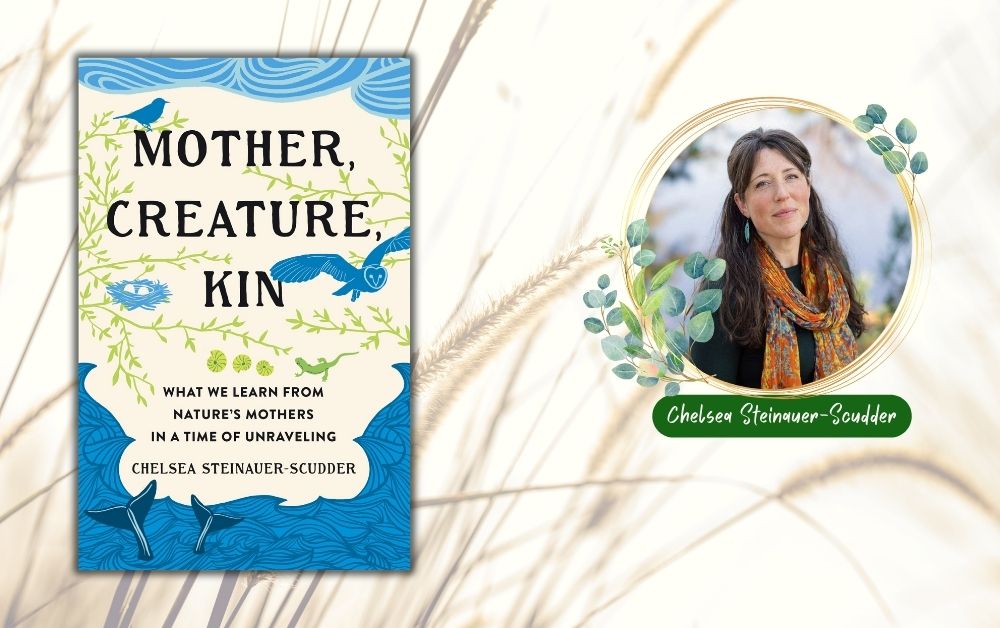
Reprinted with permission from Mother, Creature, Kin: What We Learn from Nature’s Mothers in a Time of Unraveling by Chelsea Steinauer-Scudder. Copyright © 2025 Broadleaf Books.