I wonder if Jesus’ disciples found themselves thinking, sometimes, I don’t know if this is what I signed up for.
I wonder this as I read the part of the gospel of Luke that surrounds the Transfiguration story. In this section of Luke’s gospel, it seems like all Jesus wants to do is talk about how he’s going to suffer and be betrayed and killed.
Why does Jesus keep going on about taking up crosses and losing our lives? The disciples might have wondered. What is this that we signed up for? Who is this that we’ve been following?
I think Jesus really wants them to think about these questions. Right before their conversation about suffering and betrayal, he asks his disciples this: What are people saying about me? Who do they think I am? (Luke 9:18).
His disciples reply, Well, if you really haven’t heard, people are saying all sorts of things. Some say John the Baptist, back from the dead after Herod beheaded him. Some say Elijah, the ancient prophet known for walking so closely with God that God took him up to heaven in a chariot of fire. Some say some other prophet from a long time ago.
Jesus says, and of course I’m extrapolating and imagining here: That’s nice. I’m not going to confirm or deny any of that. What I want to know is, Who do you think I am? You’ve been following me around as I teach and heal. You just saw me multiply five loads and two fish and make it feed thousands of people. I gave you power over demons and diseases and sent you out to bring good news and healing in many villages. What do you say about me?
After a beat, Peter is the first to speak up. He says, You’re the Messiah of God.
And Jesus doesn’t say, You’re wrong. Instead, he says, Don’t tell anyone this. Let them think, for now, that I’m John or Elijah or whatever they want to think. And then he talks about his own soon-coming death.
—
All this happens eight days before the Transfiguration (Luke 9:28). Jesus is talking with his disciples about his identity—and then about what it means to be the Messiah of God. He talks about how, at some point soon, things are going to get really bad. He’ll experience suffering, betrayal, and death. It’s going to look like he lost. Like he failed.
He’s going to die. He’s going to resist, with his whole being, the violent, soul-sucking, dehumanizing, isolating, illness-inducing, dividing, hierarchical, abusive, demoralizing, anxiety-inducing, human-harming ways of empire—and they’re going to kill him for this resistance.
Things are going to look really bad. Things are going to be really bad.
And yet, Jesus wants his friends and followers to know that this is all to be expected. They will have to live through it, and it won’t be easy. But they shouldn’t be shocked or unmoored completely by it. And, crucially, it won’t be the end of the story—because Jesus also tells them, after all this, he will rise.
Now, eight days later, Jesus takes three of his closest friends and says, Hey, let’s go get away from it all for a little while. Let’s go up on the mountain and pray.
I imagine him saying, Let’s take a mini-retreat. Let’s go somewhere, just for a minute, where we’re not going to hear any more about the evil things the Roman empire is doing.
We don’t need to know right this second what territories Rome is invading and conquering now, or what statues the emperor is building of himself, or what actually helpful resources and services the empire is cutting, or what war budgets they’re increasing, or what people they’re enslaving.
We don’t want to stick our heads in the sand, but it’s also okay to take a break. We’re here to care for one another and to meet our communities’ needs in every way we can—but we also need space, sometimes. We need to breathe. We need to be in nature. We need to be with trusted loved ones. We need to seek God, to pray.
He says, Let’s go up to the mountain.
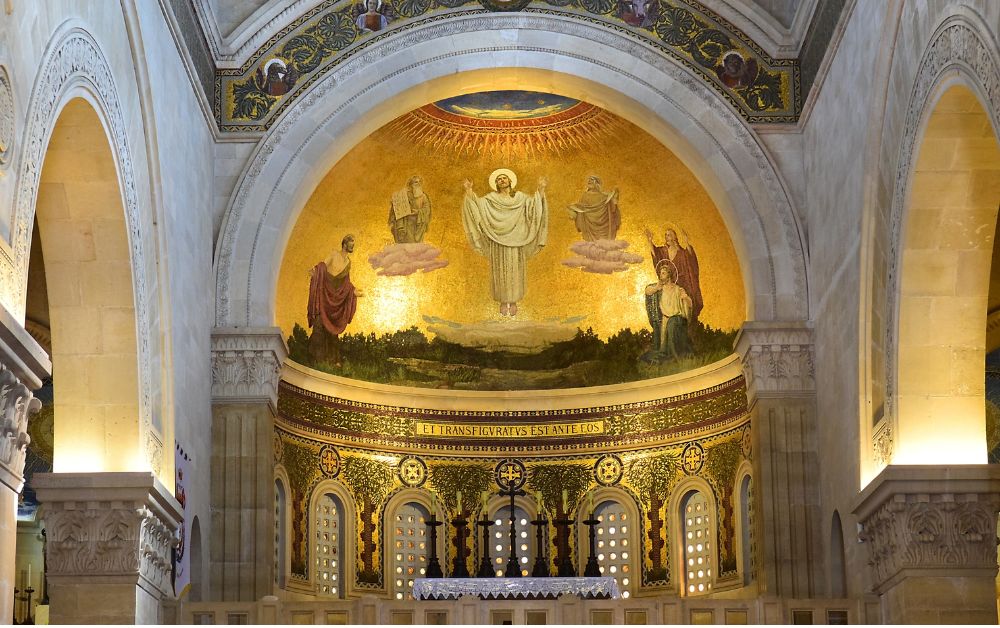
When they get there, Jesus starts praying—and the way his face looks changes. His clothes become bright, gleaming white—literally, white like lightning. And Moses and Elijah show up.
It’s totally out of the realm of things the disciples ever thought would happen as the four of them hiked up the mountain, walking and talking together.
In these last few days or weeks of walking with Jesus, the disciples have placed their feet and their minds solidly within the realm of the hard realities of life under the oppressive Roman empire. And it’s good that they’re talking about these things. It’s good that they’re processing the news together, not withdrawing into whatever privilege some of them might have, or pretending the empire’s corruption and greed and violence and inequality doesn’t impact them.
But now, up on the mountain with Jesus, something unexpected happens. In the midst of all this difficult, difficult reality, God does something stunning.
Jesus’ appearance changes and his clothes shine, and Moses and Elijah show up to talk with him about his coming death. In Greek, it’s his coming exodus—or, in the First Nations Version of the New Testament, his crossing over from this life to the next.
Moses and Elijah remind Jesus—by their words and by the fact that they are there—that death is not the end. It can be cruel and brutal and devastating—especially when, like in Jesus’ case, it happens too young, or it happens at the hands of other people—and, at the same time, it’s not the end.
The empire can do the worst thing it can think of to do. And yet, it has not won. Because God is still there, bringing life. Resurrecting.
God is there, comforting. Preparing. Present with us. Walking with us. Empowering us and filling us with courage to live a good and meaningful life for however long we’re here.
—-
As the story goes on, a cloud appears and a voice speaks from within it: This is my child, my chosen one. Y’all—(the voice speaks to them in the plural)—listen to him.
This voice speaks to Jesus’ friends and followers—and maybe it’s speaking to us, too. Y’all, listen. Listen to Jesus.
I imagine it saying, Don’t give up on the things Jesus said and taught.
Don’t give up on the ways of love and kindness and gentleness, even if it seems ineffective.
Don’t give up on the ways of truth-seeking and truth-telling, even if it seems increasingly difficult and even dangerous.
Don’t give up on advocating for equality for all people, even if it puts you at odds with those who want supremacy and control.
Don’t give up on building stronger communities, even when it seems like we’re hopelessly divided.
Don’t give up on nourishing yourselves and others, as Jesus did when he fed the five thousand.
Don’t give up on making space to care for your soul, as Jesus did when he went up the mountain to pray.
Maybe the same Divine voice is saying, today: There might be a million ways I seem absent or far away, but I am here. I am here, wherever love is. Yes, things look bad. Things are bad. And, I am still moving. I am still moving people toward love and justice everywhere. Look for those moments when my face shines through and you see a glimpse of me. Hold onto those glimpses.
What does it mean for Jesus to be the Messiah of God, in this time? What does it mean for Jesus to be the chosen one of the voice from the cloud?
For us, I think it means we listen, and we follow, and we let that be enough—even in times when it might feel like nothing we say or do could ever be enough. We listen for calls to resist evil, and we join in this resistance as we’re able to. We look for ways to love one another tangibly, even and especially when things get much worse.
It means we don’t give up on God appearing when we need it most. It means we remember that even if resistance to the ways of empire leads to death, death is not the end.
May the holy strangeness of this Transfiguration story give us strength and courage for today. May it give us hope that God still shows up in surprising ways. May we be open to it, now more than ever.