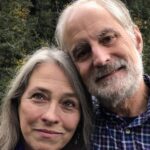
Many years ago, my wife and ministry partner, Sue, and I were leading a church group in a Lenten series on the Gospel of John. Typically, we had about 45 minutes to break open one of the exciting stories of the Samaritan woman, the one born blind, Lazarus and his sisters, footwashing. As we were going through a text, we heard ourselves saying, as we so often did, “If we had more time, we could….”
That gets tiresome quickly, right? So we began to imagine new possibilities: what if we invited a group into engagement with the Gospel in an open-ended way? We’d meet two hours a week in our living room, opening and closing in prayer and with a break for snacks and visiting, and see how it went. We started in April 2004 with about twenty folks and ended in…September 2015 with roughly the same number. Eleven and a half years in the Gospel of John!
We learned so much from that wonderful experience, more than I can name here. But key was the recognition that developing a relationship with the Story of God is so much like any other relationship: it requires time. When we meet a person we like, how do we get to know them better and more deeply? Obviously, we don’t study each other’s resumes or recite facts about our pasts. Rather, aspects of who we are and how we got that way emerge gradually as we move through our lives together: sharing a meal, taking a walk, dealing with disaster, celebrating milestones.
So much has changed in the decade since we completed that Johannine journey, for us and in the world. Few churches seem to yearn to hear the Word up close right now. The pandemic and politics have turned many of us inward, often accompanied by new anxieties. The “way out” (Greek, ex-hodas, i.e., “exodus”) might not seem as clear to us as it did a few years ago. The onslaught on “facts” and “truth” can leave us spinning, confused, depressed. What to do?
The great indigenous writer, Leslie Marmon Silko, addressed this situation in her classic novel, Ceremony (1977). The main character, Tayo, has always lived in the shadow of his athletic and popular cousin who enlisted in the US Army in World War II, only to die in Tayo’s arms on the Bataan Death March. Tayo is crushed into depression and alcohol until, out of desperation, he finds his way to a Laguna shaman who cares for his body and his spirit. Part of Tayo’s illness is being caught between two stories of who he is: the US story of militaristic masculinity and his native Laguna stories of cooperation and healing. As the shaman explains:
I will tell you something about stories, [he said] They aren’t just entertainment. Don’t be fooled. They are all we have, you see, all we have to fight off illness and death. You don’t have anything if you don’t have the stories. Their evil is mighty but it can’t stand up to our stories. So they try to destroy the stories let the stories be confused or forgotten. They would like that They would be happy Because we would be defenseless then.
The same is true for we who claim the Story of Jesus. We swim in a sea of misinformation, lies, false narratives and so much just plain bullshit that it can be hard to remember who we are and Whose we are.
The time we spent in John’s Gospel each Thursday was medicine. As we dove not only into the text of John, but also all the “back stories” that informed the Gospel (e.g., how to understand Jesus and the Samaritan woman at Jacob’s well without hearing the story of Jacob meeting Rachel there?), we began to hear at another level. In most church contexts, it is nearly impossible to take the time to listen to a Bible story up close. But if we don’t do that, other stories will fill us and tell us what to do. That’s much of what the Gospels mean when they talk about casting out “evil” or “unclean” spirits.” As Tayo learned, the Story that we carry is what animates us, fills us, leads us in a particular direction. They can lead us toward war and competition, or toward peacemaking and sharing.
I did not learn this growing up as a Jewish kid in an all-Jewish part of L.A. But when I first discovered the joy and power of deep encounter with the text—thanks in great part to Ched Myers’ now classic commentary on Mark’s Gospel, Binding the Strong Man (1988)—I was hooked! For nearly four decades now, I’ve devoted my/our ministry and life to ever-deeper encounters with the Story and the One found there.
At the same time, we know all too well how the Bible can be used as a weapon on behalf of the opposite of everything Jesus proclaimed and embodied. In many ways, this is not a “bug” but a “feature.” The collection of texts we often think of as comprising a single book, i.e., “the Bible,” actually expresses a series of arguments and battles over the questions of who God is and what it is to be God’s people. In my 2010 book, “Come Out, My People!:” God’s Call Out of Empire In the Bible and Beyond, I describe this as a spectrum between two “religions”: not “Judaism” and “Christianity,” but the “religion of creation” (ROC) and the “religion of empire” (ROE). Our Israelite and Judahite answers fought over such questions as:
- Are we to live on the earth like other creatures (ROC) or apart from them in urban enclaves, protected by threats of violence (ROE)?
- Do we welcome “strangers” (ROC) or treat them with suspicion (ROE)?
- Do we trust in the Creator to provide the food and other provisions we need freely from earth’s abundance (ROC) or do we anxiously store up for ourselves in fear of future famine via a money economy (ROE)?
Jesus entered into this ongoing struggle and claimed ROC as God’s Way while denouncing ROE as from “the devil” or “Satan.” Not surprisingly, the upholders of ROE—whether Judean or Roman—could not tolerate such talk or behavior. And, as it happened, neither could many of the Platonically-oriented philosophers who became known as “the Church Fathers.” That is another story, which I’ve told in part in my 2016 book, Empire Baptized: How the Church Embraced What Jesus Rejected, 2nd-5th Centuries. The “Christianity” they invented was almost exclusively concerned with the individual “soul” and forced the Hebrew Scriptures into that mold. One historian has called the Christian appropriation of the Hebrew Scriptures the greatest act of colonial cultural theft in history.
It is in this context that I started my project, Radical Bible, a YouTube channel. I took pandemic retirement from my teaching post at Seattle University and began making videos that go s l o w l y through texts, verse-by-verse, even word-by-word, to linger and ponder over each detail we’ve been given by the ancient authors to discern God’s Way in the world. I recently completed the series on the Gospel of Luke: 198 videos of 15-20 minutes each and have also completed the series on the book of Revelation. I am three quarters through Genesis and the books of Samuel now and I’m having the time of my life doing it! The YouTube channel is paired with a website, radicalbible.net, where I’ve posted hundreds of PDFs used in the videos, available for free use.
My hope is that you will find this emerging library a resource to call you and your circle into the kind of depth relationship our “Thursday group” had over the eighteen years in total that we met weekly in the Word. A place to start might be with the pair of videos in which I lay out “principles of biblical interpretation” in one and the “two religions” mentioned above in the other: https://www.youtube.com/watch?v=QFyq0HYdMYA. What I’m exploring here is how we can practice ways of engaging the Story that, unlike the Church Fathers, respect each text for what we can know about where it came from and what it was trying to express. At the same time, we are called to look deeply at ourselves and our own presuppositions, commitments, prejudices, and beliefs. For instance, maybe we’ve been taught that the Bible conveys “the word of God” in every verse and that it all fits into a nice, clean presentation of God’s desires for humanity. What might be involved—intellectually, emotionally, spiritually—to come to see the Bible more as a “place” in which our ancestors could engage many perspectives on the big questions, leaving hearers and readers to decide for themselves our own relationship with the texts and with God? How might our experiences as oppressed, minority or other excluded groups give us deeper empathy for and understanding of the Israelites’ struggle amidst empires? As disciples of Jesus, how can we come to embrace the thoroughly Jewish nature of the entire biblical collection and, of course, of Jesus himself?
After doing the work of text engagement and seeking to practice discipleship for nearly four decades, I can happily proclaim that I never get tired of it! As Sue and I regularly say about texts we “know,” “there is always more.” Just as we never fully know even our closest loved ones, we can never “master” the biblical text nor should that be our goal. Rather, we can hang out in it, alone or with others, ask it questions, discover its world, and feel, like that pair on the road to Emmaus, our hearts and minds “lit up” (Luke 24.32) and our whole being filled with the Spirit, ready to run to share joyously the Good News with all on our path. As we do, perhaps like Tayo, we can experience healing and renewed hope that the Story of abundant, inclusive Love is truly what makes the world go round.