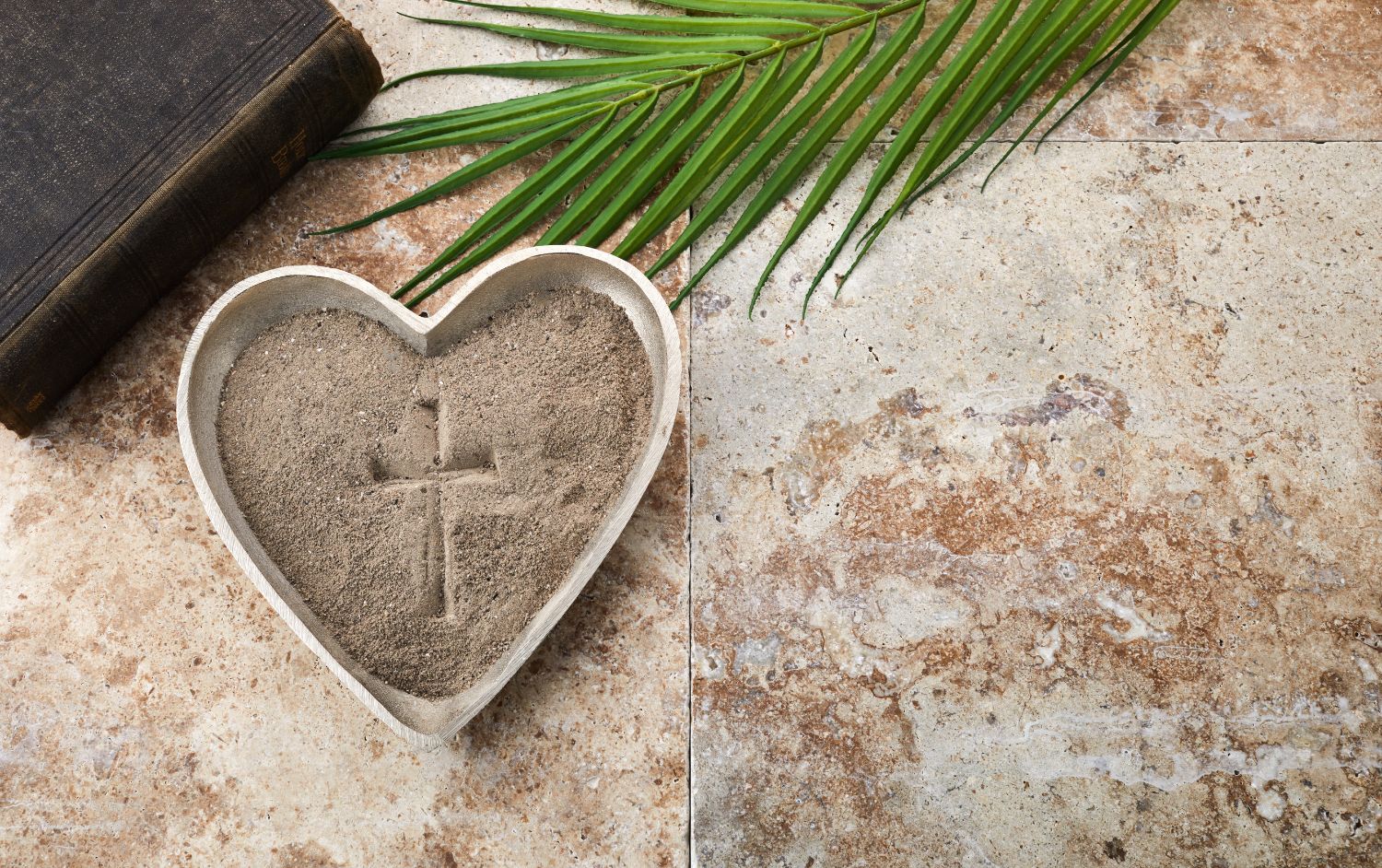
This week we honored Ash Wednesday, marking our entry into Lent, the late winter womb of the liturgical year. While the noise of the secular rings about me, I am trying to travel inside to the sacred, integrating with this somber moment within the eternal cycle.
I have been clinging to the liturgical seasons as a way to anchor myself and my motherhood amidst the precarious web that darkens our outer world at this moment. With cruelty and chaos dominating our headlines and creating shockwaves through our communities, I need a constant I can give to my daughter, regardless of any outcome.
The liturgical calendar has been a solace across time and across borders for eons. I turned to this consoling practice in earnest this past Advent. The election had just thundered through, and the unknown lurked ahead like a terrible limbo. I knew our family needed something more, something greater, something that could take us into Deep Time and encompass all those who have lit the way through other Dark Times. I bought a large, colored liturgical wheel poster that I propped on top of my bedside bookshelf, with the intention to start each morning meditating on where I was in space and time amidst this dial.
Thus, with this in mind, I planned a pilgrimage for my family to mark our entrance into Advent, a bicycling pilgrimage to Our Lady of the Rock, a Benedictine monastery on Shaw Island in the San Juan archipelago. This was an homage to Mary, who carried all the waiting and anticipation of that original Advent. My husband, our 8-year-old daughter, and I each took our bikes onto the afternoon ferry that left from Orcas Island to travel a short distance across the Salish Sea. We landed in the much more remote world of Shaw and began the 3-mile ride to the monastery.
Our ride went up a hill that hugged the coastline, and then we sailed down, still clinging to the shore. The low afternoon Advent sun made the water glow and the green pasture to our left look soft and inviting. After a mile and a half, we turned left, away from the water, past the one-room schoolhouse, and cycled through the forest. It was dusk now and very chilly as the trees cocooned around us. We didn’t see a single car on our ride through the forest.
After 50 minutes of cycling, we arrived at the monastery. It was relatively unmarked, except for a rustic Benedictine cross to the side of the open gate. We turned onto the long, gravel driveway, and rode past Highland cattle roaming in their pasture. The property was dotted with worn but tidy cottages, barns and sheds. We had come to hear evening vespers, which the sisters invite the public to every evening at 5pm.
At 4:50, church bells rang out and we pedalled along, following the noise. Soon we found the chapel – simple but immaculate, aglow with candles. One black-clad monk sat in the pews, and we slid in to join him. The sisters filed in through their own door, sitting in the seats behind a bamboo grille. With lights dim and the single Advent candle lit in its wreath, the evening vespers commenced.
For one hour, the sisters chanted and sang in Latin, following rhythms marked out for them by their foremothers, keeping a time that has been kept for over a thousand years. My daughter drifted asleep for some time on my shoulder and when she woke up, she whispered to me that it sounded like lullabies.
As the vespers ended, the candles were extinguished, final bows were given, and the sisters filed out. Six out of the seven sisters present were aged, with one relying heavily on a cane. Only one was young. There may have been many sisters not in attendance that night, but I wondered how long this monastery would continue on. Two years ago I went on retreat to another Benedictine monastery in Mt. Angel, OR, that one non-cloistered. I was the second-to-last retreatant they had, as the property had been sold to a nonprofit, and the six remaining sisters were together moving into assisted living. In 2023, the New York Sisters of Charity made national headlines when they voted to no longer accept new members.
Such a way of life is coming to a close, a way of life that has served for a millennia and a half to do many things. In a practical way, for centuries it offered an alternative to the expectations of marriage and the dangers of child-bearing. In a relational way, it has provided an alternative to the nuclear family, such as how Jesus modeled. Within this family, one could also access education and other opportunities that would often have been too difficult outside of a religious order. And of course, it has also offered grounding cycles that helped millions across the ages access the Holy. And now it may be dying. There is much to learn from these sisters before they are gone from us.
My family exited the chapel into pitch darkness, a darkness unfettered by any light pollution. We turned on our bike lights and began our traverse back to the ferry landing. As we entered the path through the forest, the trees swaddled us in a nighttime blanket. My daughter, used to the city and unaccustomed to such dark, started crying and explained the dark was frightening. We soothed her best we could and she did a heroic job pedaling. As we turned from the forest onto the shoreline path, the trees gave way and the open sky was alight with stars.
“Mommy, look up at the stars!” my daughter called out from ahead of me. “They’re so pretty!” She was now afire on her bike, her little legs bobbing up and down so fast as she hurtled along the starlit path. “Mama, be careful, there’s a patch of fog coming up,” she called to warn me, suddenly confident in her place as a nighttime cyclist. I felt a peace surrounding us all, after witnessing such a call to the sacred from fellow humans and then feeling the sacredness of night’s alchemy around us. Suddenly, a Barred owl swooped down in front of us, his wings outstretched in nocturnal glory. The last time I saw an owl in flight was exactly nine Decembers ago, when my daughter was nesting inside of my womb. It felt like a gentle sign from all that I cannot see.
We boarded the ferry and stood on the deck, watching the stars fade as the floodlights from the boat illuminated the sky. Back to our very non-monastic lives, but with a prayer for the magic of the vespers to stay with us. To stay with us all. And thus we entered Advent, waiting and preparing for what is to come.
In the brief sojourn into Ordinary Time after Christmas, I read Stephanie Duncan Smith’s gorgeous memoir, Even After Every Thing, where she maps out her travels of the liturgical year through miscarriages, births, and the pandemic. It was medicinal and a compass in my own journey. It was as if she were holding a lantern lighting the next step.
And thus we now enter Lent, Advent’s mirror, and the season I find to be the most grounding rhythm of all. “From dust you came and to dust you shall return” (Genesis 3:19). No pilgrimage awaited this threshold, just a simple attendance at mass to receive our ashes. That seemed appropriate – for Lent is about the stripped down nakedness of our vulnerable mortality, and honoring it in this simple way seems an homage to that essence. My daughter hates when the ashes are put on her forehead, but someday I hope it can help her feel rooted to her place in the Body of Christ. Alone, we are just a mist (James 4:14), but in this miracle of a moment when we are fully alive, our mist together can be a waterfall, a river, an ocean, from which more life can come forth. May it be so. May it be so.