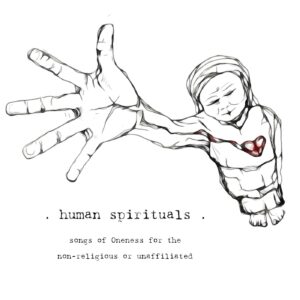
Friends, I’d like to introduce a new collection of songs which I just recently recorded and released: “Human Spirituals, Songs of Oneness for the Non-Religious or Unaffiliated.”
As the title implies, I made this collection particularly for people who – for whatever reason – no longer, (or seldom) attend church, but who miss the grounding spiritual practice of singing together, as a way to connect our souls to the larger reality of all humanity, creation and Creator.
If there is a common story in the lives of my friends and I – from my native Scotland, to the USA and across the world; friends who have been my closest and longest lasting relationships in this life – it’s that many of us were, at some point, deeply involved in a religious church life. And we have, in our own ways and with our own reasons, had to leave that lifestyle, painfully deconstruct our beliefs and loyalties, and embrace an unfolding spirituality which could contain the largeness of our ever growing understanding of life and “God”.
For some of us, this exit from church came through trauma, life altering tragic events, or religious abuse. Others found themselves burned out and alone after years in missions or ministry. Many of us lived and worked alongside folks of differing faiths, or different sexual orientations, and we found we could no longer divide ourselves from those we loved, or exclude the good we’d experienced in their lives as “ungodly”. For almost all of us “leaving church” was a painful unravelling of hardwired cultural beliefs and an obedience to a deeper ache that called us to journey on and allow ourselves to outgrow a small and exclusive belief system.
In talking to many of these friends over the years the one element of church-life which they most commonly say they miss is “worship”.
I put the word, “worship” in quotation marks, because really what we’re talking about here is the singing part. The part in the service where we use that wonderful gift of vibration, the resonance from which we’re made, the gift of melody, to engage with God, creation and one another. This spiritual expression is such a natural part of human creativity, that for me the word “worship” feels like too small a verb to describe the openness and release that the practice can provide.
And that is why we miss it, isn’t it?
Science has now discovered that we are made up of vibration and so it’s little wonder that we have an organic desire to “pour out” that resonance in a practice of love, community and rhythm.
In recent years one of my closest friends was expressing her regret at the loss of “worship” in her life, “But” she confessed, “when I go back to church and try to engage, I realize, as I’m singing, that I don’t believe in many of the ideas behind those words anymore.”
“Why don’t you”, she asked me in a later conversation, “make some spiritual “worship” songs without all those things – the things we can no longer believe in?” God-songs without the triggers, without the dogma, the guilt or the exclusivity. I shrugged the idea off at the time, but when it was suggested to me again, I allowed the concept to ferment a little and found myself wondering, “Well, what would those things be? How could we outline the triggering phrases of cultural doctrine that so many of us felt an urgent need to leave behind?”
And of course, because I myself had to wrestle with “those things” for many years, the answers came to me quickly: exclusivity, empire, the ideology of “God’s army”. Tribalism: us-and-them, or worse, us-against-them. Our God, not theirs. Strictly male-dominated images of God. God as king, judge or even punisher, rather than soul-friend, deepest Source, or Creative Spirit imbuing all things. Concrete unquestionable certainties, rather than Unfolding Mystery.
And of course, religion as a system of control, rather than Love as a life-giving journey of on-going discovery.
Once as young believers we trusted in the pyramid shape of hierarchy – with God exalted somewhere high above us, and the pastor someplace in between – to give structure and boundary to our growing lives, but as time moves on we become aware of the infinite and intimate nature of all Life. Time, space and experience change the view and Reality reveals itself as “a circle, whose center is everywhere and whose circumference is nowhere.”
When I let myself list them, the “do nots” came quite easily. So then, I asked myself, what are the “must haves”?
These came quite easily too:
Connection to one another, to all of creation and to Creator. Language that centers our beings with stillness and peace; finding our place in the wholeness and oneness of all things. Refrains of release and rebirth, gratitude and focus. Acknowledgement of pain, worry, anxiety and fear, but also openness to comfort, healing and sustenance. I wanted to add ingredients from my own ancestral lineage – the Celtic church – by using language which connects us to the invisible and infinite through nature’s elements: light, air, water and soil.
With these ideas quickly gathered I found the collection of songs beginning to take shape with words that could affirm the sacred “loved-ness” of all living things.
And, because so many friends on this journey have experienced painful religious abuse, I decided I wouldn’t use the word “God” at all, in any of the songs, preferring to allow space for Mystery to unfold uniquely to each individual as they are able and ready to receive it. (Coincidentally my biblical namesake, Esther is one of the only scriptural stories where God is not mentioned by name.)
I found I could quite easily use other words and other ideas. The Hebrew word for Spirit for example, “ruach” has multiple meanings, including breath, wind, and God’s essence:
Song Sample One: “Breathe Deep My Soul”
The feminine aspects of the Divine, as caregiver:
Song Sample Two: “Paths of Love-Soaked Life”
And simple repeated choruses of release to encourage our souls:
Song Sample Three: “Fear”
If you – like me – come from a more “matter-of-fact” type faith tradition, my description of these guidelines might sound like a lot of flowery language or even watered-down half-beliefs. But the truth as I’ve experienced it, is that it takes courage and unrelenting conviction to allow ourselves to grow past our first religion and obey the heart’s desire for something wider, deeper and more inclusive of all people.
It takes courage to step into the liminal space and allow God to be unknown. In secret. To let the ever-real, Christ-fulfilled work of death and rebirth, loss and new growth, have its way in our lives.
“God orchestrates systems change. Change happens all the time
so that every generation, every community, every person
can experience God in their world, their context, their time.”
– Elaine A. Heath, God Unbound
These last few months it’s been a pleasure to work on this collection of wide-open “worship” songs, but I’d be omitting my own struggles if I didn’t confess that as the grandchild of missionaries, the daughter of pastors, there were many days when I could hear my inner religious critic ask, “Are you sure we’re allowed to make spiritual songs that don’t define God? The christian God? But as often as the hardwired question came, the answer again and again in my heart was a resounding yes. Yes!
Yes. Most especially in this time, when the church in America is closing its doors. Defining itself by exclusivity; the long list of those who are not welcome, not included, who don’t belong.
Spiritual singing is for everyone, wherever we may find ourselves on the journey, however we name God, or maybe most especially if we don’t or can’t. We may find the Divine has outgrown our frail words and to pin such beauty down with our worn-out syllables feels blasphemous. Or perhaps we’re in that most painful liminal space where all we can do is echo Christ’s own words of surrender and unknowing, “Why God, why!?”
If your soul could use some moments of restoration, some sane, grounding sounds to break through the violent noise raging in our society I hope these songs – to listen and sing along to – can give you that centering time and strong peace.
The title of this collection seemed to arrive with the songs themselves. “Spirituals” is the beautiful name that was given to songs composed by the enslaved, or formerly enslaved, African peoples of the American south; often containing messages of resistance and resilience.
I chose this musical term rather than “hymns” or “choruses”, because of my desire to honor those who birthed American gospel music, not from inside the walls of clerical authority, or state sanctioned institutions, but from the holy sanctuary of their own souls. Their musical ancestorship and influence echoes now from almost every genre of music world-wide. To me, this reveals the eternal pattern and movement of divine Love, which is often seeded in the depths of suffering, but which bears lasting fruit everywhere.
And “Human”, because it is the name which Jesus used most often to describe himself, not assigning himself to one culture, one religion, one belief system or one race, but to the oneness of us all.
My hope is that in the difficult times we face, folks of every diversity, every language and culture, will dig out the deep sounds from our souls and feed one another with songs of love and connection. To sustain us through this strife-filled time of violence, division and inequality, music is most surely a food which our souls will need.
If you would like to hear them, these Songs of Oneness are now available on all the regular streaming services like Spotify and Apple Music.
Lyrics and Chords are also available on my website.