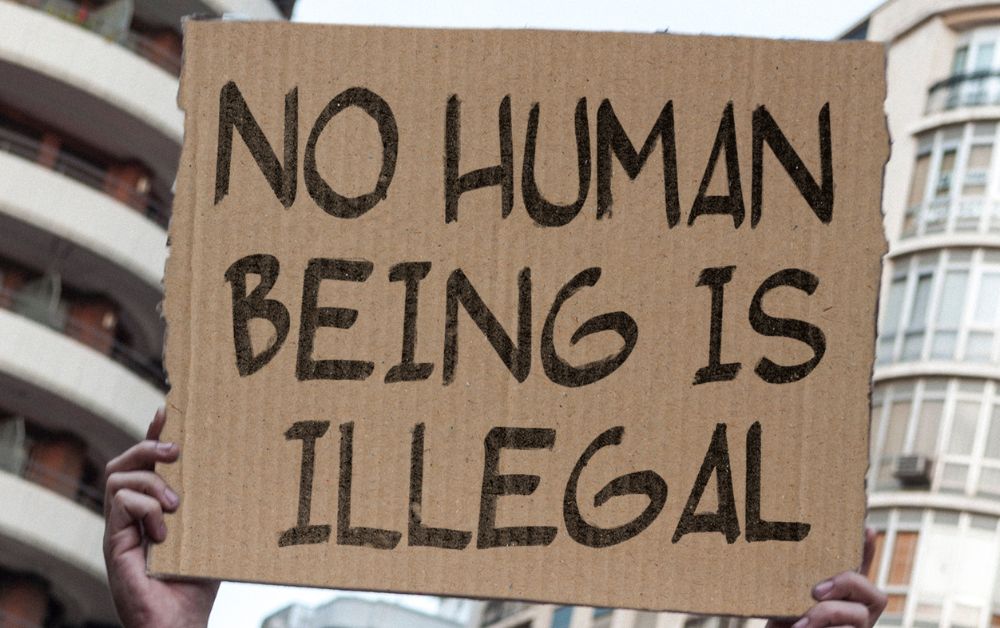
It should go without saying, but it needs saying: Immigrants are people. To many people, however, immigrants are not people. The conversations that continue to be had about immigration in America are often centered around the utility of immigrants. What work can immigrants do? What labor can be extracted from immigrants? What skills do immigrants have? But this is the language of commodification. To many people, immigrants are nothing more than commodities.
The commodification of immigrants is nothing new. Immigrants continue in a long and sordid American history of exploitation, exploitation of people. For centuries, European colonialists, racialized as white, trafficked enslaved Africans, racialized as Black, to the Americas. In the post-Civil War era, with the end chattel slavery, the exploitation of Black people continued. In Southern states, states that had seceded to form the Confederacy, state governments enacted black codes. These laws targeted Black people, subjugating them to arrest for minor offenses, and once convicted, forcing them to perform labor under, for example, debt peonage and convict leasing. With these and other Jim Crow laws, formerly enslaved Black people and their descendants were economically shackled. Though emancipated, for the overwhelming majority, their freedom was not accompanied with land ownership. So, they were essentially forced into sharecropping, working on the same plantations and lands of their former enslavers.
While Black people languished under systems of American apartheid, in the West, Chinese immigrants were also enduring racism and discrimination. In 1863, construction of the Transcontinental Railroad began. After placing a job ad and receiving a tepid response from white laborers, Central Pacific Railroad director Charles Crocker recommended hiring Chinese workers. As Gordon Chang, Stanford professor of American history and author of the book, Ghosts of Gold Mountain writes:
“For five years, from 1864 to 1869, Chinese constituted by far the largest single workforce in American industry to that date, not surpassed in numbers until the Industrial Revolution in the late nineteenth century.”
The completion of the Transcontinental Railroad, was instrumental in America’s economic growth. As Chang writes: “The United States became the only advanced capitalist country in the world that enjoyed year-round direct access to both the Atlantic and the Pacific.”
However, Chinese workers were paid significantly less than white workers, including European ( largely Irish) immigrants. Additionally, “the overall work duties and living conditions of the white rail workers,” writes Chang, “compared to those of the Chinese rail workers mirrored the pervasive racial inequality of American life at the time.” And, in keeping with America’s history of racism and white supremacy, there was violence—both legal and extrajudicial violence. As Chang writes:
“In October 1880, an armed mob of up to three thousand attacked the Denver Chinese community, which numbered a few hundred. The rioters, aiming to expel all Chinese from the city, burned residences, looted, and beat Chinese men and women, killing one. City officials rounded up more than two hundred Chinese and placed them in the county jail for their own ‘protection.’”
Two years later, the United States Congress would pass the Chinese Exclusion Act of 1882, the first in a series of laws, restricting immigration to America. The exclusion act of 1882 included a 10-year ban on Chinese laborers and barred state and federal courts from granting citizenship to Chinese resident aliens. These laws, which effectively limited immigration only to European immigrants, would be in effect until the passage of the Immigration and Nationality Act of 1965.
In 1942, with U.S. labor shortages due to World War II, an agreement was reached between the U.S. and Mexican governments. An executive order called the Mexican Farm Labor Program established the Bracero Program, permitting Mexican nationals to legally enter the U.S. to work as temporary guest laborers. The program was renewed both at the end of World War II and during the Korean War, and ended in 1964. During those 22 years, millions of Mexican workers labored in various American industries, particularly agriculture, while being discriminated against. As with communities of Black and Chinese people, and other groups of people not racialized as white, Mexican communities were subjected to racist violence. And as has been the case throughout much of American history, the American government itself was responsible for a great deal of violence.
In the summer of 1954, under the Eisenhower administration, U.S. Attorney General Herbert Brownell and Immigration and Naturalization Service (INS) Commissioner Joseph Swing launched “Operation Wetback,” a federal program to locate and deport undocumented Mexican nationals. (The pejorative term, “wetback,” used in the official name of this federal program is a racial slur that has been used to refer to Mexicans and people of Mexican heritage.) An official report from the INS indicated that 1.1 million people were apprehended. However, some historians and scholars estimate that the actual number is perhaps closer to 300,000. Regardless of the actual number, what is clear is that actual people, including American citizens who were caught up in raids and deported, were actually and actively harmed in what was then the largest mass deportation in American history. And such a large scale deportation effort has long been at the heart of Donald Trump’s immigration policies.
In 2016, then as a Republican presidential candidate and before being elected to his first term, in an interview with CNN’s Jake Tapper, Trump praised “Operation Wetback,” calling it “a very effective chapter” and “very successful.” In 2025, having been sworn in to a second term, Trump is set again to attempt to make good on his campaign promise to “launch the largest deportation program of criminals in the history of America.” As of this writing on January 23, 2025, with only three full days into his presidency, with only three full days into his presidency, Trump has signed a flurry of executive orders, including some that have already had negative effects on immigration. Surely, there will be more orders, more legislation, and more legal battles to come.
In 1967, Rev. Dr. Martin Luther King Jr. spoke at the Riverside Church in New York City. During his speech, entitled “Beyond Vietnam: A Time to Break Silence,” King said the following:
“I am convinced that if we are to get on the right side of the world revolution, we as a nation must undergo a radical revolution of values. We must rapidly begin the shift from a ‘thing-oriented’ society to a ‘person-oriented’ society. When machines and computers, profit motives and property rights are considered more important than people, the giant triplets of racism, materialism, and militarism are incapable of being conquered.”
King was right. We do need to undergo a radical revolution of values. However, that includes not only valuing people more than things, but also rejecting the commodification of people as things.
Immigrants are people, not machines. Immigrants are people, not profit motives. Of course, the targeting and deportation of immigrants will have a negative impact on the American economy. However, first and foremost, immigrants—individuals, families, people—will be harmed. So, as we continue to advocate for the rights, safety, security, and well-being of immigrants in America, we would do well to focus on the humanity of immigrants rather than the utility of immigrants and the adverse economic consequences of their removal and absence from our communities. Remember, immigrants are people.