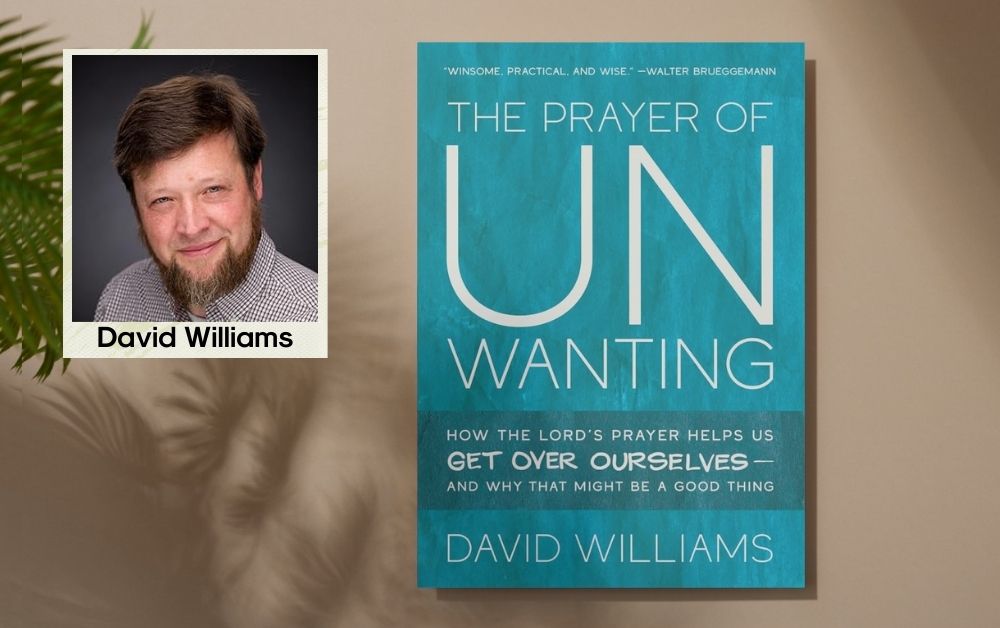
Excerpted and adapted from THE PRAYER OF UNWANTING by David Williams (Broadleaf Books, 2025). Reprinted here with permission of Broadleaf Books.
Praying in a Broken Time
I’m not particularly great at praying. Even after fifty-plus years of doing my best to follow Jesus, I often feel fumbly at it, uncertain.
Pastors are supposed to be magically amazing at praying, radiant with our capacity for mystic incantations that summon angels, who are at our beck and call. We’re supposed to be radiantly confident, so pray-ey that we’ll pray at the drop of a hat.
Not me. Thinking and writing and preaching and discussing: sure. Stillness and walking meditations? Those I can do. If you call tasks like singing and washing dishes and taking out the trash, in and of themselves, prayer, then I’m good.
It’s not that the words don’t come for me. After twenty years of ministry, words come easy. I can pop off an impromptu prayer at the drop of a hat. My struggle is with the words themselves, with the limitations of human language.
My spoken prayers often feel so small, so inadequate. Here I am, a tiny, ephemeral lump of life, humming the air around me with vibrations that serve as symbolic referents for those who live in my culture. These . . . sounds are supposed to impress or convince or change the mind of the Creator of the Universe? They have no more power than the chittering of a frightened squirrel, or the angry cawing of crows as they drive away an intruding red-tailed hawk. This is the sort of overthinking we Presbyterians are good at.
Perhaps that’s not the struggle you have with prayer. Maybe you’re just looking for a way to pray that has meaning. Perhaps you’re in a place of challenge, where you’re so shattered and broken that the right words never fall to hand. I’ve been in all those places myself.
Or maybe you’re yearning to step back into faith after a time away, but the whole idea of prayer still seems awkward or unnatural or pointless. When I returned to Christian faith in my mid-twenties after walking away from it in my late teens, I struggled to pray. Prayer came hard to a pathological overthinker like myself. My words always felt inadequate, no more meaningful than chicken scratches in barnyard soil relative to the Creator of the Universe. No amount of me rambling on meant anything.
But here’s the thing: I have learned to pray. I pray—with words—every single day, many times a day. Prayer is how I begin my mornings, while I’m lying there and the snooze timer’s counting down my minutes. I pray while walking, while running errands, while puttering about the house. I pray a whole bunch when I’m driving on the Beltway or tiptoeing my motorcycle over patches of ice on winding country roads during the winter.
The question is: how? How can average or even deficient pray-ers like me pray? How can we go about this thing called prayer?
There are many ways to pray, almost as many as there are human beings. There are also countless books on the subject.
Being a library sort of person, that’s where I go to read up on anything, and there I discovered several shelves of books about prayer: books from mystics, books from pastors, pastel-covered hardback books from tee vee preachers eager to sell you a prayer that’ll make you prosper. It’s sure done good fer them.
One day I went searching for one book about prayer in particular. Though it was supposed to be right there on the library shelf, it wasn’t. Huh, I thought. I went back and checked the catalog system. Yup. It was supposed to be there. “Lord, help me find that book,” I said, smiling to myself, and then went back. It still wasn’t there. But like Inigo Montoya guided by his sword in the woods, I was not to be denied. I looked behind a neat row of books and there it was, lying flat on its back, shoved back to a place where no one could read it.
The book was a runaway bestseller from a few years back: The Prayer of Jabez. This book was quite the thing, back around the turn of the millennium. Here I was, years later, finally getting around to reading it. I guess I’d never realized just how short it was, because dang, it was tiny. Ninety pages and change. Very small pages. Very large print.
I started in, and it was . . . well, it was interesting.
The whole book rests on two verses from the Book of 1 Chronicles: “Jabez was more honorable than his brothers. His mother had named him Jabez, saying, “I gave birth to him in pain.” Jabez cried out to the God of Israel, “Oh, that you would bless me and enlarge my territory! Let your hand be with me, and keep me from harm so that I will be free from pain.” And God granted his request.” (1 Chron. 4:9-10 ).
In the book, there is a lot of talk about Jabez and his faith and his motivations. This struck me as odd, given that the only place in the whole Bible this guy is mentioned is those two verses. And the prayer itself? Just that one verse, squirreled away in one chapter of the book of Chronicles: “Oh, that you would bless me and enlarge my territory and that your hand might be with me and that you would keep me from hurt and harm!” The author of the book decided to pray the prayer of Jabez every day, and he credited it with all sorts of amazing supernatural events in his life.
It’s a super-secret prayer, after all—supposedly one that no one else had noticed. Why, you may ask, was it secret? Because it was hidden away in a huge and agonizingly boring list of utterly unpronounceable names. Chapter after chapter of names. Seriously. That hiddenness, I think, was part of the appeal for this author and his audience. Here was a thing of mystery, buried away, like a mystic rune you find in a cryptic book.
This is what humans want. We want that one easy trick that will magically solve all our problems. “If you pray it every day, it’ll work,” the author proclaims, with utter and earnest confidence. “Be unafraid to pray selfishly,” he also proclaims, which struck me as a little odd. But most of the rest of the book was kind-hearted, simple, and earnest, and the prayer itself was easy to remember.
Mostly, that book was about a prayer that gets you what you want. And oh, how we want what we want! How much do we want that? For this little secret magic prayer, we wanted to the tune of over nine million copies sold, number one on the New York Times bestseller list for months and months.
Back then, and even now, it struck me as bizarre that so many Christians would seek out a secret magic prayer, one found in a justifiably obscure corner of the Bible. Why? Because if you follow Jesus of Nazareth, he tells you how to pray.
The challenge with the perfect, simple prayer we know as The Lord’s Prayer is that it can become a tumble of vowels and consonants, a jumbled mass of sounds. We can pray it on autopilot while our mind wanders far afield. Yet the challenge of a thing is often its genius. The very words so long burned into memory means that the prayer almost prays itself— which means we can pray it anytime, perhaps especially in moments when our own words fail.
Prayer, if it is to be a real connection with God, must shake us loose from ourselves, drawing us away from the shallow selfishness of our expectations. If it does not, then we don’t really put ourselves in a position to receive what Jesus is offering.
So many of us have been well-schooled in praying for the things we want. We’ve learned to go to God for health, and security, and safety for ourselves and our loved ones—for adding to our property, in the words of Jabez. But in His short, radical prayer, Jesus taught us to pray for what we don’t always want.
For God’s will to be done, not ours. To be forgiven as we forgive. For God’s kingdom to come. This ancient prayer contains radical potential for us today precisely because its words are not our own.
It’s a prayer that doesn’t promise to give us what we want. It changes the heart of our wanting.
Because when our desire is broken, what we want so often hurts us. What we want can so often be nothing more than what we have been programmed to want. We want more and more and more, because if we are to be good little consumers, we must never stop desiring more. We want because we are afraid of not having enough. We want because we feel compelled to have more than our neighbor, particularly if we don’t like our neighbor. We want to be dominant. We want to have power over others.
And Lord have mercy, do we see the impact of those ill-begotten desires around us right now.
Our broken wanting breaks the world.
In the face of that brokenness, reclaiming the prayer that grounds us and shapes us towards grace seems all the more essential.