Just a day after the inauguration of Donald J. Trump as the 47th president of the United States, President Trump, Vice President Vance, their families, and other important political figures attended a service at the Washington National Cathedral. During this service a homily was given by the Right Reverend Mariann Budde. In this homily, Bishop Budde preached a message which called upon them to be merciful to the many individuals and groups who are fearful of this new administration, particularly those in the LGBTQ community and immigrants.
It is highly likely that many of you are already familiar with the homily and the events that followed. To my disappointment, this message received a swift, furious, and vitriolic response from many Christians, some of whom even went so far as to denounce the “sin of empathy.” Politicians were also quick to fire back, with one congressman even going so far as to suggest the Bishop’s deportation and another in the offering of a resolution to denounce the Bishop’s message. All in all, the debates on social media made one thing abundantly clear: there is not only a complete and seemingly irreparable political divide, but ultimately a divide over what the gospel message even is at its core.
Whether one agrees with all of the Bishop’s theological and political positions is, in my opinion, irrelevant to the controversy. What matters here is the content and spirit behind the homily, of which I can find no biblical or theological error. Yet the criticism levied against the Bishop largely comes down to the belief that it was inappropriate, insulting, and a mishandling of the gospel message. But is this truly the case? Does the gospel message have a political, albeit nonpartisan, dimension? It seems clear to me that even a cursory glance of the Old Testament/Hebrew Bible reflects that there is a place for critiquing political authorities when they commit unjust and immoral acts. There are many, many examples of prophets whose most remembered moments are when they confronted a king for their immoral actions and their abandonment of the covenant. Yet for many there is a disconnect here, particularly since the context of Old Testament/Hebrew Bible was quite different from our context today. After all, we live in a western democracy with a strict, albeit theoretical, separation between church and state, a reality not reflected in the political structure of ancient Israel/Judah.
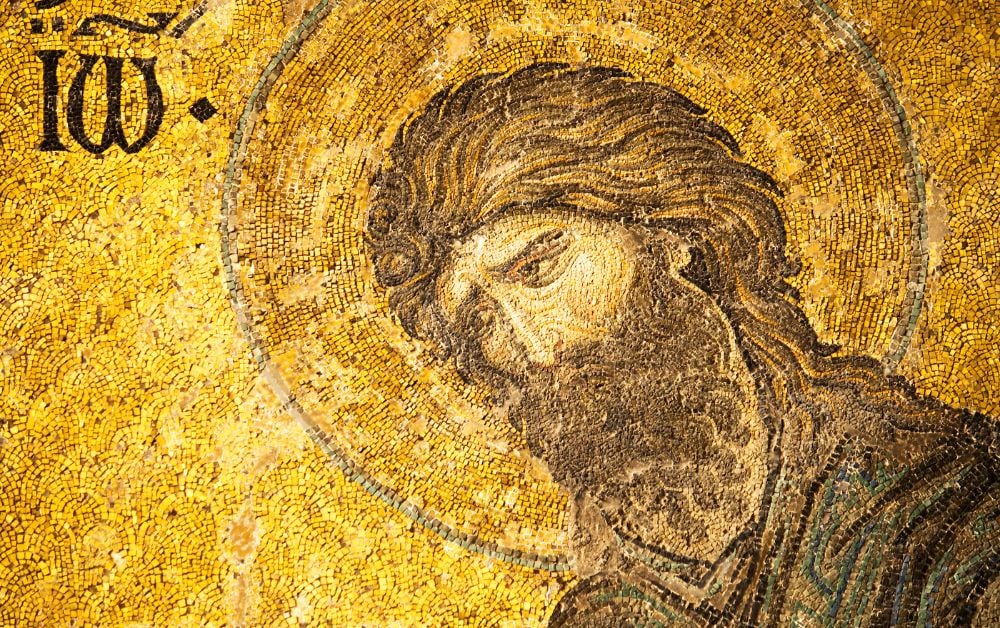
Though I believe that those prophetic calls are just as relevant and vital for the Christian faith today as they were during those times, I want to explore an example of speaking truth to power in the Bible that is perhaps less difficult for us to envision today: John the Baptist and Herod Antipas. This episode is recorded in at least some form in all four Gospels (Matt 14:1–12; Mark 6:17–29; Luke 3:19–20; 9:9; John 3:24) and by the first-century historian Josephus (Jewish Antiquities 18.5.2). It recounts how John the Baptist—the forerunner pronouncing the arrival of the Messiah and the one who baptizes Jesus Christ—was beheaded by Herod Antipas—son of Herod the Great who we know from the account of Jesus’ birth.
As Matthew states, “For Herod had arrested John, bound him, and put him in prison on account of Herodias, his brother Philip’s wife, because John had been telling him: ‘It is not lawful for you to have her’” (Matt 14:3–4 NRSV). Here, we see that John the Baptist rebukes Herod Antipas due to a moral fault. As Josephus tells us further, Herod had visited his brother Philip and fell in love with Philip’s wife, Herodias. Following this affair, both Herod and Herodias agreed to divorce their spouses and marry one another. This event was not an isolated or minor incident, but one that had significant political ramifications at that time. This is because Herod’s previous wife was in fact the daughter of another king, Aretas the Nabatean who ruled south of Judea. Herod’s actions angered Aretas and led to a military conflict between the two. Josephus even notes that many at that time felt that this conflict was divine judgment over Herod’s actions, both in the affair and in his treatment of John the Baptist.
So we see that, even in the midst of the complex political situation of the time, John the Baptist still spoke up and criticized Herod for his immoral actions in the event. Unfortunately, this prophetic rebuke led to John’s arrest and eventual execution. Yet, we see in John’s actions a continuation of the prophetic confrontation of kings in the Old Testament/Hebrew Bible which the church for two thousand years has also emulated.
With this story in mind, I want to encourage you all today with this: there is indeed a place for prophetic preaching which calls leaders to account for their immoral and unjust actions. Regardless of the prevailing views in our society today, virtue and character matters in the political realm. While the government is not the church and therefore not beholden to Christian belief or ethics, it is still called to a moral standard from God which includes the defense of the innocent and the vulnerable. To this end, the church has a vital role in speaking on behalf of the marginalized in society; for when the government engages in immoral and unjust practices, the church, as part of its witness to the true King of Kings and Lord of Lords, must speak out and proclaim what is right, good, and true.