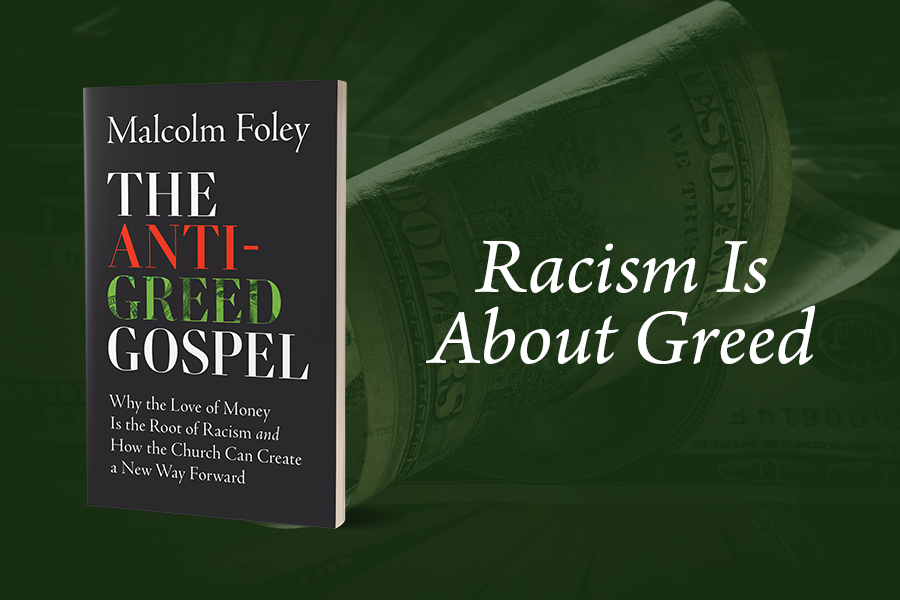
Money. Mammon. Riches. All names for the same rival god, the service of whom the Scriptures call greed. Mammon lies at the root of lynching, of racial violence, of racial capitalism, and ultimately of the very concept of race itself. The demonic cycle of self-interest cannot be broken personally, communally, or cosmically without reckoning with greed. Those who are best positioned to spearhead this reckoning are those who serve the God of the Scriptures.
The best way to combat greed, envy, and their systemic counterpart, exploitation, is through philanthropy. By philanthropy, I mean the actual love of humanity, even though when we think about that word, we tend to think about lavish generosity. I am very intentionally not saying that the opposite of exploitation is generosity because generosity, while good, can be one sided. It can easily turn into paternalism. Our vision of philanthropy, often hearkening back to Andrew Carnegie, Cornelius Vanderbilt, John D. Rockefeller Jr., and their ilk, is often limited to thinking about only generous donations to good causes. We don’t often consider that those donations often come with strings attached: ways in which the giver maintains control and sometimes gains power (or significant tax benefits). The philanthropy I have in mind to rebut the demonic cycle of self-interest is not that kind. Rather, I invite you to consider a different kind of philanthropy: divine philanthropy.
The incarnation is described in John 3:16 as a gift. We are told that God loved the world in a very particular way: he gave his Son. The nature of this philanthropy, this divine love for humanity, is such that it did not leave God unchanged. Now, before the classical theists get mad, I should clarify that I’m not saying that the nature of God changed. What I am saying and what every Christian would affirm is that there was a time when the Son of God was not human. The Son took on flesh. He became human. He assumed the form of a servant. He emptied himself as an act of generosity.
In human philanthropy, givers can give from a distance, keeping a position of so-called superiority while receivers remain in a position of so-called inferiority. That is not the kind of giving that Christ calls us to, nor is it the kind of giving that he exemplifies at the cross.
Instead, when we see our brothers and sisters in need, we are to give in a way that brings givers and receivers together, mimicking divine philanthropy. Solidarity is another word to describe this reality, but this solidarity has a particular purpose: equality. This is Paul’s focus in speaking to the Corinthian church in 2 Corinthians 8. To borrow controversial language, Paul is not talking about equality of opportunity. He’s talking about equality of outcome, which characterizes the eschatological kingdom. This kingdom is a kingdom in which everyone has what they need and has enough to share. It is depicted as the mountain of the Lord in Micah 4:4: “Everyone will sit under their own vine and under their own fig tree, and no one will make them afraid.” After appealing to the Corinthians to give to their poorer Macedonian brothers and sisters, he makes two profound theological moves, an appeal to Christ and an appeal to equality.
Content taken from The Anti Greed Gospel by Malcolm Foley ©2025. Used by permission of Brazos Press, a division of Baker Publishing Group.