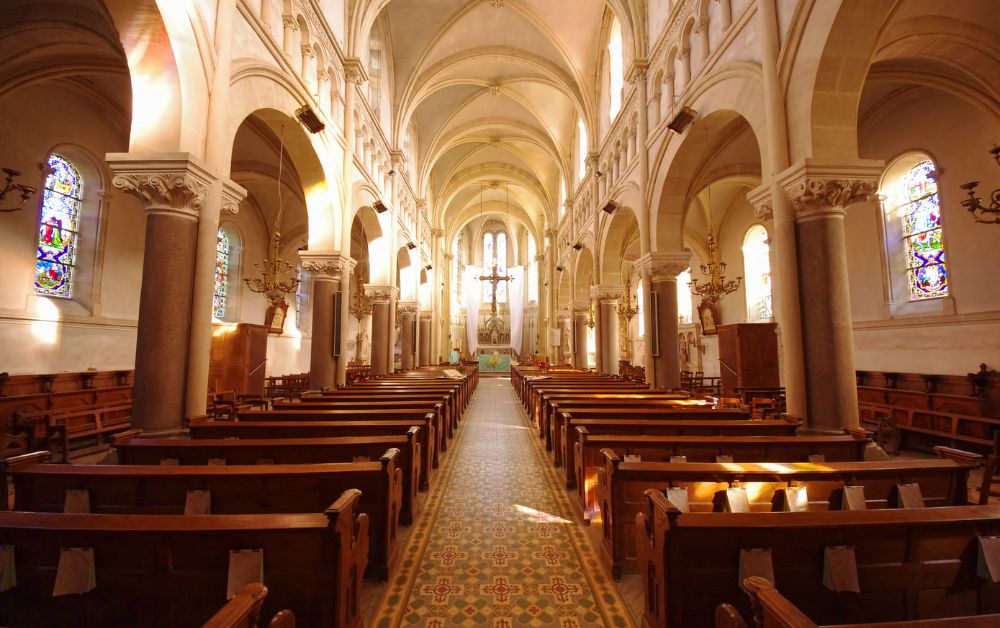
“[L]et us worship God again in simplicity, instead of making a fool of God in splendid edifices; let us be in earnest again and stop playing.” – Søren Kierkegaard (‘The Present Moment’, 1854)
“[T]he Most High does not dwell in temples made with hands.” – Stephen (Acts 7:48-50, Isaiah 66:1-2)
No matter what your ‘theological/denominational/doctrinal persuasion’, this much is clear: the case from Scripture itself against the time-consuming construction of costly ‘church buildings’ – often open to the public some 1-2x a week, and a prerogative exclusively held by relatively ‘privileged areas’ (i.e., those which retain a certain level of security/stability, exorbitant financial reserves to cull from, et cetera) – is indeed rather obvious. We would do far better in prioritizing, in lieu of ‘it’, what Messiah actually emphasized and even commanded for us to regard as paramount – dedicated, unpretentious and self-sacrificing service to ‘the least’ of the earth (Mark 10:21; Matt. 25:31-46), the precise need of the hour.
We live, in Maria Skobtsova’s words, ‘eschatological times’. As Skobtsova understood and exemplified superlatively, nothing less than an international movement of self-effacing (Matt. 6:1-4), non-stop service to ‘the least’ of every nation on earth will suffice anymore (Matt. 7:11; Luke 10:25-37); if He ever ‘winked at such ignorance’ (Acts 17:30) as ours, as pertains to ‘what we have, in effect, become’; how (arguably) diametrically opposed we find ‘Christendom’ and ourselves to be, to His purposes, to He Himself, at this momentous hour – after two millennia, it is implausible He continues to wink at aforesaid presumption, willful ignorance and subtle-or-outright rebellion to His words and Spirit, now – the world being ever-increasingly ‘on fire’, with seemingly ‘no solution in sight’, and in no small part because of how we have chosen to ‘play, as opposed to be, the church, the light’ (i.e., wasted time and resources); correspondingly, anything less than Matt. 25:31-46’s ‘brand of Christianity’ – which a world-afire-and-in-desperate-need, in many a sense, awaits the unveiling of – somewhat inevitably smacks of ‘pharisaism’ and ‘avoiding the issue’.
Keep in mind that the only temples (or tabernacle) in relation to Him which Elohim even countenanced to be built (according to The Bible), were to be constructed in specific and particular localities, of His own prescribed choosing – with even the minutest, precise details and the minutest, exact measurements vis-a-vis each relevant ‘house of worship’ conveyed in crystal-clear terms by Adonai Himself.
If He ever did wink at our collectively deviating wildly from said paradigm, perhaps willfully ignoring such plain-to-see Scriptural realities, and peradventure presumptuously and incautiously getting ahead of them (to construct our ‘own buildings’, albeit in His Name, etc.)– one might venture to say, at this juncture, given the gravity of our present global predicament and moment, and the mass confusion engendered by such ‘mixing-up of priorities’ – He may not wink at as much any longer.
As ‘most everyone knows by now’, the early believers in Yeshua – deemed to be among the truest and finest Christianity has ever known – did not seek to construct such edifices-of-worship; such a topic is not even broached in The New Testament, except in a prohibitory (that is to say, in effect, ‘no’) manner, as was arguably the case in Stephen’s final address before his martyrdom.
Subsequent to the appearance of The Messiah, the focal point came to be we ourselves becoming, through transformed lives: ‘a habitation of God by the Spirit’ (Eph. 2:22; 1 Cor. 3:16; John 14:23, et al.); or, understanding Messiah Himself to be The Temple (Matt. 18:18-20, et al.). What has become an arguably- or near-idolatrous practice, the manmade, man-centered prioritization of ‘the church building’, has had the deleterious effect of at least sometimes undermining, sometimes impeding: a more direct, sensible and likely more fruitful path vis-a-vis these precious and accessible-to-all realities – of daily, intimate communion with God, and with our neighbor (Mark 12:29-31).
As is well-known, in stark contrast to us, these early Christians ‘held everything in common’ (Acts 4:32), distributed necessities of life according to persons’ day-to-day needs (4:34-35), and congregated in, essentially – random apartments, or houses (2:44-46).
As it turns out, this was an ‘excellent’, practical and profoundly more rational approach (and, of course, a vastly more joyous and egalitarian one, to boot), making far more sense than what ‘we are doing today’ (consider, for a final moment):
– To avoid needless premature deaths – which may arise when ‘broadcasting’ a given location of worship, amid myriad ‘dangerously and extremely hostile’ actors. That is to say, it is not necessarily ‘heroic’ or ‘beautiful’ (nor is it Biblical) to build church buildings in aforesaid hostile territory, where violent persecution is not an infrequent occurrence – it is rather, potentially, putting the lives of His people needlessly-at-risk, for an object that is a mere tradition of man (Matt. 15:8-9; Mark 7:6-7).
– To avoid unnecessary exorbitant expenditure of potentially life-saving resources – The early church could not be considered monetarily rich by today’s standards – yet, with far less, they were certain to have done a comprehensively better job in ‘remembering the poor’ (Gal. 2:10); had ‘extracting tithes’ of it’s congregants for the purposes of property-acquisition-and-construction-of-an-edifice been at the top of the to-do list, it isn’t hard to see that a de facto abandonment of the poor – such as we are witness to today – would have likely transpired.
– To safeguard spiritual integrity – As Red Letter Christians, we are aware of the injunction, by way of Messiah’s own words to us, to live as if each day of our sojourn here might be our last (Luke 12:35-48; Matt. 24:45-51; Mark 13:33-37; Luke 21:34-36 et al.). Perhaps correspondingly, in a number of Epistles, respective Apostles/writers seem to firmly believe that His Parousia is imminent, potentially within their own respective lifetimes; Paul, James, Peter, John, The Book of Hebrews – all make reference to His Second Advent as if it could come within their generation.
Many focus on ‘how mistaken’ that assessment was. Yet there is a redemptive aspect to this. Perhaps living with that ‘holy expectation’ was a key to their remarkable discipline and extraordinary daily walk with Him. Whatever the case may be – it is again easy to infer that ‘building church buildings’ was never on their agenda – for the very constructing of these edifices (and all of the planning, fundraising, mobilized human effort/expenditure inevitably involved), is presupposed by the assumption the societal order will be stable, at least for a generation or two (without such a core presupposition, who would dare to raise ‘the millions of dollars or more’ that can be required?).
In other words, it was part and parcel of the early church’s spiritual practice to live, to pray and to act as if His Parousia was on the horizon – building ‘church buildings’ was thus unthinkable to these believers.
Yet, and with all due respect: for those who would cling to ‘the church building’ idea as something indispensable, something helpful – Godspeed – with one concluding caveat: In light of the above, it is advisable to begin opening the doors of these places (7 days a week) to the homeless (Isaiah 58:7; Zechariah 7:9-10), those who are uniquely suffering (Matt. 25:39; Jer. 7:4-7) and those who need care (Luke 10:29-37).
Anything less than this – in our age, characterized and seemingly defined by harrowing and unspeakable injustices – runs the risk of ‘playing with fire’ (Heb. 12:29).
Yi Dongjeong is a writer based in South Korea.