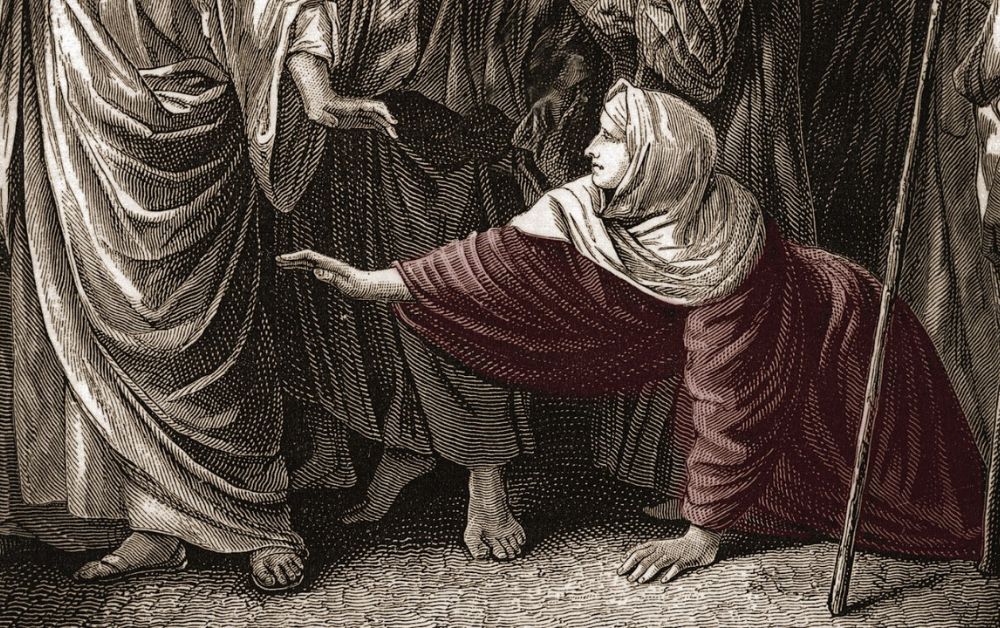
In Jesus’ day, the presence of blood meant a person was unclean and required specific ritual practices to become cleansed. To touch others or other objects without such ritual cleansing caused sin to accrue to that person and to whatever or whomever was touched. Therefore, for this woman, who had some form of chronic bleeding over a twelve-year span, to dare to even go into the crowd was a huge “sin”. To go even further and to touch the robe of a spiritual healer/leader was tantamount to cursing him with leprosy.
Yet what happened? Jesus felt a flow, shall we say, of healing energy moving out of himself. This we can accept as part of the story even if we doubt it is actually possible. (However, a clinical massage therapist I know very well, trained in Biological Sciences, at times actually physically feels the tensions and pains of clients whose bodies she is working on. She is then able to consciously have these “energies” pass through her into the earth–even when she is on the second floor of a building. She is of no religious persuasion and so is not attempting to put any religious meaning to this phenomenon. It is what it is.)
To continue with our story: Jesus has felt this movement of healing energy and so he turns and asks who has touched him? When he realizes who has done so, what does he say? Does he condemn her for defiling him? Does he shame her into running back into her isolated misery?
No. He says a rather remarkable thing: “Take heart, daughter, your faith has healed you.”
Christians today probably can hear this and shrug: So? What’s the big deal? Remember, in that day, any execration with an issue of blood anywhere on the body or clothes required extensive cleansing rituals and separation from other people. During women’s monthly periods, they were required to stay separate, especially from having sexual relations or even sleeping with their spouses, for a certain specified number of days, then undergo certain specified rituals and finally join in a ritual bath before being considered clean to relate “normally”. How then can Jesus say that this woman’s “faith” has made her whole? Faith in what is one question. But that faith itself can not only heal her but make her ritually clean, that is a far grander claim than any current person would ever have considered.
Jesus had not yet died on the cross. Jesus (or his followers) had not yet declared his own role in any kind of eternal salvatory story. The woman could not, therefore, have had faith in his resurrection or his having “died for her sins”. What, then, did she have faith in? If it were in Jesus himself as some kind of special healing force, why did Jesus say it is her own faith that has healed her?
I would like to suggest that it was her faith in what he was demonstrating: that every single person, no matter their ritually unclean or unacceptable state, was a beloved human being of the father of Love, and that touching the messenger of such a beautiful, “saving”, idea would make it real. Jesus began with, “Take heart”. How much fear about the uncleanness and the possibility of perhaps even being stoned for such sinful action did she carry? “Take heart.” Be of great courage. Know that you did not sin, daughter. Know that believing you are a beloved and accepted daughter of the Father of All will bring you into, will heal you into, the wholeness of that reality as the daughter of the Most High.
I would end with that, but I feel the need to emphasize what this story is not: it is not a story about having faith in a resurrected Jesus whose death on the cross saved me from the sins I have from being a human descended from a sinning Eve and a dumb Adam. The only sin this woman feared was being unclean and touching a clean person. The only illness she had was one that was not healed for twelve years. Twelve is a sacred and metaphorical number throughout the Bible and basically means “her whole life”. This woman could have been very young or very old, but Jesus’ use of “daughter” seems to indicate she is young. Imagine a young woman unable to be married or have children or even to have guests in her house or attend gatherings anywhere because she has to be shunned: she is an “untouchable” in the deepest sense that culture had. Or, even worse, perhaps her bleeding began after she was married and had one or more children: she could no longer be with her husband or to feed her own children, to even wash their clothes. She was not a leper begging on the street, but the shame would have been socially just as horrible: her whole family would have felt diminished by her condition, the shame of not being able to bear children, of not being able to be married so her parents or family did not have to continue to support her, the list goes on and on. In our culture, it would be the equivalent of having been sent to an insane asylum to never be seen again in public.
And so, what did she have faith in? She could never have actually seen Jesus or those he had healed. She would have only the stories she heard, listening behind the door while the family and friends talked about this strange man who defied understanding, who worked miracles.
I find it very encouraging to think about the power even of just a story that gave this woman the courage to defy all the social expectation that likely would have led to her being stoned. Perhaps there was just enough hope to make her realize that to actually just get close to such a source of possible acceptance would be worth it, for living this way was a living death.
Do you and I have the power of such acceptance of others to help them gain enough hope to reach out, to dare to defy the beliefs they have been taught about their unworthiness, their uncleanness, to even just touch the hem of those of us who believe in their wholeness? And through our own faith in that incredible wholeness of each one of us in this Creation, can a little of that power then touch the hearts of these lost and rejected children of God thus truly inspiring their own remarkable healing?