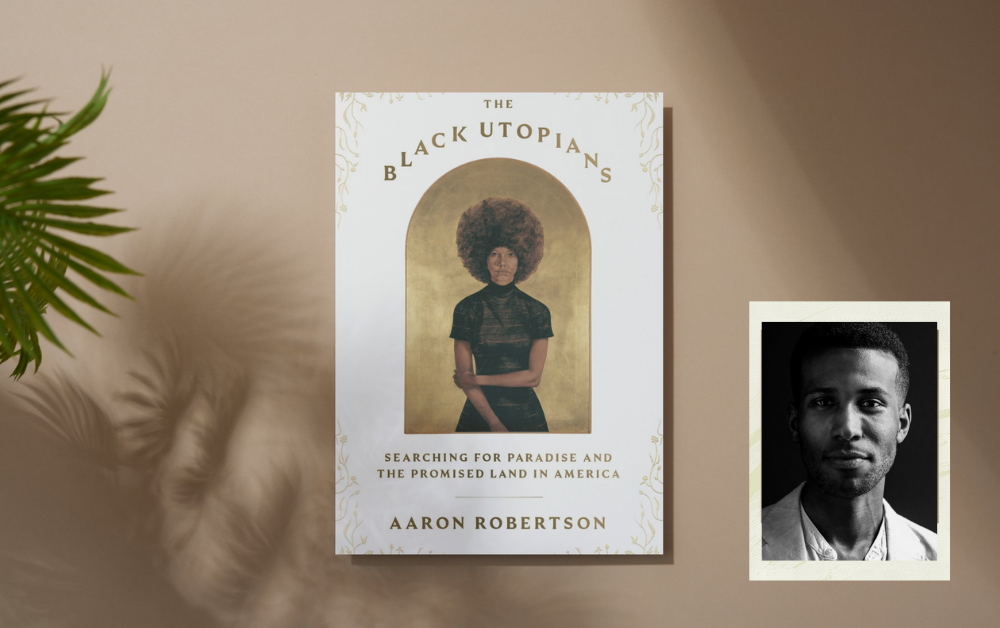
“Excerpted from THE BLACK UTOPIANS: Searching for Paradise and the Promised Land in America by Aaron Robertson. Published by Farrar, Straus and Giroux. Copyright © 2024 by Aaron Robertson. All rights reserved.
I didn’t go back to Promise Land for more than ten years after my paternal grandfather’s death. I had convinced myself that there was nothing left for me there but memories too sweet to taste without him and perhaps a rushed moment of tribute beside a gravestone. I regretted missing the family Christmas in 2018—I don’t remember my reasoning—and when I finally decided to return for one of our infrequent reunions, in 2019, sickness incapacitated me the day before my flight from New York, in a hot August. I had been in love and was so fearful I was falling out of it that I could barely expel urine from my body. I phoned my grandmother to weep and apologize. What I called self-sabotage she called the devil. She prayed, crying quietly along with me, and shared a scripture, Psalms 34:19: “Many are the afflictions of the righteous: but the LORD delivereth him out of them all.” The pandemic would delay my homecoming for another three years.
A prodigal son’s return is usually a celebratory affair, but I arrived alone in front of the old chalk-white schoolhouse and the St. John Church on Promise Land Road. Little seemed to have changed. There was the lonely tree beside St. John’s, closed for needed renovations and still dealing with its rust-red, slowly deteriorating roof; the covered stage between the church and school with a couple of picnic tables on it; and beside the road, a tall pole with a wind-whipped American flag. Other additions I didn’t recognize. When had the concrete sidewalk connecting the church and school been laid? I had never seen the trailer behind the school that now served as the town’s community center.
I was waiting for Serina Gilbert, the seventy-seven-year-old board chair of the Promise Land Heritage Association and the woman who would give me a private tour of the community center and school, which now functioned as Promise Land’s museum. I was glad for the tour even as my pride made me bristle at the need for it. I had seen a picture somewhere of Serina, whom I had always known as Cousin Kay, giving a presentation on Promise Land’s history to white members of a motorcycle club. The image of rapt, leather-clad riders sitting on tiny benches in the schoolhouse’s original central bay—the very seats that black kids once occupied seventy years prior—was both amusing and touching. I feared I would get the same rundown on the origins and changing fortunes of Promise Land. I would assure Kay that yes, yes, I knew that already. I haven’t forgotten.
Kay was my late grandfather Ruffus’s cousin. They grew up together and attended the Promise Land School in the 1940s and ’50s, many decades before its kitchen and dining wing became a gift shop that sold T-shirts and colorful jewelry, home decor and other trinkets. In the 1980s, when Kay was a medical social worker at Howard University’s Center for Sickle Cell Disease, she had studied the behavior of medical staff toward black men with the illness. When the Human Genome Project began in the 1990s, allowing researchers to map the genes that cause sickle cell anemia, Kay developed an interest in genealogy and her family’s heritage. “You become who you are based on what you’ve gone through,” she told me over the phone, months before my visit. Kay retired the year that her mother, Essie Vanleer, decided she would no longer leave Tennessee to visit her daughter in Maryland. She would miss Kay, but her church and friends were in Promise Land. Who knew how much time she had left? Kay surprised herself by selling her house and moving back to Promise Land to be with Essie, at the urging of the Holy Spirit.
For more than thirty years, Essie and Kay, descendants of some of Promise Land’s original founders, did more than anyone else to preserve the town’s history and establish its reputation as one of the oldest known settlements founded by formerly enslaved people in the country. As the longtime executive director of the Promise Land Heritage Association, from 2006 until 2019, Kay brought Promise Land to the attention of state universities, government agencies, and cultural institutes, as well as national museums. She helped get the Promise Land School (originally built in the 1880s) into the National Register of Historic Places. She is trying to do the same for the St. John Church.
As I photographed my surroundings, Kay pulled up in her van. I waited while she maneuvered her motorized wheelchair out the side. Her youthful eyes and serious gaze looked much as I remembered. Because her high voice had never lost its vigor, the only surprise was the grayness of her thinning hair. I had always interpreted her smiles upon seeing me as tentative blessings, each one an invitation to fully assume the role of my grandfather’s heir and take a proper interest in our common inheritance—this land and its manifold meanings.
The generation of people who founded the Promise Land Community Club in the late 1980s and, later, the Heritage Association were aging and dying. Kay, not only the town’s greatest advocate but also its most important historian, could not continue this work forever. She planned to write a memoir with the help of a professor at Tennessee State University. In the meantime, she encouraged younger people with familial ties to Promise Land to keep the place alive. In a later email to me, she wondered if her daughter, an L.A.-based musician, and I would consider “exploring the development of a rural colony/ retreat for artists/writers/musicians/performers,” citing the example of the Woodstock Byrdcliffe Guild in New York, an Arts and Crafts utopian community founded in 1902. I liked the idea, but to this day I have deferred its execution.
*
Two months before my return, a nonprofit called Next Leadership Development launched the Black Towns & Settlements: Foundation for the Future project, which included an interactive digital map of historic blacktowns in the United States and Canada. It was a noble effort, but not at all comprehensive, featuring around eighty communities. The project’s creators estimated that there may have once been anywhere between 200 and 1,200 blacktowns and settlements that existed throughout North America. These places were usually founded by former slaves who had escaped plantations, purchased their own freedom, or fought for it during the Civil War.
The only entry for Tennessee was a place called Free Hill, a town 150 miles northeast of Promise Land, near the Kentucky border. Founded in 1816, Free Hill was an unincorporated community like Promise Land, and its original inhabitants were the ex-slaves of a North Carolina planter’s daughter. Perhaps Free Hill made the cut because it still had a small number of residents. One could barely call Promise Land a “town” in good faith since only two of its buildings still stood—neither the school nor the church served their original purpose now—and no one lived there anymore. These days, most visitors to Promise Land come for its annual summer festival or sporadic family reunions.
After visiting the community center, which still had displays up from a 2020 traveling Smithsonian exhibition on changes in rural America, Kay and I ended our short tour at the schoolhouse-museum. Assorted display cases contained pictures of long-dead Promise Land residents, including descendants of the Nesbitt brothers, the founding fathers John and Arch. Shelves carried items that would have typically been found in the homes of Promise Land’s early settlers: stoneware pitchers, crocks, whiskey jugs, a kerosene lantern, an enamel coffeepot, a cast-iron pot and flatiron, washboards, a metal coal scuttle. When I realized they were only replicas, I felt somehow duped.
When we finished, Kay asked whether I’d read a book by the sociologist Elizabeth Rauh Bethel called Promiseland: A Century of Life in a Negro Community (1981). I had. It was the second time in two weeks that someone had mentioned it to me. The last instance was during my trip to South Carolina the week before, when I visited Beulah Land, the Shrine of the Black Madonna’s farm. My research trips had taken an unorthodox route, ending where perhaps they should have begun, with my own family. I told myself at the time that this was intentional. How fitting it would be to enact my grandfather’s favorite biblical parable, the Prodigal Son, by coming back to a place that never really belonged to me but which many relatives said would always be my birthright. I avoided confronting one of my fears at the time—that after years of reflection on black people’s attempts to imagine greater worlds, I might arrive in Promise Land to find a place exhausted of potential.
With Bethel’s book I thought I had found a rare historical account of my Promise Land. It focused instead on a blacktown in the South Carolina Piedmont called Promised Land. It was also established in 1870, the same year that Washington Vanleer, one of Kay’s ancestors, made the first land purchase in Promise Land—14 acres for $10 apiece. Like the Tennessee hamlet, the South Carolina blacktown had a general store, a church, and a school that closed when the county it was in integrated following the decision in Brown v. Board of Education.
These kinds of places, Bethel wrote, “forged a settlement based on economic security, held together by pressures from the world beyond [their] boundaries as well as ties within the community.” Promised Land, SC, and Promise Land, TN, were “microcosm[s] of the many Negro communities where people have devised unique strategies for coping with their racially defined subordinate status.” Each was “a case study of alternatives to self-hatred, retreat, and accommodation.” What had Promise Land been? What would become of it?