Do you remember the first time a movie botched one of your favorite book characters? It’s an experience that every serious reader shares. When you spend hours of imagination constructing what a character should look, sound, act, and feel like, it’s hard to withstand an alternate portrait.
Now, imagine this scenario in reverse. Think about a real-life person who deeply influenced you – someone whose life is an embodiment of beauty, goodness, and truth. And then you encounter a fictionalized version of that person through a biography or film… and it’s all wrong.
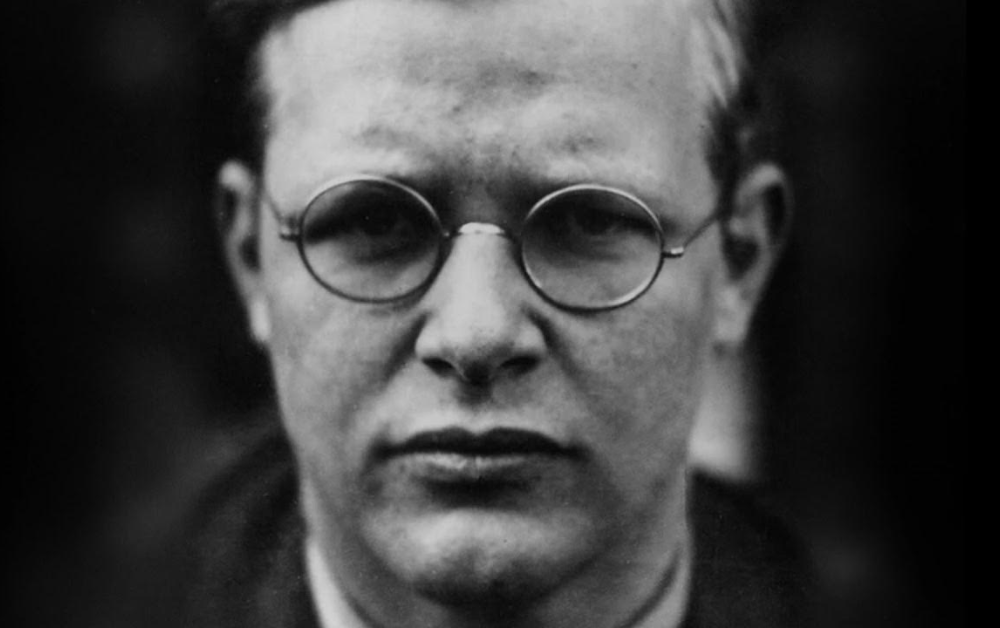
Dietrich Bonhoeffer is one of my people. I talk about him often since studying his life and thought in seminary. Those around me know my love for Bonhoeffer because I quote him nearly every time I teach. That’s why several people have sent me a movie trailer with some form of, “Check it out! Aren’t you excited about this?”
In response, I’ve mainly deflected with the concern that they “won’t get him right.” Now, for integrity’s sake, I need to say it clearly: No, I’m not excited about the new Bonhoeffer movie.
For me, the title says it all: Bonhoeffer: Pastor. Spy. Assassin.
Calling Dietrich Bonhoeffer an assassin reveals the core motivation for sharing his story: entertainment. America is a violent society, so pairing the identities of “pastor” and “assassin” sells tickets. American Christians crave what Walter Wink called the “Myth of Redemptive Violence.” Bonhoeffer’s name is often appropriated for this paradigm, most notably by far-right Christians using his name in alarmist talking points to gain political allegiance. Perhaps this film will be more thoughtful, but its description of Bonhoeffer trading peace for murder is not reassuring. Bonhoeffer’s family members and the International Bonhoeffer Society even named the movie in a petition against misusing Dietrich Bonhoeffer’s name.
Dietrich Bonhoeffer is not a weapon to justify violence or recruit for partisan politics. In a church that traded baptism for violent nationalism, Bonhoeffer was a subversive witness.
Do not be mistaken: “pastor and assassin” is an oxymoron. To be one is to cease being the other. The earliest Christians understood this, practicing radical obedience of Jesus’ words: “But if anyone strikes you on the right cheek, turn the other also…But I say to you: Love your enemies and pray for those who persecute you” (Matt. 5:40, 44). The 2nd Century Christian, Athenagoras of Athens, noted the absurdity of Christians killing when he defended the church against a charge of cannibalism (due to the bread of Eucharist being called “Jesus’s body”): “For when they know that we cannot endure even to see a man put to death, though justly, who of them can accuse us of murder or cannibalism?” (1)
Dietrich Bonhoeffer continued within this tradition when he wrote, “If the world despises one of the brethren, the Christian will love and serve him. If the world does him violence, the Christian will succor and comfort him…Where the world exploits, he will dispossess himself, and where the world oppresses, he will stoop down and raise up the oppressed.” (2)
So, how should Christians and peacebuilders make sense of Bonhoeffer’s involvement in the plot against Adolf Hitler’s life?
First, scholars Mark Nation, Anthony Siegrist, and Daniel Umbel question the extent of Bonhoeffer’s involvement in this plot in their book Bonhoeffer the Assassin?. They draw on Sabine Dramm’s work, in which she argues that Bonhoeffer joined the Abwehr to avoid conscription into the army – not primarily to join the conspiracy – which reflects his peace ethic regarding military service. (3) We have no evidence that Bonhoeffer substantially contributed to any assassination attempts. He was surely no trigger man. We simply know that he had conversations with people involved in seditious activity. Dramm describes his role as “intellectual pastoral care” for the resistance movement. (4)
Second, Bonhoeffer’s theology and ethics were complex. In the posthumously published Ethics, Bonhoeffer revealed his evolving ethical framework through the concepts of “active guilt” and “responsible action.” Active guilt is the act of knowingly taking on sin out of love for another, an imitation of Jesus bearing the weight of humanity. (5) His concept of responsible action, then, is the method for carrying out active guilt. He argued that the one who “acts responsibly becomes guilty.” (6) This is the key: Bonhoeffer acknowledged the reality of guilt rather than arguing that violence against Hitler was inherently good or just.
Further, Bonhoeffer did not reject his earlier writings about the cross as the justification for nonviolence. In a 1944 letter to Eberhard Bethge, Bonhoeffer reflected that, though his outlook on faith had developed, he stood by what he wrote in The Cost of Discipleship. (7) He acknowledged a dialectic relationship between the obedience of Discipleship and the freedom of Ethics: “Obedience knows what is good and does it. Freedom dares to act and leaves the judgment about good and evil up to God.” (8) Considering his own writings, Bonhoeffer’s connection to the resistance movement was less a “changed mind about violence” than a “next step” in his theological-ethical framework.
Modern interpretations of Bonhoeffer tend to overemphasize one aspect of Bonhoeffer’s life and wash over his previous decades of theological development, pastoring, peacemaking literature, and consistent witness for a cruciform, liberative community. Bonhoeffer’s identity and legacy cannot ignore these significant facets of his life.
Bonhoeffer was certainly a pastor, he participated in a form of counterespionage, but he was no assassin.
(1) Trans. Roberts, Alexander and James Donaldson, The Ante-Nicene Fathers: Translations of The Writings of the Fathers down to A.D. 325, Volume II, Grand Rapids: Wm. B. Eerdmans, 2001, 147.
(2) Dietrich Bonhoeffer, The Cost of Discipleship, rev. ed. (New York: Macmillan Publishing Company, 1963), 289.
(3) Mark Thiessen Nation, Anthony G. Siegrist, and Daniel P. Umbel, Bonhoeffer the Assassin?: Challenging the Myth, Recovering His Call to Peacemaking (Grand Rapids: Baker Academic, 2013), 78-9.
(4) Nation, Siegrist, and Umbel, Bonhoeffer the Assassin?, 87-9.
(5) Dietrich Bonhoeffer, Ethics (New York: Touchstone, 1995), 237.
(6) Bonhoeffer, Ethics, 237.
(7) Dietrich Bonhoeffer, Letters and Papers from Prison, ed. by Eberhard Bethge (New York: Touchstone, 1997), 369.
(8) Bonhoeffer, Ethics, 248-49.