The voices are powerful and insistent.
They tell me what a Christian vote should look like.
They tell me that there is only one choice in exercising my civic right to vote, only one way to vote that reflects my faith.
And I very much want to express the vital principles of my faith when I cast my vote, because I believe those principles support the common good and flourishing of all people.
The problem is that these insistent voices do not agree. Rather than offering analysis and persuasion with gentleness and honor, they demean and revile those of other political persuasions. In their disagreement, they call one another’s faith into question. And too often, we follow their lead.
The pressure on Christians to conform to their leaders and peers can be tremendous. It can lead to feelings of guilt and marginalization where we don’t agree with whatever majority happens to surround us. It can cause us to follow powerful voices out of fear or anger, rather than seeking Biblical principles out of love and humility. It can lead to an easy, automatic acceptance of the proper way to vote, with little examination of our motives and conscience, of Biblical standards, or of the impact on our communities and neighbors. It can at times cause our worst motives to become normalized and applauded, making it acceptable for self-interest to drive our votes.
Disagreement among faithful Christians becomes a source of division, even judgment, and the love that should unite us together in unity is splintered. We sow fear and reap suspicion. We forget that we are together the Body of Christ, all different but united under the Head. We forget that not everyone is an ear or a hand, that the body also requires eyes and feet and hearts, all with different functions, to be complete. Our goal is unity, not sameness. But rather than working toward unity, we criticize, disparage, and scorn our fellow Christians, to the point of classifying them as enemies if they disagree with our own brand of politics.
And while the world watches, the Kingdom of God is diminished.
But we need each other. We need the perspectives and wisdom each member brings to provide balance and fullness to the Body. We need to appreciate that our various gifts and experiences may lead faithful Christians to different political conclusions. And we must honor and accept one another, building one another up, giving one another grace, just as we have received grace. This is how the Bible teaches Christians to live together. We must obey Jesus and love one another, even in our disagreement.
But.
But…
We MUST be faithful.
Let’s not pretend this is easy.
The issues are complex, and complicated further by the difficulty of seeking out plain, unembellished truth. The proper, faithful response to various issues does not reside in a single political party. Candidates who completely reflect biblical principles are scarce, if they can be found at all. This can cause us to be apprehensive and uneasy that we might inadvertently place a vote that goes against God’s will. It can prompt us to follow other voices blindly in order to reassure ourselves that we are safe from that error. It can petrify us into inaction, so that we choose not to risk voting at all.
Where does this leave us as people who want to be faithful, Christian voters?
Hopefully it leaves us humbled.
Hopefully it makes us realize that no vote is perfect, in the same way that no candidate is perfect.
Hopefully it sends us to our Bibles to seek guidance.
Hopefully it reassures us that God will accomplish His will, regardless of the outcome of any election…even this one.
Voting is hard. And it should be.
But we can vote Biblical principles to the best of our ability. This means understanding what the Bible has to say about the issues that drive an election. It means careful thought about what God has revealed to us in His Word about justice, peace, power, freedom, the poor, the orphan, the foreigner, the elderly, the marginalized. It means examining our hearts, and changing where necessary, to position our opinions with Biblical principles, rather than simply reflecting our own preferences and emotions.
As Christians surrounded by many insistent voices, it is imperative that we become informed. Yes, it’s hard. Yes, many sources of information are biased. But we must search out facts, and not just accept information from whatever sources happen to reinforce our own desires or fears. We cannot be perfectly informed, but we can learn as much as possible of the facts.
We can vote from a heart of love. First, love for God, which means aligning our hearts with His by understanding and following what He has taught us about how to live. And second, love for our neighbors as ourselves, remembering what Jesus taught us about who our neighbors are. When we vote, we can stand firm against fear, anger and hatred toward any of our neighbors. Jesus commanded us to love one another, even those we might think of as enemies. It was not just a suggestion. The Bible tells us that love drives fear away. Love lays down its life. Love desires what is best for another person. Christians must let go of fear, anger and hatred in favor of love.
We can vote from gratitude. We can take the time to recognize and deeply appreciate the blessings of living in this country. Then from that gratitude, ensure that we are voting to share those blessings rather than hoarding them for ourselves and those in our acceptable circles.
We can vote for the benefit and protection of children. Children who have no voice. Children who are refugees. Children who are hungry, or dying from starvation. Children who are afraid, or homeless, especially those whose homes have been destroyed by terrorism and war. Children who are dying in horrible ways because power chooses bombings and raids and warfare out of fear, hatred, anger or greed. For many of us, this may mean having the courage to step out of our comfortable worldview, and look directly into the face of horror and depravity. To choose to really see small, mangled bodies. To remember that Jesus said to bring the children to Him, not to bomb, starve, and destroy them.
We can vote for peace. Because the Lord we serve and honor and love is the Prince of Peace, Who left His peace with us, and told us to follow Him.
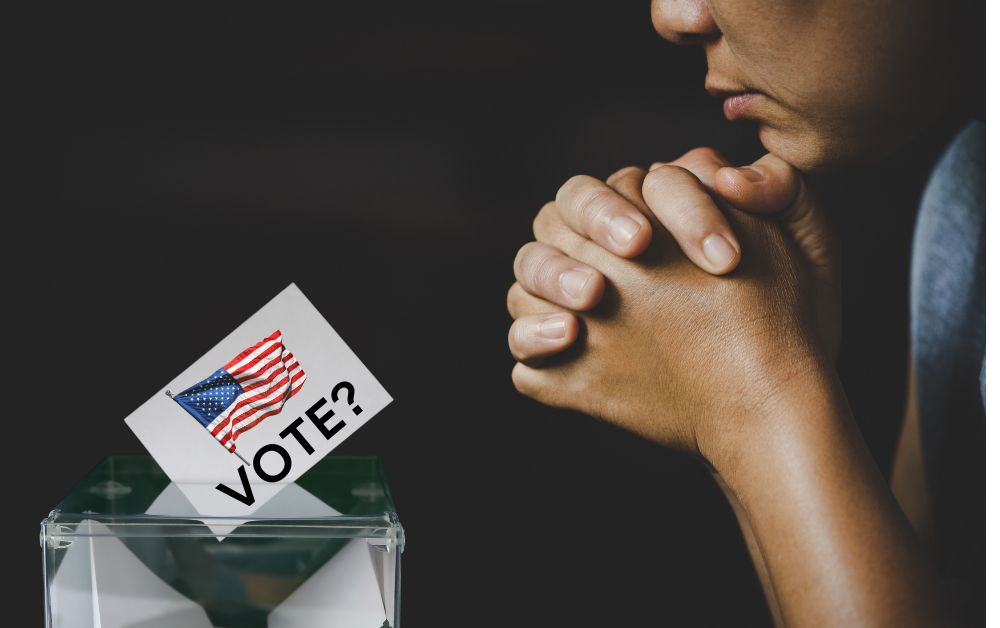
Of course, as Christians we must pray. Pray for wisdom. Pray to understand what the Bible teaches about living in community. Pray to align our hearts with the heart of God as we vote.
Finally, we should always remember that politics and candidates are not our hope. Our hope is in Jesus Christ alone. Trust that God remains good, and in control, whatever the outcome of any election.
Then we can vote, faithfully and to the best of our ability.
And be at peace.