
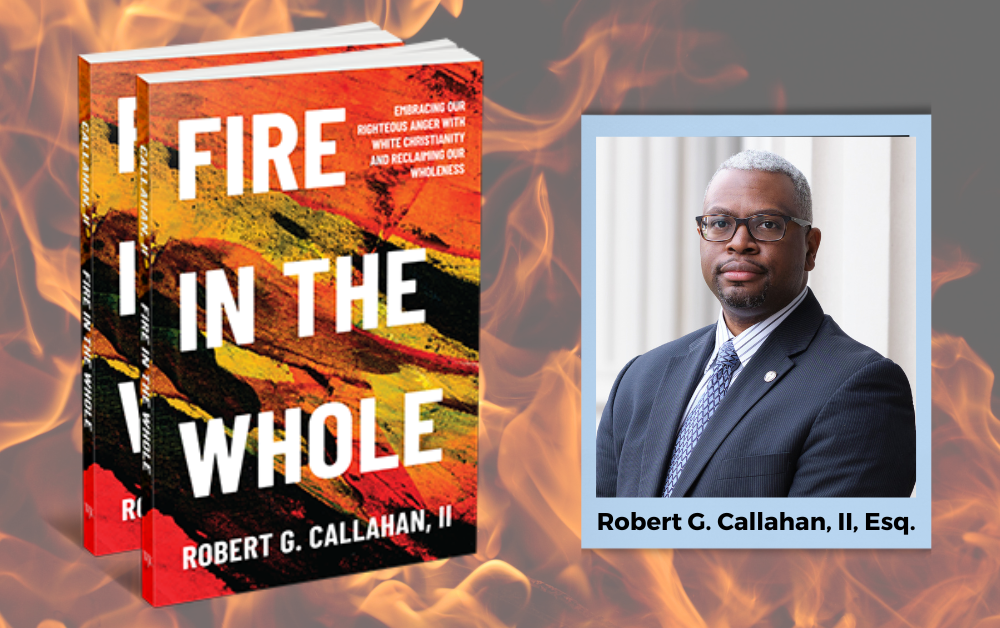
Excerpted from Fire in the Whole. © 2024 Robert G. Callahan, II. Used by permission of Westminster John Knox Press.
Chapter 12
Permission to Leave
While I believe that it’s important for those of us who have been harmed by racialized spiritual abuse to accept that the cavalry is not coming, that’s not to say that all is lost. And if you’ve made it this far, I think it’s important to acknowledge that we’ve done a lot of work throughout this book to arrive at this point. Uncovering all the painful aspects of divorcing ourselves from white Christianity is difficult, emotionally taxing, spiritually exhausting work. But, in a way, everything we’ve covered so far has been prelude to the most important work to be done: we need to decolonize our faith, resolve not to look back, and commit to our healing. It’s time to leave and leave it all behind.
Just as unhealthy relationships don’t have to be problematic 100 percent of the time to be abusive, so too a toxic church may still have beautiful aspects that, nevertheless, cannot justify our continued presence there. People whom we love may continue to attend because they don’t yet fully appreciate the scope of the blight. Spiritual leaders whom we admire may continue to work there due to financial dependence or naive aspirations of reforming the institution from the inside out. Leaving may mean that ministry opportunities unique to that congregation may be lost. But we have to leave for our own spiritual and emotional health.
As a parallel for knowing when to leave spiritually abusive environments, one of my good friends, Dr. T. J. Webb, shares this advice about toxic workplaces:
I don’t know who needs to hear this, but this can be true:
• My job is abusive/exploitive, and I need to leave immediately.
Even if the these are true too:
• I love the people I work with.
• I respect the people I work for.
• I believe in the mission of the organization.
My advice: leave anyway. Unless you know it’s imminently going to get better, make a plan to leave. You can maintain friendships with your coworkers. You can support the mission from the outside if you choose. You can choose to forgive, even build-up, its leaders—from a distance. But even a great organization with great people and a great mission doesn’t have the right to expend your well-being. It can be a great organization for the community, for clients or patients, for the whole human race—and not be a great organization for you, the employee. So leave. Leave as quietly or as loudly as your conscience demands on behalf of your coworkers, the mission, and the person who will have your job next. There are other organizations with great people and great missions; go to one of those instead. And when you get there, look around to figure out who in your new great organization is on the brink of leaving and only hasn’t because they believe in the people and the mission so much. Then work to create change and make a way that they can stay and thrive instead. (1)
One of the first lessons that the Bible has to teach us is that it is completely possible for an oasis—a place that was once beautiful, wholesome, and nurturing—to become polluted. And just like Eden, we know it’s possible for humanity to be the reason for that contamination. So it is with the church.
While it is important for believers to walk out their faith with the support and accountability of community, it is no failure on our part that a place that once fulfilled those needs has become hostile to our flourishing. I imagine that ours is not the only generation to wrestle with these realities. Faithful believers objecting to the institution of slavery, bans on women in ministry, the vices of segregation, and LGBTQIA+ exclusion have all likely found the American church as unrecognizable as we do today. History is on our side.
It’s important to understand that leaving doesn’t mean we lost. It doesn’t mean that all hope is forever lost for those we walk away from. Leaving is recognition that our emotional and spiritual resources are better spent elsewhere, and so we choose to be loving to ourselves. My wife explains it this way:
My letting go and walking away doesn’t mean that God walks away. He may still work in those who hurt me and they have a journey to walk to know Him. It is not selfish of me to let go. It’s not just about me. It’s also about our children and anyone else in our lives that we invest in who wants and needs the love I have to give.
My sincere, long-held desire to follow Jesus and be right with Him may have been manipulated by toxic theology and left me wondering if I’ll ever be enough. But to be manipulated, my sincere desires to follow Jesus had to be there first.
I still love Jesus. The problem is not my faith; it’s not God. The problem is God’s people.
Here’s the deal: I don’t know how to end racism. I’m pretty sure that it can’t actually be done. We can regulate, to some extent, racist behavior. We can dismantle racist institutions. We can’t regulate racist thought. The local church, where people congregate with the specific purpose of understanding what our sovereign creator has to say, should be the most reliable venue for neutralizing the effects of racism in our society. Having refused to undertake that responsibility, the church can no longer rightly be seen as the church. I laughed out loud when I watched pastors online in 2020 crying out to God, asking for a fresh word for our nation, standing in congregations that should have been closed due to COVID-19.
It’s important to understand that leaving doesn’t mean we lost. It doesn’t mean that all hope is forever lost for those we walk away from. Leaving is recognition that our emotional and spiritual resources are better spent elsewhere.
What if God’s message to America in 2020 was, “Stop killing Black folks; love the Lord with all your heart, soul, and mind; love your neighbor as yourself by wearing a damn mask”? I imagine Jesus in heaven, tapping a microphone like “Is this thing on?” while his every word is ignored by the church.
God’s will for humanity has not been hidden. And what the Lord has to say to us remains the same as it has ever been: “He has shown you, O mortal, what is good. And what does the Lord require of you? To act justly and to love mercy and to walk humbly with your God” (Mic. 6:8). It’s been the same word now for twenty-eight centuries and counting. Therefore, I ascribe great fault to a church that teaches any other doctrine or emphasizes any other role in society.
A congregation set on seeing God’s kingdom come and God’s will be done but ignoring the greatest commandments—love of God and love of neighbor—is not the Lord’s church. And in our current climate, love of neighbor has a very specific application in fighting the specific evil of racism in every facet of society in which it rears its ugly head, particularly when its members operate locally in those realms: law enforcement, education, politics, medicine, theology, law, real estate, employment, finance, and so on. To be clear, love of God and love of neighbor does NOT look like a political pep rally, has no relation to nationalistic sentiment, and likely has more to say about what we’re missing than explaining why we’re right. This is the great work of our time. If the church wants to be mobilized to act in society, look before you: the harvest is plentiful.
Ignorance, Inaction, or Apathy
Sometimes when I think about the apparent indifference of Christianity to the way that white supremacy lands on minorities in its churches, I’m reminded of a scene from the movie Boyz n the Hood. After his brother, Ricky, is killed in an unprovoked act of gang violence, Doughboy (played by rapper Ice Cube) laments the societal erasure of Ricky’s life demonstrated by the fact that the local news reported on affairs in the world abroad but had nothing to share about the death of his brother. He sums it up by saying, “Either they don’t know, don’t show, or don’t care about what’s going on in the hood.” Ignorance, inaction, or apathy. (2)
What enabled me to definitively cut all ties to white Christianity and its people was the revelation that there are only three possible explanations as to why these churches neither change, nor seem to care:
1. they don’t have the information (ignorance);
2. they have the information but don’t see fit to act on it (inaction); or
3. they don’t care (apathy).
As to the first possibility, we live in the age of information. The wisdom of nearly every culture that has ever existed from the beginning of time is available to us free of charge in digital format on devices that most of us carry in our pockets. No one with an IQ greater than 60 is deprived of the knowledge, or resources, to learn the information. The accessibility of data is too great. This is especially true when we, believers of color sitting in their congregations, are the best resources available and they refuse to listen to us. They have radar, but it’s not turned on. So they don’t see the dangers minorities are warning of.
As to the second possibility, I’ve learned it is completely possible for Christians to believe everything that we have to tell them about how we are all negatively impacted by the influence of white supremacy in the body of Christ, and even to feel concern, but to take no action toward rooting it out of our faith. There are a number of reasons this may occur: they believe that their busy lives can’t accommodate another cause; they’re intimidated by the magnitude of the problem and don’t know where to begin; they don’t want to commit their resources to the cause; or they’re afraid that speaking out will lead to their own ostracization. Whatever the reason, their concern just isn’t great enough to act upon.
For some of these white believers that we’ve lived in community with, however, it’s entirely reasonable to think that they believe everything we share with them—including the heartache we’ve endured—and simply don’t care. They just don’t see our plight as their own. At its core, this is a lack of empathy. Our problem just doesn’t affect them. Meanwhile, we’re negotiating the rubble of wrecked lives, bleeding and bandaged, as the church watches indifferently. Here there is no concern. They see the bogeys on their radar. They recognize that there is a clear and present danger. But they will not deploy resources to aid us because we are considered acceptable losses in their eyes. In these settings, pastors will smile to our faces but privately label our issues as part of a social gospel and actively subvert our efforts behind closed doors.
We’ll recognize that our congregations fall in this category when we recognize ourselves as victims of gaslighting. At TFI, for example, there was a consistent refrain when minorities expressed a need for the church to discuss race publicly: “we’ll get back to you” coupled with full-fledged ghosting while every action taken in the meantime displays complicity with white supremacy. When we’re in institutions that refuse to change, it’s vital that we have an accurate understanding of who we are in their eyes and why they’re not responding. Either they don’t know, don’t show, or don’t care.
In March 2018, the New York Times published an article titled “A Quiet Exodus: Why Black Worshipers Are Leaving White Evangelical Churches,” (3) which reports examples of the deep wounds felt by minorities in toxic churches. Tamice Namae Spencer reflected on her disappointment in the response of her predominantly white church after the killing of Trayvon Martin. When white members said she was being “divisive” when she brought it up, Spencer thought, “It’s not even on your radar and I can’t sleep over it. . . . And now that I’m being vocal, you think I’ve changed.”
The same article also mentions the efforts of the Rev. Dwight McKissic, one of my African American acquaintances and senior pastor of Cornerstone Baptist Church in Dallas, to address racism in the Southern Baptist Convention (SBC). In 2017, McKissic proposed a resolution for the SBC to condemn the burgeoning racism of the alt-right movement that was definitively shot down. “Pastor McKissic was told that racism had already been adequately addressed by the Southern Baptists,” reported the Times. He was further admonished “that the resolution was inflammatory and that sympathy for the alt-right was not an issue in the church.” However, the SBC was reportedly embarrassed by the optics of their decision after their rejection of the resolution became public knowledge. Thereafter, a modified version of McKissic’s proposal was passed. Despite his experience in 2017, McKissic continued to be a faithful, active member of the SBC in the following years. But minorities can hold on only so long. Fast-forward six years.
In June 2023, Dwight McKissic attended the annual convention for the SBC, as he had done many times before. However, that year, he and his executive staff members attending the meeting recognized it would be their last one as they departed the convention floor after the vote to place unbiblical restrictions on women.
Responding to one of my social media posts regarding the three paradigms listed above influencing white Christianity (ignorance, inaction, and apathy), McKissic warns nonminority pastors that these three perspectives create questions that minorities in their churches or organizations will “inevitably ask—personally, privately, or publicly. . . . Those [minorities] who leave cannot make peace with [these questions] unanswered,” McKissic concludes. (4)
Here, I find it important to reemphasize that malicious intent in the form of actual hatred toward minorities is not a necessary ingredient of racially inhospitable churches. I’m not arguing that the white church is composed exclusively of racists. I’m just saying there are other ways for believers to warm themselves than standing beside burning crosses set ablaze by the folks with the pointy hoods. The wealth of knowledge available concerning the experiences of minorities in the modern church precludes their ability to claim ignorance. They’re not misinformed. They’re uninterested. And those who continue to joyfully attend and serve these churches do so with full knowledge of their complicity. Meanwhile, the news media daily presents us with evidence that those tasked with the great responsibility of guiding believers are increasingly unqualified to do so.
“Hey, Brother”
In her book, Untidy Faith, Kate Boyd discusses the involuntary response that millennial women feel when they receive private messages that start with the phrase “Hey girl.” The initiated know the message will come with some pitch for a multilevel marketing scheme vision selling the idea of a #Blessed life.
Most Black Christians have a similar, visceral reaction to reading the phrase “Hey, brother” or “Hey, sister.” To some, it’s just a greeting. But we Red Tails, veterans of the religious culture war, recognize this seemingly innocuous salutation as the first salvo in a battle with the “all lives matter” crowd.
- “Hey, brother. I saw what you wrote on your wall. I just wanted to tell you that I love you, though I don’t agree with you that . . .”
- “Hey, sister. I saw your post about white supremacy. Would you be willing to meet for
covfefecoffee or lunch to talk about it? I just want to hear your heart on this topic. My treat!”
Those who agree to these meet-ups believing they’re going to converse with an open-minded acquaintance soon find themselves in heated battles to defend their ideological position. Worse, they’re often admonished that their perceptions are somehow unbiblical, or even demonic.
I have a radical suggestion: let’s stop giving spiritually abusive people access to our hearts and minds. No more coffee meetings. No more lunches. Those who are truly interested in learning about our experiences need to demonstrate their commitment to learning about antiracism by doing their own work rather than asking us to give the Cliff Notes. For our own sanity’s sake, I propose we stop agreeing to teach 100-level classes about what the church needs to fix about racism. We’re well beyond that now. If our white colleagues want access to our thoughts and emotions, they need the prerequisites to that course:
101—Understanding God Is Real and Has a Lot to Say about Love and Justice in the Bible
201—Slavery Was Bad and There’s No Way around That
301—Racism Really Exists, in Forms Both Overt and Subtle, throughout Society
350—Racism Is Bad and Black Lives Really Do Matter
401—There Is No Room for Racism in the Body of Christ nor in American Society
We can’t afford to wait for believers to abandon white supremacy and join us on this side of the ravine. A tree is known by its fruit. Therefore, the value they ascribed to us who are suffering emotional, spiritual, and even physical violence due to racism will be made known by their actions. By how quickly they make the journey. But stagnation—neutrality—is hardly an option.
If your spouse walks out of the dressing room and asks, “Do these clothes make me look fat?” you’d better have some response. You will not get away with declaring you don’t want to be involved. Of course, you could say you don’t want to be involved, and that answer is going to land you in the office of a counselor or a divorce lawyer. At some point, the refusal to provide honest feedback is, itself, unloving. There are some circumstances in which neutrality just cannot be afforded. There is no middle ground. No one is neutral on a moving train. (5) Similarly, we have permission to shed ourselves of the lie that “both sides” have work to do, or that “neither side” (the first cousin of “both sides”) is doing things the way it should.
It is beyond time for white Christianity to repair the damage it has intentionally inflicted upon minority image-bearers. If the church can’t take ownership of its sins, it’s time to go. You have permission to leave. Nor should we settle for a cheap form of reconciliation that costs nothing of those who want to move past “the race thing” and get to the business of being a church. We can recognize cut-rate attempts at harmony:
• It costs little or nothing of the perpetrator.
• It comes at great emotional or other cost to the victim.
• The burden to facilitate learning or healing rests on the victim.
• The efforts to facilitate learning or healing are tempered; for example, “Whoa, hold on a minute,” “Slow down there,” and the like.
• There is unwillingness to empower the voices of the marginalized with positions of leadership equal to or greater than those serving at the highest levels.
• There is unwillingness to publicly and unreservedly repent, seek forgiveness, and repair the harm done.
• There is unwillingness to publicly take a backseat in order to amplify the voices of the marginalized and learn from them.
• Tranquility within the congregation is more important than providing justice for the disenfranchised.
Anything less than full dedication to the objective of closing the rift that separates us is a half measure that will only delay or thwart the healing that is so desperately needed in the church. The objective cannot be unity for the sake of unity. Rather, it has to be solidarity—unity and agreement of thought and action, specifically in a theologically correct, fully inclusive, sleeves-rolled-up, hands-get-dirty application of the gospel. In that context, we have to understand that there is a biblical way to view sin and a nonbiblical way, then correctly locate ourselves in the context of that view.
Let’s be clear: in an abusive relationship, the abuser is in sin. This is true of all abuse, including spiritual abuse. It’s the abuser who is responsible for the condition of their sinful heart. There are no “sides” to consider.
If the abuser goes to church, they should be confronted with their sin. They should be counseled and guided through the process of abandoning that sin. By contrast, the abused should find the church to be a refuge for healing, validation, and protection.
But when the church is the abuser, where do the abused go? Who watches the watchmen? As an aside, the reason religious trauma wounds so uniquely is because the source of healing and the instrument of pain are the same. Now, we can pray for our abusers. We can speak truth to the abuser. But the abuser is responsible for the posture of their own heart. For this reason, our abusers have the grave responsibility, as we all do, to seek and know and understand Christ for themselves because the local church may not be equipped, or appropriate, to guide them in their understanding. And in a vacuum, the world will disciple them instead. For this reason, Christians need to be quick to listen to minorities, quick to repent, and quick to rectify so that there is hope of repairing the emotional damage as the believer is working through their crisis of fellowship, if not faith. We can’t skip acknowledgment of the problem and go straight to happily ever after.
Getting to Unity
Six concepts frequently get conflated and misapplied within Christianity when it comes to unity in race relations: repentance, forgiveness, reconciliation, restitution, reparations, and restoration. It’s vital to understand each concept in order for us to give ourselves permission to leave. Otherwise, we can be manipulated into believing that the healthy Christians’ relationship to Christ and neighbor require our continued presence and participation in abusive spaces.
Repentance
The easiest concept to begin with is repentance, because repentance is about your vertical relationship with God. That’s it.
Repentance (Greek metanoia, “change of mind”) involves “turning with contrition from sin to God; the repentant sinner is in the proper condition to accept the divine forgiveness.” (6) Repentance deals with the condition of our souls—an inquiry that only God is ultimately qualified to decide. Repentance requires us to ask, “Have I properly humbled myself before God in recognition of my sin?” For Protestant Christians, no works are required in repentance.* God may yet require more of us as a matter of discipline, repair, reconciliation, and so on. But those additional actions are not prerequisites to God’s absolution of our sin. The additional efforts we make toward those goals (discipline, repair, reconciliation, etc.) may provide evidence to the outside world that we have, in fact, repented. However, only God sees our heart.
*Remember: every time a Christian talks about “works,” a mosquito gets its wings. I know this is a subject filled with centuries of doctrinal debate. Let me simplify for our context: when I say “no works are required in repentance,” I simply mean no other rituals or tasks are required.
Forgiveness
Forgiveness is about your horizontal relationship with other people and requires no action by others. Forgiveness may be triggered by an act of repentance, but forgiveness does not require repentance as a prerequisite. Likewise, the repentance of another person does not automatically trigger our forgiveness. This is because forgiveness and repentance are exclusive; they don’t occupy the same plane.
We forgive to help our hearts move on. Forgiveness is executed unilaterally and done solely for the benefit of our own hearts and minds. Our act of forgiving our trespassers requires no action on their part. Therefore, forgiveness does not require further relationship with the one who wronged us. Nor does it require our continued trust in that person. Those who wronged us may not even know (or care) that we forgave them. As an example, we may find ourselves working to forgive our grandparents for wrongs they perpetrated against us decades ago, and working to do so long after they are deceased. Similarly, we may forgive someone who hurt us in a former romantic relationship, without ever telling them as much. Perhaps the ongoing nature of their toxicity makes such a conversation unwise. Yet it does not hinder us from lightening our hearts by forgiving them. Likewise, we may forgive someone with whom we have ongoing relationships, while knowing that continued vulnerability with that person would be unwise. In a book called Soul Care, Dr. Rob Reimer observes:
“There is a difference between forgiveness and trust. Forgiveness is a gift granted by the offended party. Trust is earned. And while forgiveness is unilateral, reconciliation is bilateral; it requires that both parties fully participate.
In order for reconciliation to occur, the offended party must fully forgive to the level of the offense: if there is a five-gallon offense, there must be five gallons of forgiveness. And the offender must fully repent to the level of the offense: he or she must offer a five-gallon apology. Only then can trust be re-established and the relationship reconciled. When someone is unwilling to repent, you can still fully forgive them, but the relationship will be shallow at best.” (7)
I’ve never heard an evangelical pastor preach that forgiveness does not mean giving our abusers continued access to us. But, in case it is unclear, forgiveness is not the same as reconciliation.
Reconciliation
Reconciliation is also about our horizontal relationship with other people, but whereas forgiveness is unilateral, reconciliation is bilateral; it needs cooperation from both sides to succeed. One cannot do it alone. Importantly, reconciliation is a noun, not a verb. It is a state of existence, the successful result of doing work to fix the harm committed—not the work itself. Victims of abuse often fall prey to cheap reconciliation that offers no repair of the damage but expects relationship all the same. This manipulation inevitably leads to further abuse.
In Christian spaces, it seems that we rarely have a healthy understanding of what forgiveness is and is not. When the language of forgiveness is manipulated by abusers to reverse the roles of victim and offender and coerce an unhealthy form of reconciliation, we call that abuse. If we choose to forgive, but the offender doesn’t like subsequent boundaries that we create, they may chalk it up to a lack of forgiveness on our part. That’s fine, so long as we know better.
Actions designed to facilitate healing reconciliation—at minimum—shouldn’t create further harm. Feelings of guilt, or viewing reconciliation as something that must be achieved, rather than something we get to achieve, are clear indicators that our efforts toward reconciliation are misguided.
Restitution, Reparation, and Restoration
Restitution, reparation, and restoration are the methods by which we accomplish true reconciliation.
Restitution is replacement value paid for the thing stolen, lost, or broken, one for one. It is a legal term of art. Restitution asks, “How much?”
Reparation is also a legal term of art, literally meaning “repair.” Reparation is what is done to fix the problem. It asks, “How do we fix it?” In contrast to restitution, reparation is completely unconcerned with the expense involved in repair. Therefore the cost of reparation may exceed the expectations of those responsible for the repair. This, of course, is why we shouldn’t do something that we’re aware may cause damage in the first place. Nevertheless, the party responsible for making reparations is not the party in the best position to determine what is necessary to repair what’s damaged and, therefore, doesn’t get to dictate the terms of the repairs.
As an example, our abusers don’t get to say, “Stop complaining! It didn’t hurt that bad.” Because every person is unique, it may take more to repair the relationship with one person than it does for another. This may be true even though both persons were victims of the same offense. In the legal world, lawyers say, “You take your victims as you find them”—meaning that the offender is liable for the damage caused to their victim even though another person may not have been equally harmed.
Restoration is the final state of the thing after it has been repaired to its original condition. Restoration is the end goal and a necessary precedent to reconciliation, which may be accomplished by way of restitution and/or reparation. Restoration examines the finished product and determines whether all has been made right. Have we left things as we found them before the offense or (if we found them in disrepair) in their original, good-as-new condition? Visually, we can conceive of restoration as healing without a scar.
So when we consider how to go about reaching the goal of reconciliation, we consider these steps:
• Restitution asks, “How much does it cost to fix it?”
• Reparation asks, “How do we fix it?”
• Restoration asks, “Did we, in fact, fix it?”
You don’t commit to restoration because it’s cost effective. You do it pursuing the end result—to see the thing in its former glory. In the case of classic cars, for example, it may cost an absurd amount of money to locate and install an antique hood ornament. However, serious collectors are willing to pay more than the market price for a missing component because the end goal is to see the whole car restored to its former glory.
If nothing else, I hope these distinctions clarify that reconciliation is neither cheap, convenient, nor easy. Too often, I think white Christianity wants to skip over the work of reconciliation and go straight to “happily ever after.” A crucial distinction between reconciliation and repentance is the public nature of the amends. The horizontal nature of reconciliation necessarily requires that the healing process be observable. Before we can even hope to move forward as a united body in Christ, we need the church to acknowledge its wrongs publicly—not just privately to God. Not in individual meetings among minorities. This needs to be done as often and in as public a fashion as possible. We need white Christianity to confess its complicity with racism as loudly as the untruths it touted from the pulpits.
Only by witnessing this done publicly will those who were complicit hear, see, and begin to reflect on their roles. And only then should we consider reoccupying their spaces. Only the most sincere, sustained efforts can assure minorities that white Christianity desires our whole selves in combined worship, build long-term reconciliation, and fortify our relationships against the future waves to come. Only after this work is done can we be made whole. And if a church is unwilling to produce fruit in furtherance of this work before asking us to rejoin, it is time to take our leave.
For all its talk of unity, white Christianity should be ecstatic to receive, and incorporate, feedback from us on its role in fighting racism. Is unity really the goal, or is unity just a euphemism for conformity with cultural Christianity? Are we pursuing a comprehensive vision of reconciliation that commits to discipling the church in how it missed its complicity with racism? Or is the goal that everyone plays nice together and no one rocks the boat? I recently heard someone say it in a way that should resonate with the church, “The end goal is not unity. Unity is a mechanism to the end goal. Gangs are united. The Nazis were united.” Our goal, as believers, is unity under Christ.
Social Distance
During the early phases of the COVID-19 pandemic, one of the ways Americans were encouraged to view the necessity of quarantine was an image of a book of matches. If you strike the first match in a book of matches while it’s still connected to the others, you’ve really lit the entire book. Because they’re all connected, it’s only a matter of time until the last one gets burned. But if one of the matches is removed from the middle of the book, the created space provides a buffer between the inflamed matches and the ones on the other side.
Let the reader understand: Sometimes the only thing we can do to protect ourselves and the ones we love is to remove ourselves from exposure. Sometimes we need to recognize that others are too far gone to be reformed. But we needn’t sacrifice our sanity, our emotional health, or the well-being of those who stand behind us simply because we started off connected.
The same dynamics that are at play in emotionally abusive relationships can exist in toxic church environments as well. There are lots of valid reasons that people who are trapped in abusive relationships feel obligated to remain there: emotional dependence, reliance on a community of mutuals, deference to perceived spiritual authority, and so on. It’s not the victim’s fault; abusers understand these weaknesses and are prone to exploit them. It’s one thing to deconstruct and realize that you’ve changed. It’s something different to deconstruct when you realize that it’s actually the church that’s changed.
By remaining in these environments, we grant our abusers continued access to us—facilitating continued abuse. Meanwhile, we put on a good face, enduring suffering in seclusion under the misguided nobility of quiet martyrdom. At the same time, our continued presence assures those outside the relationship that this environment is safe—not just for us, but for them as well. In a sense, we provide cover for the abuse, inadvertently becoming accomplices in the process. When we think of the decision to remain in these terms, we can see that it is incompatible with the teachings and actions of Jesus. In fact, as the Rev. Dr. Malcolm B. Foley points out, leaving is a way of caring for our abusers by cutting off their ability to sin against us. (8)
In the same way that remaining in a toxic environment sends a message, so too does our departure. By leaving, we diminish the hold that our abusers have on us and their capacity to reproduce, and we provide warning for those who are unaware of the dangers that exist. Willfully subjecting ourselves to suffering for the sake of suffering is not part of God’s plan for our lives. God doesn’t want us living and worshiping in abusive spaces. Nor does God desire to use our presence as an endorsement, luring others to the same condemnation. It’s important to have models of faithfulness that don’t look like staying in abusive church settings or leaving faith altogether.
With this in mind, our path is clear: If your church doesn’t understand the importance of dismantling racism head-on in this day and age, revelation isn’t coming. You’re not in a safe space. Leave. If you’re not empowered to publicly tackle the issue of racism head-on, leave. If the shot-callers think you’re too loud, leave. If the pastors who caused you offense aren’t willing to take a backseat and learn from someone on the topic, leave. The longer we stay, the greater the effects of psychological manipulation will be. You have permission to leave.
1. T. J. Webb (@tjwebbmd), “My advice: leave anyway,” Twitter, January 5, 2022, 1:39 p.m., https://mobile.twitter.com/tjwebbmd/status/1478813487962984450.
2. Boyz n the Hood, directed by John Singleton (Columbia Pictures, 1991).
3. Campbell Robertson, “A Quiet Exodus: Why Black Worshipers Are Leaving White Evangelical Churches,” New York Times, March 9, 2018, https://www.nytimes.com/2018/03/09/us/blacks-evangelical-churches.html.
4. Dwight McKissic (@pastordmack), “Tweet thread non minority evangelical pastors ought read,” Twitter, September 30, 2022, 9:56 a.m., https://twitter.com/pastordmack/status/1575862129475084294?s=20.
5. Ashley Irons, Ryan Holmes, and Elijah Misigaro, We Talk Different (podcast), https://podcasts.apple.com/us/podcast/wetalkdifferent/id1161601126?i=1000465927338. See also Howard Zinn, You Can’t Be Neutral on a Moving Train: A Personal History of Our Times (Boston: Beacon Press, 1994).
6. F. F. Bruce, The Acts of the Apostles (London: Tyndale, 1952), 97, quoted in Blue Letter Bible, s.v. metanoeō, accessed March 14, 2024, https://www.blueletterbible.org/lexicon/g3340/esv/tr/0-1/.
7. Rob Reimer, Soul Care: 7 Transformational Principles for a Healthy Soul (Franklin, TN: Carpenter’s Son Publishing, 2016). Note: Reimer references the dynamics of repentance with a different view from my own.
8. “Leave Loud: Malcolm Foley,” Pass the Mic (podcast), May 30, 2022, https://podcasts.apple.com/us/podcast/leave-loud-malcolm-foley/id1435500798?i=1000564486307.
Excerpted from Fire in the Whole. © 2024 Robert G. Callahan, II. Used by permission of Westminster John Knox Press.
