Oklahoma governor Kevin Stitt made a noteworthy comment following the September 26th execution of Emmanuel Littlejohn, a man the governor’s own self-appointed Pardon & Parole Board recommended for clemency. The governor said, “As a law and order governor, I have a hard time unilaterally overturning [the jury’s original] decision.”
The phrase “law and order” here is a catch-all term for a rigid way of defining safety as the absence of violence rather than the presence of wellbeing. “Law and order” is so constricting that the governor is unable to heed the wisdom from his own Pardon & Parole Board.
I was a “law and order” Christian for most of my life. I too thought individuals forfeited their right to live free or even live at all when certain acts were committed. My obsession with law and order overshadowed my call as a Christian for grace.
Governor Stitt’s comment especially disgusted Tremane Wood, on death row in Oklahoma, when I sat down with him last week for a visit. Tremane did not kill anyone – his brother did – but because of the felony murder law, Tremane is held equally accountable since he was present at the killing.
Tremane and I shared Gummi Bears from the vending machine while he told me how he recently had to help Emmanuel down the stairs because he was too ill to make it on his own. Emmanuel, Wood’s friend for more than 20 years on the row, was brought into the execution chamber in a wheelchair before his lethal injection.
The death penalty is still legal in the United States at both state and federal levels. Twenty-three states have ended the practice. Even though over half of Americans report that they believe the death penalty is administered unfairly, we executed 24 people last year and 19 people this year. Of those numbers, two states who carried out executions had not done so in 13 years.
That’s the story of the death penalty – stops and starts, a pendulum going from one end to the other. But if you step back and survey the overall movement, we are a long way from the peak of 1999, when 20 states executed 98 people.
This summer, America saw its 200th exoneration from death row in the modern era of the death penalty, or, since 1977, when the Supreme Court ruled executions could resume despite not requiring each state to implement reform statutes. That first execution in the death penalty’s modern period in January 1977 was by firing squad.
Fast-forward to this fall, when we reached our 1600th execution.
There can be little debate about the facts: We know the death penalty is applied in a racist manner, is torture, does not deter crime, is egregiously expensive, is arbitrary, and does not serve murder victim family members.
Where the discussion gets to its deepest and most personal levels is when we talk about the effectiveness or necessity of punishment. Do violence, harm, and crime deserve to be met with further violence? Does this break the cycle of violence or enable its eternal endurance?
There is hope, though. Groups like Conservatives Concerned rally political conservatives to address what our nation knows – the death penalty keeps no one safe.
Groups like Equal Justice USA’s Evangelical Network, which I am privileged to help lead, work among Christians to make the case that the death penalty is not only something we see Jesus reject but that, in his own death by capital punishment and resurrection, we are brought into a new era of history, one in which people do not need to judge, condemn, or execute others. The life, death, and resurrection of Jesus recalibrates what justice requires in that true justice is shalom, true justice is everyone having what they need.
These two groups, political conservatives and evangelical Christians, have historically felt an unbending respect for the letter of the law and placed the highest priority on avoiding both felt or real chaos. But, like people, laws can be wrong. Even when law reigns and life is orderly, we can still, and easily, miss our call to take risks and love our neighbor. The death penalty epitomizes how law and order can dehumanize, disenfranchise, and distance us from those most in need.
Each October 10 is World Day Against the Death Penalty, a time when the United States can confront the reality that we are the only Western democracy still practicing the death penalty, that we lead the world’s executions alongside China, Saudi Arabia, and Iran.
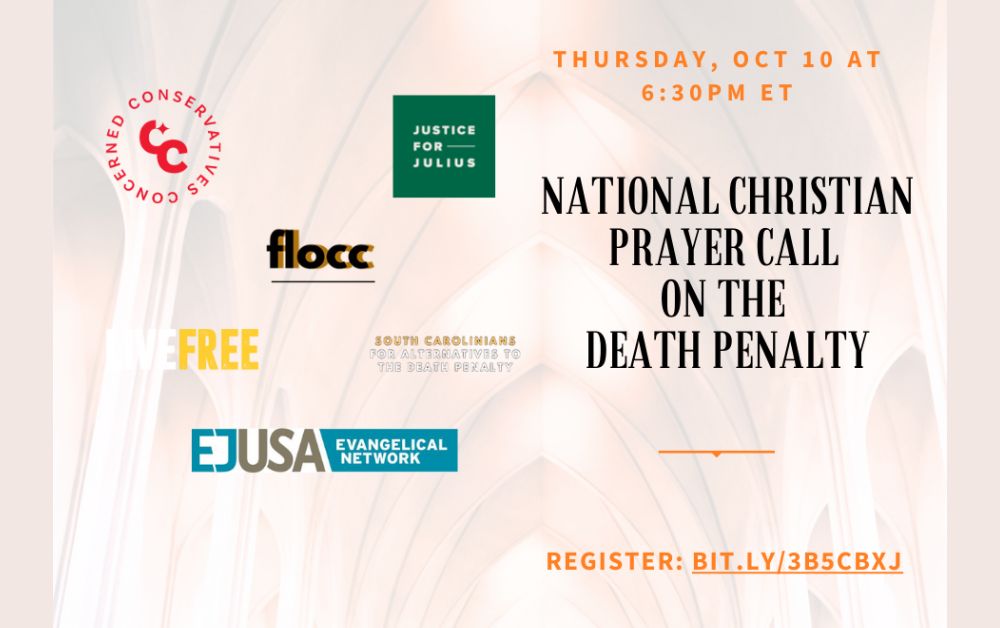
On the evening of October 10, at 6:30pm EDT, you can join the National Christian Prayer Call on the Death Penalty. This is a gathering of Christians who want to come into a space of power, peace, and prayer to honor this year’s World Day Against the Death Penalty. You’ll hear from death row exoneree Sabrina Butler-Smith, murder victim family member David Taynor, and have time to join in prayer over some specific aspects of the death penalty: murder victims’ family members, the federal & state death penalty, people on death row, policy & lawmakers, and the hearts & minds in our country.
You’ll leave challenged, encouraged, and equipped with resources to take your next steps in moving from awareness to action around the death penalty. No matter your view on capital punishment, come to learn more and consider how Christians can respond to the realities of maintaining the death penalty as a response to harm.
In Jesus we see the death of death in what he did on the cross and with the resurrection, and we’re seeing the death penalty give its dying gasps. But your partnership, your advocacy, and your prayers are all needed.
What changed me out of my law and order Christianity was proximity. I had proximity to other people’s pain, their lived experience, those in prison. My belief that law and order was what kept us safe collapsed when I saw that our criminal legal system – with the death penalty as the chief example – does not bring true safety, healing, or accountability that repairs.
Join me and many others on October 10 for the National Christian Prayer Call on the Death Penalty, and be part of the movement to bring healing after harm.
Sam Heath leads Equal Justice USA’s Evangelical Network. His faith background in Southern Baptist, Presbyterian, and now Anglican denominations enables him to tell stories about the realities of justice and injustice in America and hold together a view of the world as a place both exceptional and exploitative. He was a church elder in Charlottesville, VA for 6 years, where he still lives with his wife and three kids. Before coming on board with EJUSA in 2021, Sam taught high school history for 10 years in North Carolina and Virginia. He has a B.A. in education and psychology from the University of North Carolina Chapel Hill and a master’s in theology from the University of Virginia.