
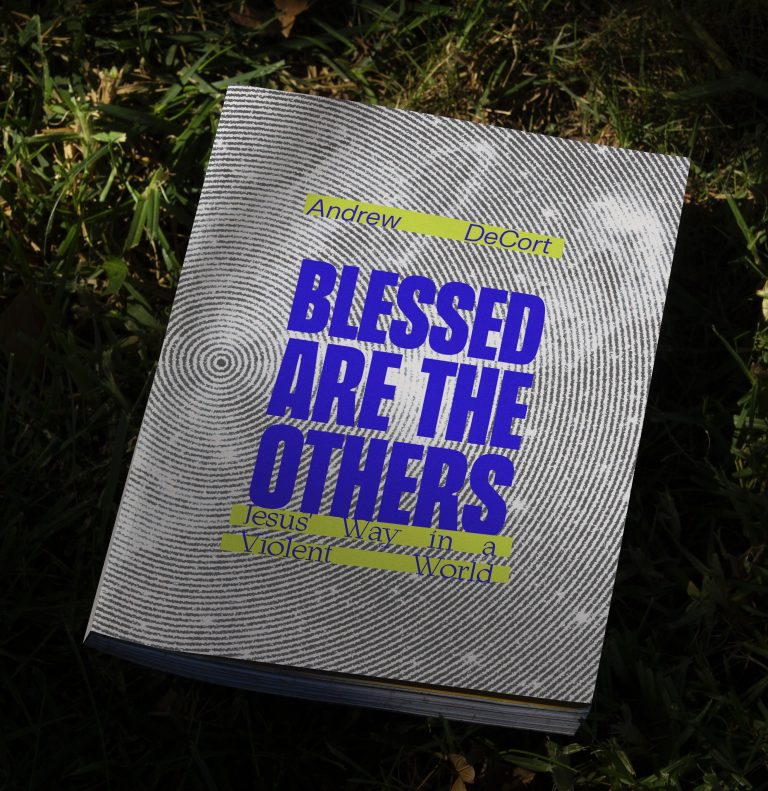
This meditation is an excerpt from Andrew DeCort’s new book Blessed Are the Others: Jesus’ Way in a Violent World (BitterSweet Collective). The book is out September 24; learn more and signup for updates here. This post was previously published by Cultivare and is being used with permission.
Dietrich Bonhoeffer (1906-1945) was a German pastor and dissident theology professor during the Holocaust. Robert Coles called him one of the top-ten moral leaders of the 20th century. His life bears witness to the power of radical surrender without resignation.
In 1933, Adolf Hitler came to power and promised to make “a Greater Germany.” Days later, at the young age of twenty-six, Bonhoeffer became the first Christian leader to speak publicly against the dangers of Hitler and his authoritarian “greatness.”
Thereafter, Bonhoeffer devoted his career to training dissident Christian leaders to follow the Beatitudinal Way of Jesus against Nazified Christianity. He helped Jews escape Germany and sounded the alarm against the horrific atrocities of Hitler’s regime.
But as Bonhoeffer hungered and thirsted for justice, he lost seemingly everything.
In 1936, Bonhoeffer was banned from teaching at the University of Berlin. A year later, his underground school for anti-Nazi pastors was shut down by the Gestapo.
Bonhoeffer continued his work under these difficult conditions. But in 1940 and 1941, he was banned from public speaking and publishing his prophetic writings. To his eternal honor, the authorities judged that he lacked “the requisite political reliability.”1
A year later, Bonhoeffer was expecting to be arrested or killed. He wrote a will and gave it to his best friend Eberhard. Then on April 5, 1943, the Gestapo knocked on his door and took him to prison.
The next two years in Nazi prison would severely test Bonhoeffer’s practice of compassionate surrender. He survived what he called “repugnant” interrogations. Throughout this time, Bonhoeffer witnessed his society, Christian community, and close colleagues descend into some of the most appalling othering and hellish injustice in history. With each day, it became clearer that he himself wouldn’t escape alive.
Amid this anguishing loss, Bonhoeffer wrote a “daily meditation” on July 7, 1944. What would he say about this time of such severe loss in his life and world? Would he rage and resign?
We witness a person who was practicing radical surrender. Bonhoeffer’s compassion for others’ suffering had become elemental and all-encompassing. Out of his poverty, grief, nonviolence, and hunger for justice, Bonhoeffer wrote from his prison cell:
The world would have no hope if [God repaid evil for evil]. The world lives by the blessing of God and of the just and thus has a future. Blessing means laying one’s hand on something and saying: Despite everything, you belong to God. This is what we do with the world that inflicts such suffering on us. We do not abandon it; we do not repudiate, despise, or condemn it. Instead we call it back to God, we give it hope, we lay our hand on it and say: may God’s blessing come upon you, may God renew you; be blessed, world created by God, you who belong to your Creator and Redeemer.”2
It’s hard to believe that these beautiful words were written in a Nazi prison amidst the Holocaust. But they were. They show what becomes possible when we live into the radical surrender of Jesus’s Beatitudes and refuse to resign to despair. We practice an unkillable hope.
Bonhoeffer was able to surrender the loss of his rights, his freedoms, his friends, indeed, his whole world – without giving up. He could do this because he trusted that the unbreakable blessing of God holds us: Despite everything, we belong to God.
Bonhoeffer lived deeper into this radical surrender until his final day on earth. With his last words before being hanged on April 9, 1945, Bonhoeffer confessed,
“This is for me the end – but also the beginning. I believe in the principle of our Universal Christian siblinghood which rises above all national hatreds and that our victory is certain.”3
Radical surrender without resignation is the way to humane happiness. Let us follow Bonhoeffer’s Beatitudinal Way today with its soberingly similar challenges.
Adapted from Andrew DeCort’s book Blessed Are the Others: Jesus’ Way in a Violent World, out September 24th with BitterSweet Collective. Andrew is the author of Bonhoeffer’s New Beginning: Ethics after Devastation (Fortress Academic) and Flourishing on the Edge of Faith: Seven Practices for a New We (BitterSweet Collective). Follow his writing at andrew-decort.com.
1 See Conspiracy and Imprisonment: 1940-1945: Dietrich Bonhoeffer Works, Volume 16, edited by Mark Brocker (Minneapolis, MN: Fortress Press, 2006), 182.
2 Dietrich Bonhoeffer, “Daily Text Meditation for June 7 and 8, 1944,” in Conspiracy and Imprisonment: 1940-1945: Dietrich Bonhoeffer Works, Volume 16, edited by Mark Brocker (Minneapolis, MN: Fortress Press, 2006), 632 (translation modified).
3 See Andrew DeCort, Bonhoeffer’s New Beginning: Ethics after Devastation (Minneapolis, MN: Fortress Academic, 2018), 217.