An excerpt from Everything Could Be a Prayer by Kreg Yingst © 2024 Broadleaf Books. Reproduced by permission.
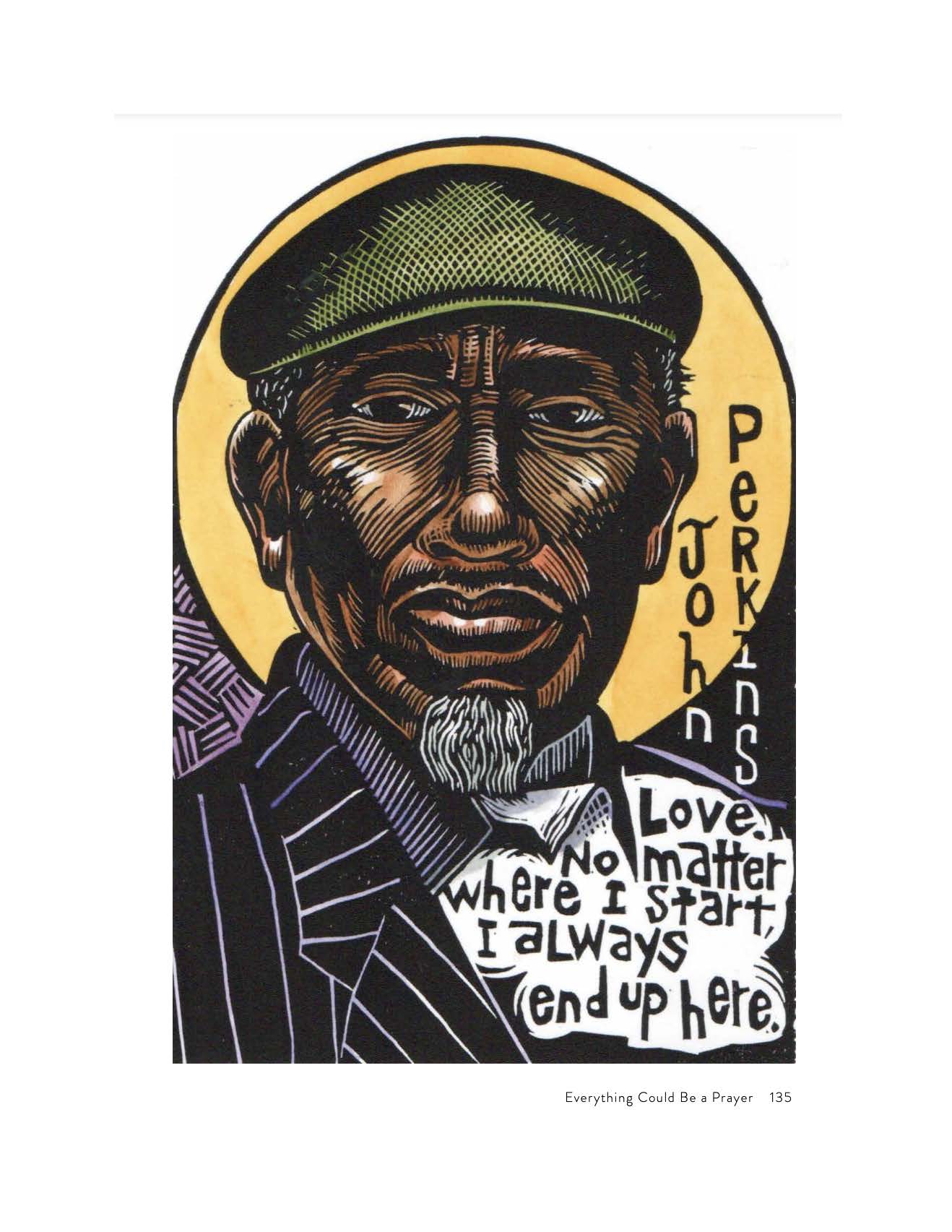
JOHN M. PERKINS (1930–) Reconciliation
All this is from God, who reconciled us to himself through Christ and gave us the ministry of reconciliation. —2 Corinthians 5:18
Dr. John M. Perkins traveled a long road: from a Mississippi sharecropper’s son with a third-grade education to a man of faith who counseled five presidents and garnered numerous honorary doctorate degrees. The road was not an easy one. Perkins’s mother died of malnutrition when he was just an infant, and his dad abandoned him. At seventeen, he witnessed the murder of his brother by a police officer. Twenty-four years later, officers brutally beat him after he tried to bail out students who had participated in a boycott. That beating caused severe physical issues that he carries with him to this day. Most people would be bitter. But here’s what Perkins says: “Almost immediately God began to do something radical in my heart. He began to challenge my prejudices and my hatred toward others. I had learned to hate the white people in Mississippi . . . and if I had not met Jesus I would have died carrying that heavy burden of hate to my grave. But he began to strip it away, layer by layer.” Perkins committed his life to the ministry of reconciliation. “This is a God-sized problem,” he writes. Then quoting G. K. Chesterton, he says, “It isn’t that they [people in the church] can’t see the solution. It is that they can’t see the problem.” He concludes, “One of the most important things we can do to move the cause of reconciliation forward is to pray for the brothers and sisters who we have been separate from.” As a sharecropper’s son, Dr. John M. Perkins planted seeds in the rich Mississippi mud. As a leader of immense moral vision, he planted seeds of reconciliation that are now beginning to bear fruit.
Prayer:
God of unity, reconcile us to those from whom we’ve been separated. Make us of one mind, heart, and body. Plant a mustard seed in us to nurture and grow as we become the kingdom of heaven here on earth. Help us always end up with love. Amen.
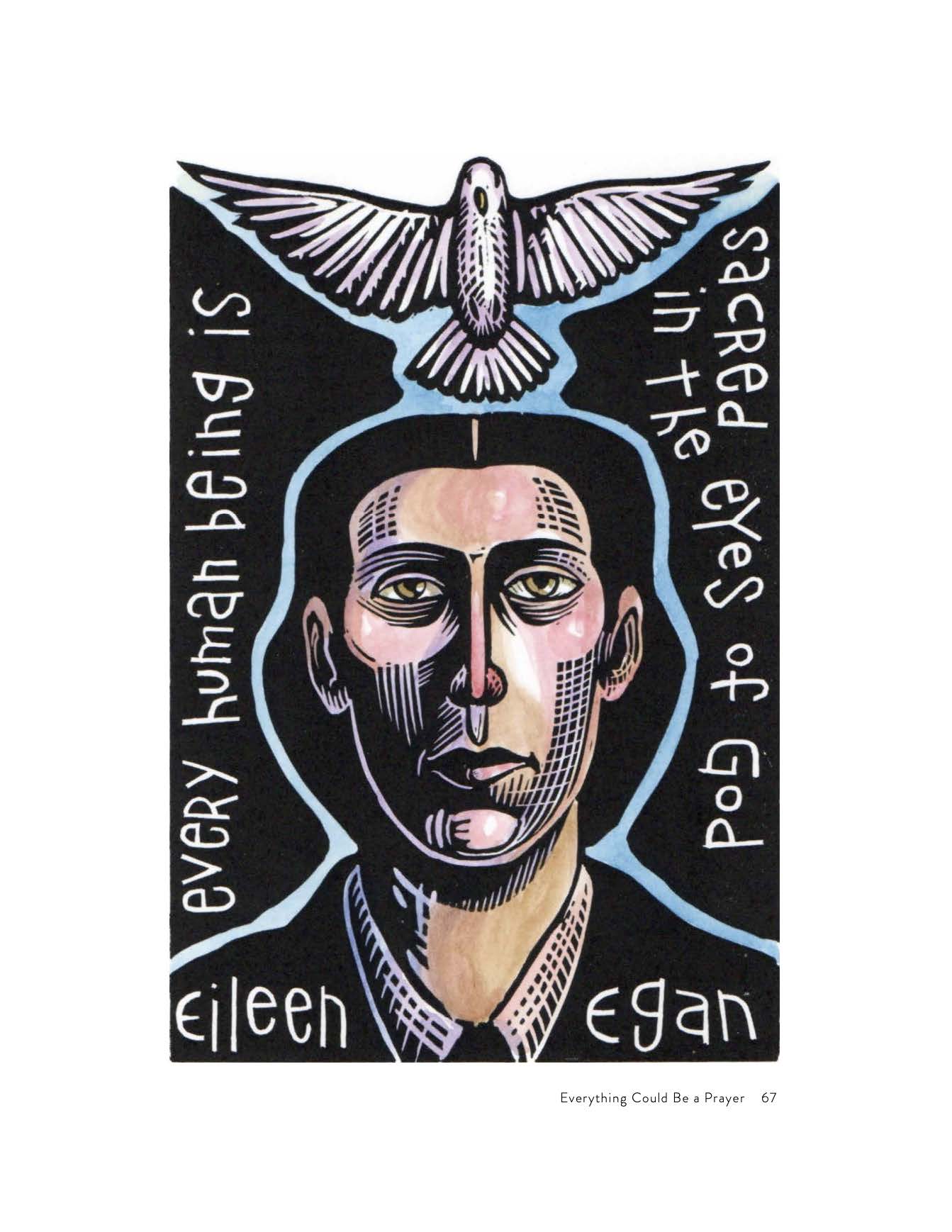
EILEEN EGAN (1912–2000) Gospel Nonviolence
Blessed are the peacemakers, for they will be called children of God. —Matthew 5:9
Being a disciple of Christ isn’t easy. The kingdom of God—sometimes referred to as the upside-down kingdom—defies the logic of the world, which maintains that if someone takes your eye, you take theirs! But Jesus challenges us to live in the kingdom of heaven now. “Do not resist an evil person,” Jesus says, “If anyone slaps you on the right cheek, turn to them the other cheek also” (Matt 5:39). Catholic journalist and peace activist Eileen Egan took this teaching about gospel nonviolence—a term she preferred over pacifism—to heart. A close friend of Mother Teresa and Dorothy Day, she likewise worked for healing and justice. Egan cofounded Pax Christi USA, an organization with a vision that “rejects war, preparation for war, every form of violence and domination, and personal and systemic racism.” Egan was once asked if people were justified in defending themselves. Wasn’t it okay to harm others if they attacked you? She responded by saying, “Use the Eucharist as your defense.” What an unusual tactic! Yet there might be truth here. As a shared meal, the Eucharist offers us God’s grace and mercy. It absorbs us into the body of Christ, which takes the blows of hatred of those who attack. We become, in some way, co-sufferers with Christ. When Egan was eighty years old, she was attacked by a man on the streets of New York. Her hip was broken and seven ribs were fractured. In the aftermath, Egan chose not to testify against her attacker in court. She visited him while he was in jail, and she arranged for housing once he was released. “I look on my attacker as a human being,” she reflected. “I don’t want to push him further down. I’d rather raise him up.” No, following Jesus isn’t easy. Yet by being conduits of his love, we can bring peace and healing to a weary world.
Prince of Peace, you offered your body and blood for me; you pleaded for the forgiveness of those who tortured and murdered you. Fill my heart with gospel nonviolence: with gentleness and love and peace that passes all understanding. Amen.